
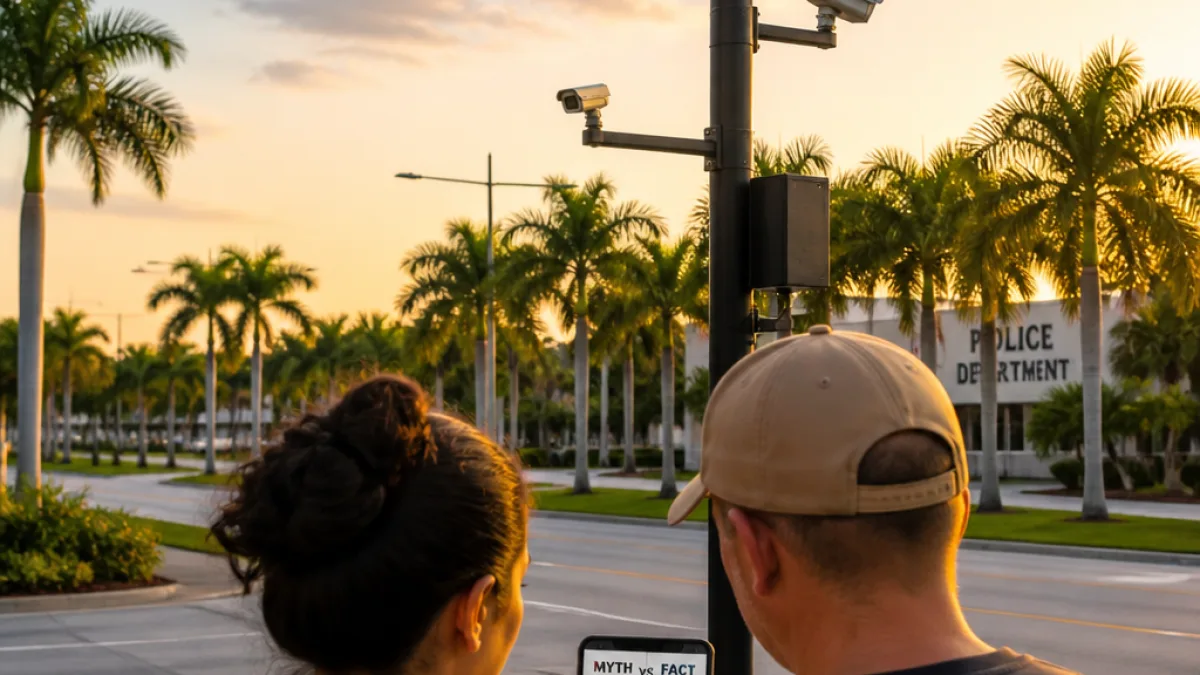
The Coral Springs Police Department has publicly defended its deployment of automated license plate readers, saying the cameras are focused on identifying vehicles connected to crimes and that access to the data is limited to authorized personnel under department policy and law.
The department issued a social media post structured as a "myth vs. fact" rebuttal after residents raised concerns about the cameras—manufactured by Flock Safety—and how the technology is used in the city. The post outlined what the department says the readers do and do not do.
What the department says changes for residents
According to the department, the readers capture license plate information and vehicle characteristics to help investigators locate stolen vehicles, identify suspects in robberies and homicides, and generate leads more quickly than traditional methods. The police said the cameras do not identify drivers or passengers and are not intended to monitor residents' day-to-day activities.
- Data use: The department says data is accessible only to authorized personnel for legitimate law enforcement purposes.
- Purpose: Police credited the technology with assisting recoveries of stolen vehicles and locating wanted offenders.
- Comparison: The post compared the readers to other everyday technologies—cell phones, navigation apps, toll systems and security cameras—arguing the devices serve a specific investigative purpose.
Coral Springs Police also cited a year-to-date violent crime clearance rate of 63%, which the department noted is higher than commonly reported national averages. The post referenced a national range of 35% to 40% for context.
| Measure | Reported figure |
|---|---|
| Coral Springs violent crime clearance rate (YTD) | 63% |
| National violent crime clearance range | 35%–40% |
Public reaction and outstanding questions
Public response to the department's post was mixed. Top comments on the social media thread questioned how long data is retained, how the department distinguishes innocent drivers from vehicles linked to crime, and whether comparisons to consumer technologies are appropriate when residents cannot opt out of police cameras.
"myth vs. fact"
Officials did not provide new details in the post about specific retention periods or independent oversight mechanisms. The department said use of the system is governed by its internal policy and by applicable law but did not publish policy details in the social post.
For Coral Springs residents, the debate crystallizes two competing concerns: whether automated plate readers produce measurable investigative benefits and how to ensure privacy and safeguards for innocent people. The department highlighted outcomes such as stolen vehicle recoveries and faster investigative leads; community members continue to press for clarity on data handling and limits.
At this stage, the Coral Springs Police Department stands by the technology as a targeted investigative tool. Residents seeking more information should watch for any future releases of the department's policy or requests for public records that might specify retention times, access logs and oversight procedures.