
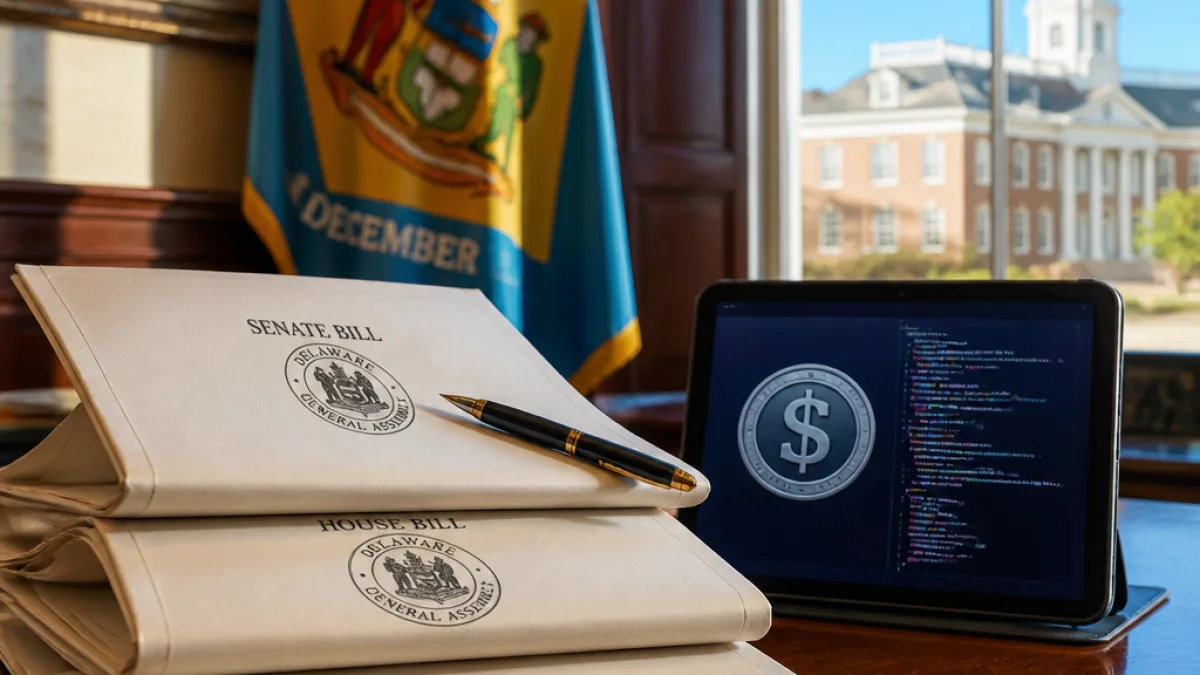
WILMINGTON — On July 6, Gov. Matt Meyer signed a three-bill package that significantly revises Delaware's regulatory approach to banks, money transmitters and payment stablecoin issuers, bringing the state’s statutory framework closer to the realities of digital finance.
What the laws change
The measures — Senate Substitute 1 for Senate Bill 16, Senate Bill 18 and Senate Substitute 2 for Senate Bill 19 — took effect immediately upon the governor’s signature, though parts of the package require implementing regulations before all provisions are operational.
Taken together, the bills create three complementary regulatory frameworks:
- Modernized banking law: SB 16 explicitly recognizes digital assets as personal property that Delaware-chartered banks may hold in a fiduciary capacity and allows for more flexible board structure and risk-based chartering.
- Expanded money transmission oversight: SB 18 replaces the prior money-transmission statute with language that expressly covers virtual-currency activity, including licensing and financial safeguards.
- Stablecoin licensing and standards: SB 19 establishes a state license for payment stablecoin issuers, setting reserve, redemption and reporting expectations intended to align with recent federal proposals.
Rules that could affect businesses and customers
The package sets specific operational and consumer protections for newer forms of digital money while clarifying how traditional institutions can handle those assets.
| Bill | Key feature |
|---|---|
| SB 16 | Recognizes digital assets as personal property; permits custodial holding by state-chartered banks; modernizes charter procedures |
| SB 18 | Overhauls money-transmission statute to expressly include virtual currency; adds licensing, net worth, bond and disclosure requirements |
| SB 19 | Creates state licensing for payment stablecoins; requires eligible reserves, two-business-day redemptions, capital and BSA/AML compliance, monthly reserve reports |
Key consumer protections in the package include provisions that treat virtual currency held by money transmitters as a proportional property interest shielded from creditor claims. For payment stablecoins, holders are given priority over other claims against an insolvent issuer.
Practical takeaways for Delaware businesses
- Banks chartered in Delaware can now explicitly hold digital assets in a fiduciary role, potentially expanding custody services.
- Money transmitters and virtual-currency firms should prepare for licensing, financial-security and disclosure obligations under the new law.
- Stablecoin issuers must maintain eligible reserves at least equal to outstanding stablecoins, provide monthly reserve reports reviewed by an independent accounting firm, and be prepared to redeem tokens within two business days.
Several provisions will require implementing regulations. That means state regulators will have a significant role in defining how the new standards are applied in practice and the timeline for compliance.
Delaware joins a growing group of states updating money-transmission laws to address virtual currency, strengthen financial requirements and modernize licensing and supervision. The new statutes also set a state-level stablecoin framework intended to align with federal efforts to regulate payment stablecoins.
The changes could influence how banks, trust companies and fintech startups choose to operate in Delaware — a state long known for adapting corporate and financial law to modern business models. As regulators draft implementing rules, affected firms should follow guidance from the state to ensure timely compliance.