
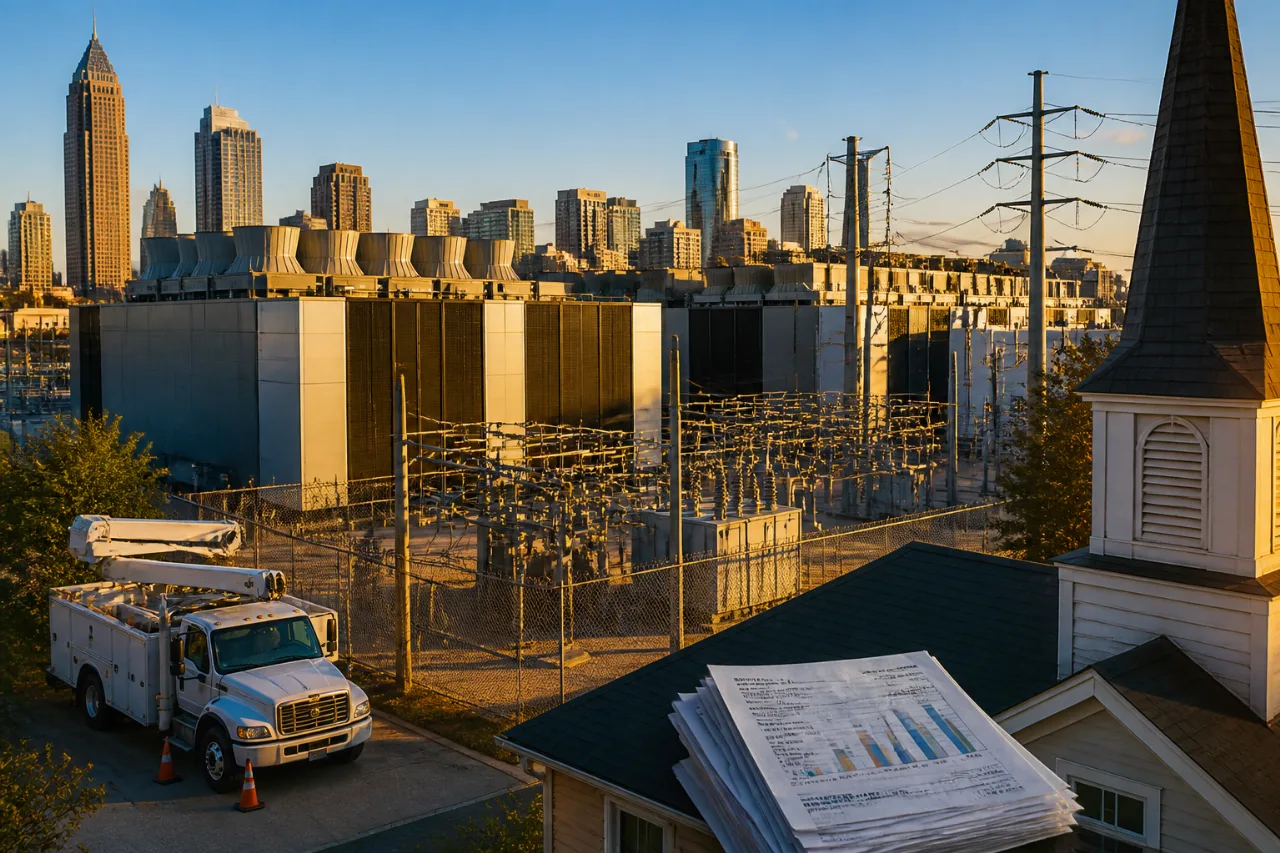
The Georgia Public Service Commission voted Tuesday to launch an inquiry into whether Georgia Power’s largest customers, including data centers, are avoiding certain fuel charges and leaving those costs to be recovered from households and small businesses.
What the probe will examine
The investigation will focus on how customers billed under Georgia Power’s Real Time Pricing (RTP) rate — a tariff used primarily by very large industrial accounts — contribute to the company’s overall fuel costs. The move stems from disputes raised during Georgia Power’s fuel cost proceeding earlier this year and questions about how costs and revenues are being allocated between customer classes.
“Experts identified nearly $1 billion in costs that data centers pay nothing towards, but families, churches, and small businesses do,”
The comment above was made by PSC Commissioner Peter Hubbard after the commission voted to advance the investigation. Hubbard, one of two Democrats on the five-member commission, said the probe is intended to bring clarity to whether exempting certain charges from RTP customers shifts responsibility to smaller customers.
Company position and the rate case context
Georgia Power told regulators it supports the review, consistent with a settlement that resolved the company’s spring fuel cost case on May 11. The utility emphasized that its revenue comes from two distinct streams: a fuel charge, which reimburses the company for fuel expenditures without profit; and base rates, which cover plant investments, transmission infrastructure and the company’s authorized returns.
A Georgia Power spokesperson warned that isolating costs without accounting for revenues produces an incomplete picture. In a written statement provided to The Telegraph, Matthew Kent said:
“Identifying costs in one bucket without considering the revenue in the other bucket creates an incomplete and incorrect narrative.”
Why this matters to Georgia residents
Commissioners and consumer advocates contend the allocation of fuel and base-rate revenues can materially affect what different customers pay. Consumer groups cite expert analysis suggesting nearly $1 billion in fuel-related costs could be underpaid by large RTP accounts, shifting more of the burden onto smaller customers. Regulators will now scrutinize accounting, rate design and whether current credits to large customers adequately offset fuel charges they do not pay.
- Who’s under review: Large industrial customers on Real Time Pricing, including data centers.
- What’s at stake: Potential reallocation of fuel-cost responsibility across customer classes; impact on residential and small-business bills.
- Next steps: PSC staff will pursue written discovery, hearings and technical review to trace costs and revenues.
Quick reference
| Item | Detail |
|---|---|
| Regulatory body | Georgia Public Service Commission |
| Targeted rate | Real Time Pricing (RTP) |
| Alleged shortfall cited | $1 billion (as cited by commission critic) |
| Company | Georgia Power |
The outcome of the investigation could lead to recommendations for changing how costs are assigned or to adjustments in future rate proceedings. For Georgians worried about rising utility bills, the probe presents an opportunity for regulators to more closely examine whether current rate structures are equitable across customer groups.
Regulators did not set a public timeline for completion of the investigation at Tuesday’s meeting. Interested parties, including consumer advocates, local governments and representatives of large customers, are expected to participate in the process as it unfolds.