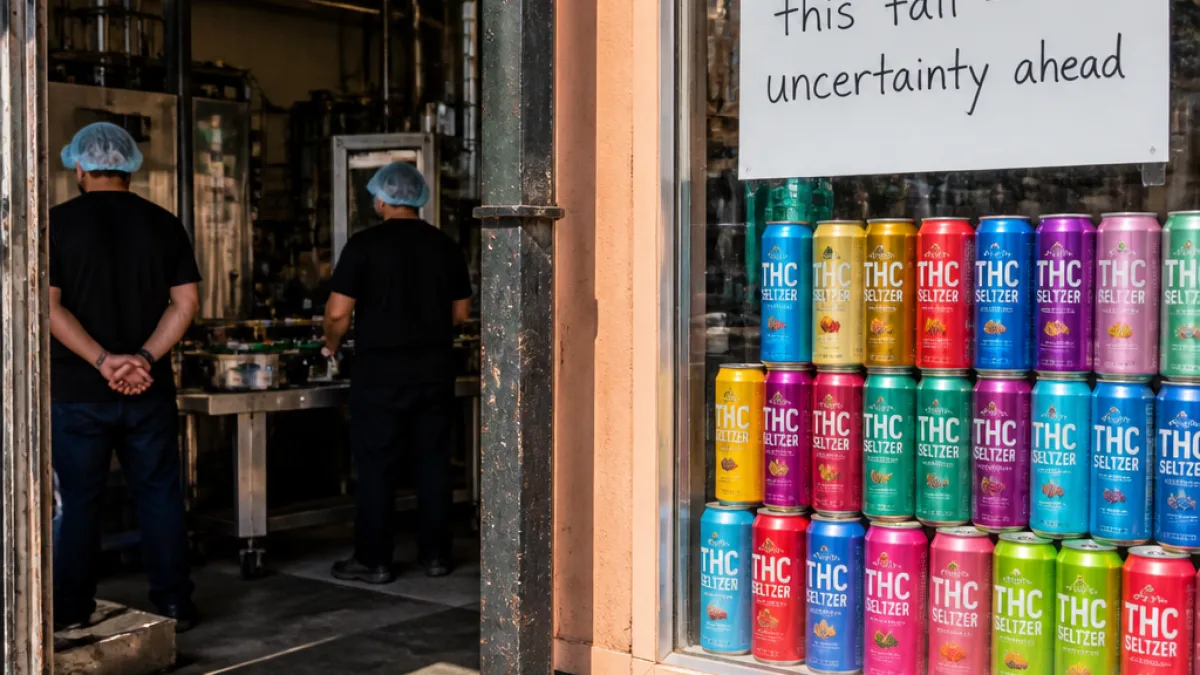
Colorful cans of THC seltzers and spritzes have become an everyday sight in New Orleans bars and corner stores, the visible face of a sector that sprang up in Louisiana after federal and state rules opened a new category of cannabis-infused consumables. But the rapid growth that lifted several local startups into the market's national conversation now sits under a cloud: federal legislation that would ban certain THC beverages is scheduled to take effect this fall, and industry leaders in the Pelican State say the uncertainty is already producing layoffs, halted expansions and scaled-back production.
An industry that arrived quickly
What began just three years ago has turned into a large and fast-moving niche within the broader cannabis product market. Nationwide, THC drinks are the fastest-growing segment of an industry that includes gummies, tinctures and topicals, and the market has drawn more than $1 billion in sales. In Louisiana, the category helped push total sales of THC-infused products — including gummies, topicals and tinctures — to about $33 million in 2024, producing roughly $4.3 million in state tax receipts from about 2,500 licensed retailers.
Local companies and the stakes
New Orleans' drinking culture made it fertile ground for beverage startups. Several local brands quickly scaled from garage operations to multi-million dollar businesses. Company-reported figures show Crescent Canna ranks among the country's top sellers and brings in at least $2 million monthly, according to its co-founder and CEO. Basin Street Beverages, known for Louie Louie, and the THC drink division of Urban South Brewery each report annual revenues in the several millions.
The potential federal ban — led by Kentucky Sen. Mitch McConnell — targets specific THC products and would take effect this fall. Industry participants had hoped for regulatory relief or a delay from federal or state officials, but no such aid has materialized. That lack of clarity is already affecting operations across the state.
- Layoffs and hiring freezes at several Louisiana companies.
- Cancellation or postponement of new production lines and expansion plans.
- Shifts in product mixes as businesses prepare for restricted markets.
Why the timing matters for Louisiana
For a state that sees tourism, hospitality and food-and-beverage sales as important economic pillars, the sudden rise of THC beverages provided new revenue streams for craft producers and retailers. The industry’s roughly $4.3 million in tax revenue in 2024 helped underwrite state services while creating retail demand across thousands of licensed outlets.
| Metric | 2024 figure (Louisiana) |
|---|---|
| Total sales — THC-infused products | $33 million |
| State tax revenue from those sales | $4.3 million |
| Licensed retailers selling THC products | ~2,500 |
| Reported monthly revenue — Crescent Canna | $2 million (company-reported) |
Local owners say the coming restriction is not only a business threat but also a signal of how quickly federal lawmakers can reshape an industry still finding its regulatory footing. Several Louisiana producers have described tactical pivots — reformulating products, exploring non-THC lines or slowing capital investments — to survive if the ban takes effect.
For consumers, the shift could mean fewer choices on store shelves and a smaller local marketplace for beverages that bridged craft brewing techniques with cannabis-infused formulations. For retailers, particularly small businesses that relied on popular drink lines to draw customers, the loss would be both immediate and visible.
As Louisiana's THC beverage makers wait for the political and legal dust to settle, the state faces the prospect of losing an emergent industry that in just a few years built supply chains, produced taxable sales and created new local brands. Whether those companies can adapt or whether the federal action will effectively shrink the category nationwide remains an open question — one that will be answered in the coming months.
Reporting from New Orleans.