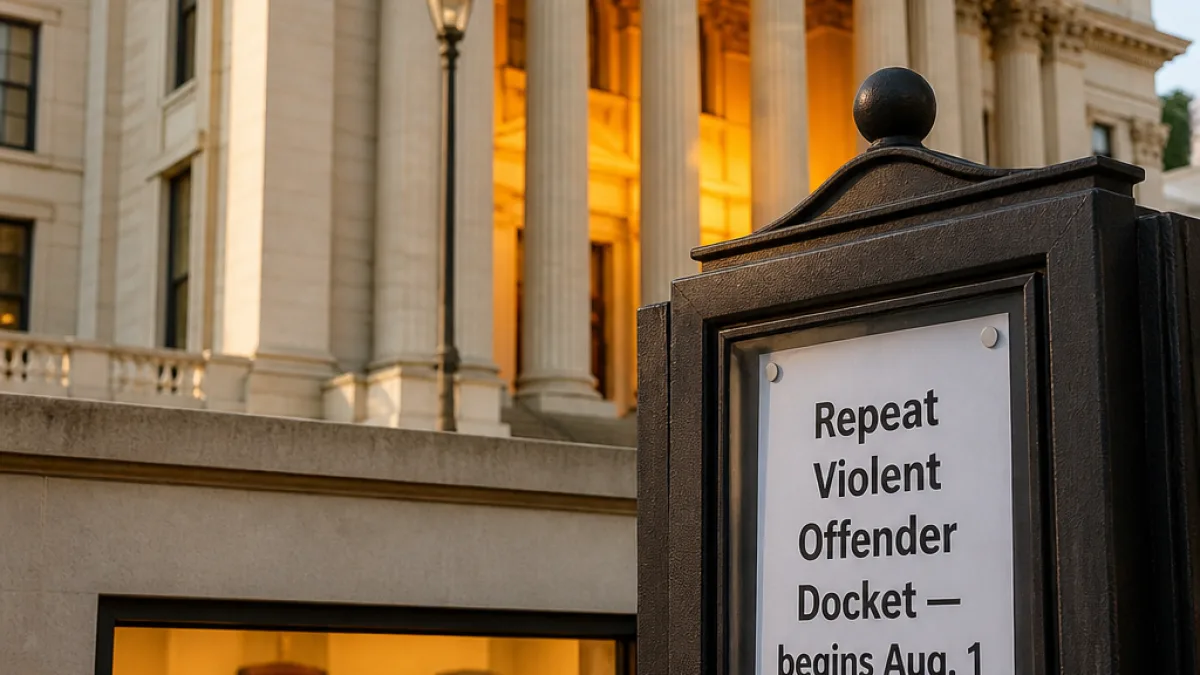
Mobile County will become the first judicial circuit in Alabama to operate a dedicated Repeat Violent Offender Docket, officials announced, a specialized court process set to begin Aug. 1 that aims to accelerate new prosecutions of repeat violent offenders and reduce case backlogs that can take years to resolve.
How the docket will work
The administrative action creating the docket was taken by Wesley Pipes, presiding judge of the 13th Judicial Circuit. Mobile County Circuit Judge Vicki Davis will oversee qualifying cases from arraignment through final resolution. The district attorney’s office said it will assign two of its roughly 30 prosecutors to handle matters filed in the new docket.
Eligibility for the docket is limited to people with a prior conviction for a specified violent felony who are later charged with another qualifying violent offense either while on supervised release or within five years after release from incarceration. Prosecutors expect the process would have encompassed roughly 150 to 200 defendants in recent years, though only new qualifying cases filed on or after Aug. 1 will be routed to the docket; pending cases will not be retroactively assigned.
- Launch date: Aug. 1
- Presiding judge: Vicki Davis
- DA prosecutors dedicated: 2 (of ~30)
- Estimated annual eligible defendants: 150–200
Crimes that may qualify
The docket targets some of the most serious violent crimes prosecuted under Alabama law. Offenses listed as qualifying include:
- Murder
- Rape, sexual torture and sodomy
- Felony assault and domestic violence
- Robbery and manslaughter
- Kidnapping and arson
- Shooting into occupied buildings or vehicles
- Reckless endangerment with a firearm
“Recidivism is a major issue,” Mobile County District Attorney Keith Blackwood said. “In many cases, we see it takes years for the new cases to be resolved. We believe there is a better way without changing the law while respecting a defendant’s constitutional rights.”
Local context and expected effects
Local officials framed the docket as an administrative tool to prioritize time-sensitive, high-harm cases without altering statutory law. By having a single judge manage qualifying matters from start to finish, the county expects fewer delays caused by changing judges, scheduling conflicts or transfers between courtrooms. For victims and families, the goal is quicker case resolution and greater predictability in court scheduling. For defense lawyers and defendants, the process concentrates resources and attention on a narrower category of cases.
| Aspect | Detail |
|---|---|
| Start date | Aug. 1 |
| Presiding judge | Vicki Davis |
| DA staff assigned | 2 prosecutors (of ~30) |
| Estimated prior caseload | 150–200 defendants (in recent years) |
Officials say the initiative is not intended to change defendants’ constitutional protections; rather, it is an attempt to improve efficiency and accountability for a group of offenders with repeat violent convictions. The measure reflects a growing interest among prosecutors and judges nationwide in specialized dockets — though this will be the first in Alabama focused specifically on habitual violent offenders.
For Mobile residents, the new docket could mean faster movement of high-profile violent cases through the courthouse at Government Plaza and more concentrated prosecutorial attention on public-safety priorities. How the docket affects overall case outcomes, conviction rates or recidivism will depend on implementation and on resources devoted to the effort, officials said.