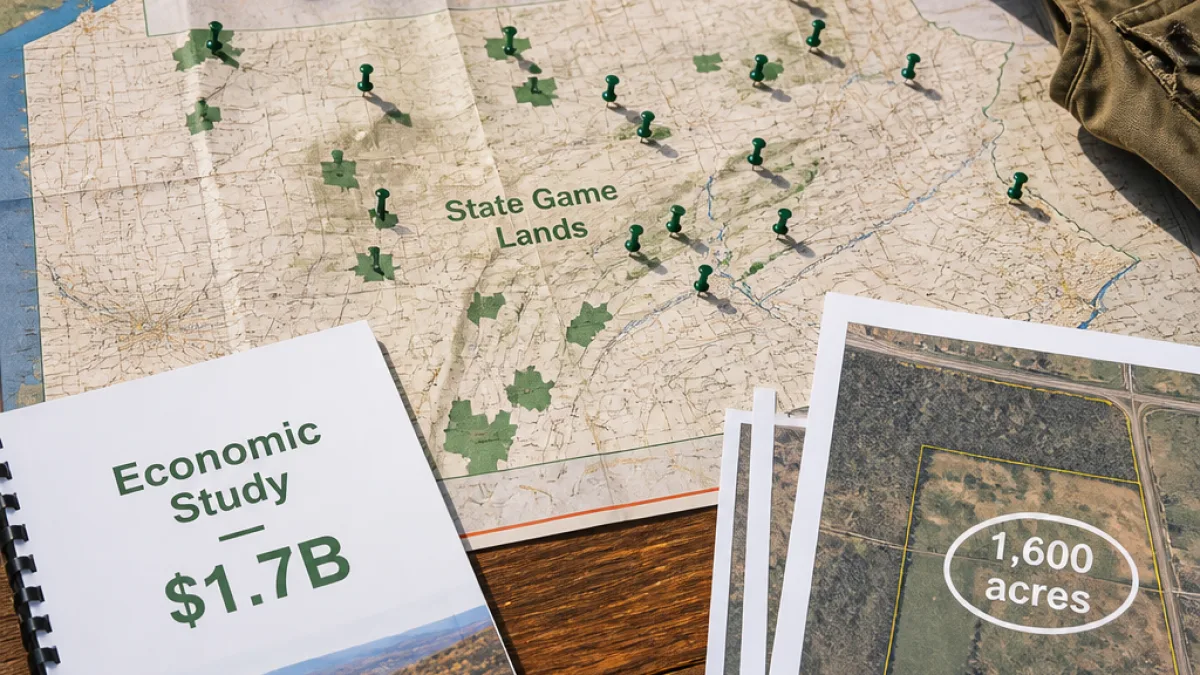
The Pennsylvania Game Commission on July 10 unveiled a new economic analysis that values the statewide impact of its game lands at more than $1.7 billion and approved several property purchases totaling roughly 1,600 acres.
Study details and acreage
The study, prepared by Industrial Economics, Incorporated, analyzed the commission’s portfolio of roughly 1.5 million acres spread across more than 300 state game lands. Commission officials said the report measures how those public lands contribute to local and statewide economies through hunting, recreation and related spending.
At the same meeting, commissioners authorized multiple acquisitions that will expand the commission’s holdings. The newly approved tracts add to land the agency manages for wildlife habitat and public outdoor access.
Payments in Lieu of Taxes and local budgets
State law sets a payment of $9 per acre to be made to counties, municipalities and school districts for land the Game Commission owns instead of traditional property tax payments. That payment is split: the commission covers $3 per acre, and the state provides the remaining $6 per acre. The state’s contribution is funded from gambling-related revenue and the per-acre amount automatically increases every five years.
"We hear that us owning land reduces local property tax revenue and can hurt economic development," said Ken Duren, the agency's wildlife habitat management real estate division chief. "I feel that game lands, in particular, but public lands, in general, are not actually inhibiting development from happening."
In 2026, combined PILT distributions to counties, municipalities and schools totaled $13,859,457.09, the commission reported.
- Economic impact: More than $1.7 billion attributed to state game lands, per the Industrial Economics analysis.
- Land holdings: Approximately 1.5 million acres across 300+ game lands managed by the PGC.
- PILT payments: $9 per acre, split $3 (PGC) and $6 (state), with $13.86 million distributed in 2026.
Where PILT falls short — and where it matches up
The study compared potential property tax receipts from privately held undeveloped land with PILT distributions for comparable parcels owned by the state. In more developed regions of Pennsylvania — particularly northwestern and eastern parts of the state — PILT payments were lower than what private owners would have paid in property taxes. In less developed areas, PILT sometimes compares more favorably to potential tax receipts, though the report emphasized multiple factors beyond simple tax comparisons, including conservation value and public access.
| Item | Figure |
|---|---|
| Estimated economic impact | $1.7 billion+ |
| PGC acres managed | ~1.5 million acres |
| PILT per acre | $9 (PGC $3; state $6) |
| 2026 PILT total distributed | $13,859,457.09 |
Agency officials told commissioners the PILT arrangement recognizes that state ownership removes those acres from local property tax rolls, while still providing a predictable revenue stream for local governments and schools. The state’s contribution each year is tied to gambling-derived revenue and the statutory formula.
The commission also framed public lands as not inherently blocking development. Ken Duren, who oversees habitat management and real estate for the agency, said the presence of game lands does not automatically stop nearby or regional development, noting there remain many private acres available for development across the state.
For county and municipal leaders, the findings offer data to weigh conservation and outdoor recreation benefits against fiscal trade-offs when large swaths of land are in public ownership. The report could inform future discussions about land acquisition priorities and the formula that determines how PILT payments are adjusted.
As commissioners move forward with the newly approved purchases, the PGC will continue to administer habitat management, public access and the distribution of PILT funds to local governments and schools.