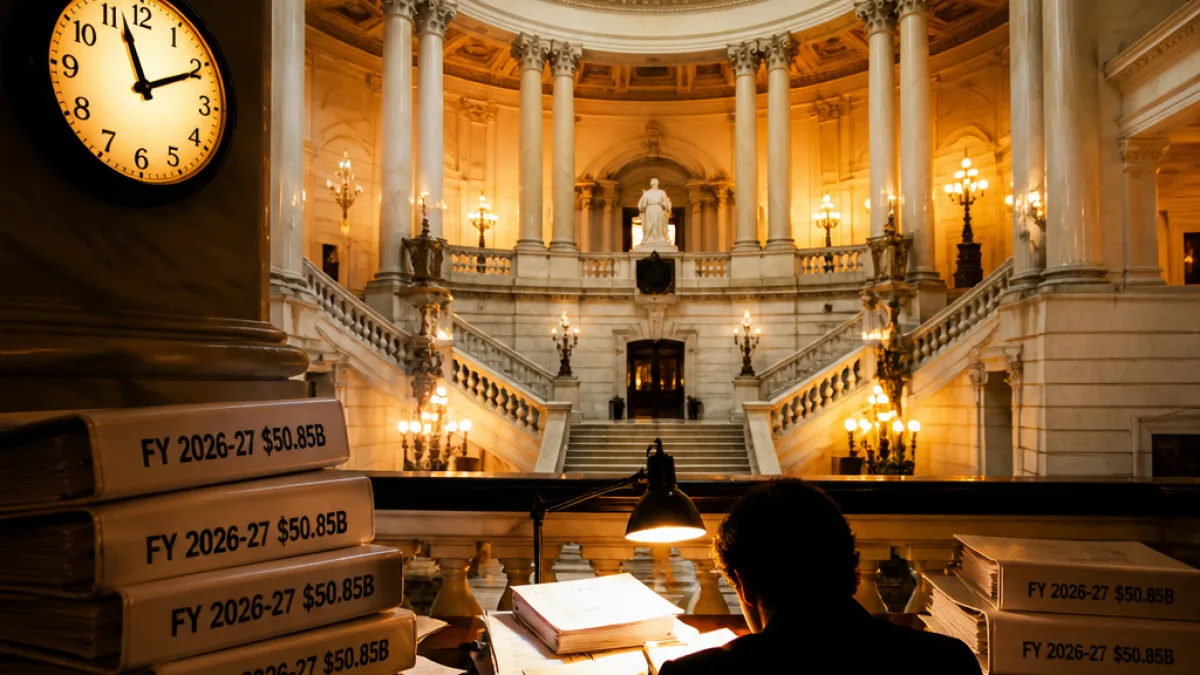
HARRISBURG — Leaders of the divided Pennsylvania General Assembly late Saturday released a $50.85 billion spending plan that lawmakers say balances new investments in public education and retirement benefits while trimming some of Gov. Josh Shapiro’s priorities.
Budget numbers and timing
The package, more than a week past the constitutionally mandated June 30 deadline, represents roughly a 1.4 to 1.5% increase over last year’s spending and is about $2.4 billion below the governor’s February proposal. Lawmakers scheduled further floor action Sunday in both chambers to complete votes.
| Item | Amount |
|---|---|
| Total spending | $50.85 billion |
| Increase over last year | ~1.4–1.5% |
| Difference from governor's plan | $2.4 billion less |
What the budget funds — and what it leaves out
Education received a significant boost, with at least $565 million in new funding routed largely through the state’s newer adequacy formula. That formula was adopted as a legislative response to a 2023 Pennsylvania Supreme Court ruling that found parts of the prior school-funding system unconstitutional.
- Public schools: $565 million increase, mostly through the adequacy formula.
- Teacher pensions: Cost-of-living adjustments for educators who retired before 2001.
- Public safety: Retirement updates for municipal police and fire personnel included.
- Excluded items: No minimum wage increase; no sweeping legalization or taxation of recreational marijuana; no $1 billion bonds for housing and infrastructure that the governor sought.
The budget also leaves several contentious issues largely unresolved. Language clarifying the status of skill games was removed after the state Supreme Court declared those devices unlawful, creating pressure for the legislature to act. Data center regulations and potential elimination of a tax break for internal equipment were among policy areas that may still see negotiation.
"At the end of the day, I think what you're seeing moving forward is an investment plan in the commonwealth that you'll see a significant amount of bipartisan support (for)," said House Appropriations Chairman Jordan Harris.
Negotiators trimmed proposals seen as partisan in closed-door talks, including measures tied to recreational marijuana and an increase to the minimum wage. Lawmakers also resisted tapping into the state’s reserve despite a sizable balance: officials said the commonwealth’s rainy day fund remains near $8 billion.
Next steps and stakes for counties
Both chambers must approve the package by a simple majority before it goes to the governor for signature. For counties and school districts across Pennsylvania, the allocation changes — particularly the adequacy-based boosts — will shape local budgets for the coming year and influence decisions on property tax rates and program offerings.
Lawmakers said they aimed to avoid another protracted impasse after last year’s multimonth delay. With final votes scheduled for Sunday, the administration and local officials will be watching for the signed bill’s implementing language and timing of fund disbursements.
— Maya Kaplan, Pennsylvania correspondent