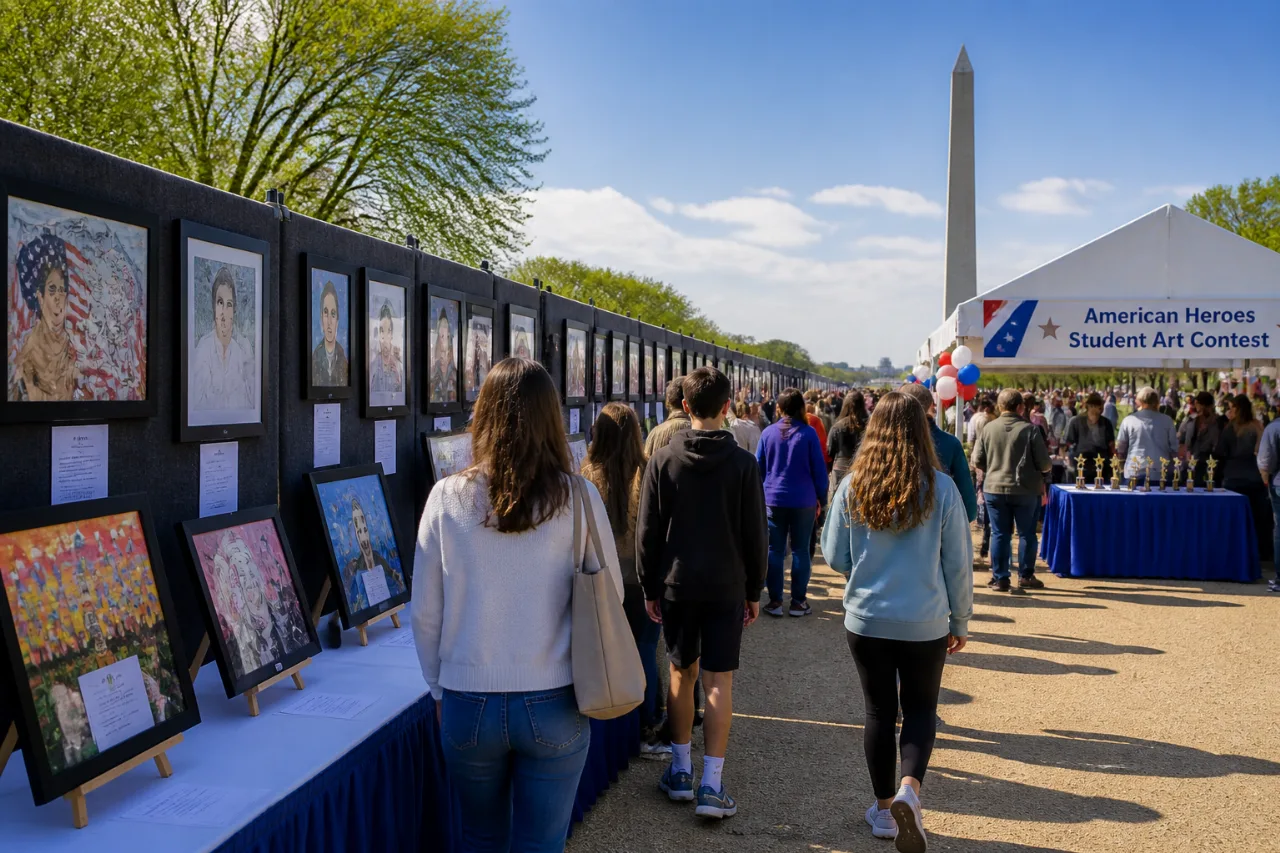
Students from across the country were honored in Washington, D.C., on July 8 for artwork inspired by figures featured in the National Garden of American Heroes. The celebration, part of the Freedom 250 and National Endowment for the Humanities’ American Heroes Student Art Contest, brought state winners to the nation’s capital to display original pieces and explain the people who inspired them.
Program, process and prizes
Participants were asked to select an American hero from the Garden and produce an original, handmade two-dimensional artwork accompanied by a 200-word artist statement explaining their choice. Entries were judged by a panel of artists and educators who looked at artistic skill appropriate to age level, creativity and alignment with the contest’s thematic goals.
There were three submission brackets:
- Upper elementary — Grades 3–5
- Middle school — Grades 6–8
- High school — Grades 9–12
Winners from each state received travel support — airfare and hotel — to attend the Great American State Fair on the National Mall, held July 7–9. The Second Lady, Usha Vance, appeared with some of the young artists during the event.
Selected state winners and works
The contest produced a wide range of subjects and approaches. Examples among the upper elementary winners include:
- Emma Grace Hjelm (Alabama) — "Oakville's Hero"
- Hulda Elisabeth Cox (Alaska) — "Freedom at Last"
- Quinn Thyfault (Arizona) — "Louis Armstrong"
- Roy Kim (California) — "The Spark of Ideas"
- Shambhavi Singh (Iowa) — "Harriet Tubman - Leader of Freedom"
| Category | Grades |
|---|---|
| Upper elementary | 3–5 |
| Middle school | 6–8 |
| High school | 9–12 |
Local angle and community impact
For many students, the trip to the National Mall offered a rare chance to see their work displayed in the capital and to connect with peers from other states. Families and school representatives accompanied winners to the fair, where the artwork became part of a broader public celebration tied to the nation’s 250th anniversary.
Beyond recognition, the contest asked young people to research historical figures and reflect on their significance in concise artist statements. That element aimed to combine civic learning with artistic development — an approach educators say can deepen students’ connection to history and community.
As the Freedom 250 observance continues across the capital this summer, local classrooms and community arts programs may find this contest a model for combining creative work with civic education. Families and teachers looking for more information or future participation opportunities should watch announcements from the Freedom 250 initiative and the National Endowment for the Humanities.
Coverage of community arts and student programs will continue from News Block as events connected to the Freedom 250 progress through July and beyond.