The Pentagon intends to maintain a federal National Guard mission in Washington, D.C., through Inauguration Day, Jan. 20, 2029, a Guard official confirmed to The Hill on Tuesday. The plan, first reported publicly in March, is awaiting final approval from Defense Secretary Pete Hegseth.
Who is here and how long they may remain
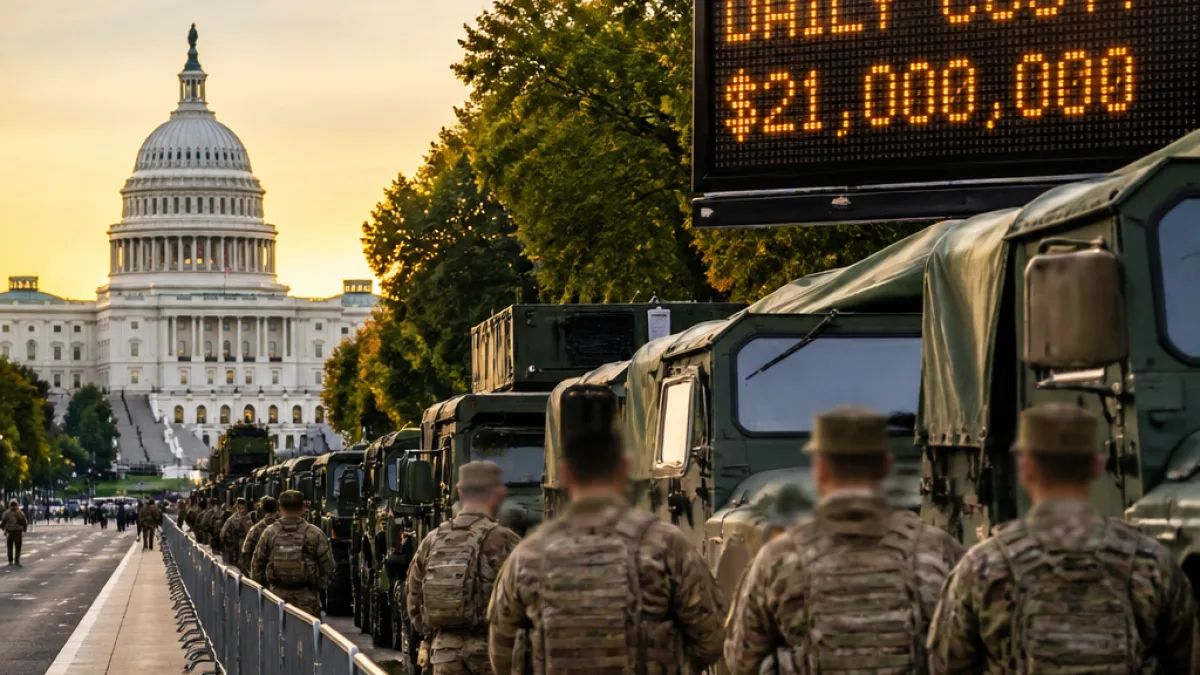
As of the latest count, about 5,150 Guard members are deployed in the District. That total includes 599 members of the D.C. National Guard and 4,403 personnel flown in from 21 states, Puerto Rico and the U.S. Virgin Islands. The deployment has stretched nearly a year, beginning in the late summer when the federal government temporarily assumed certain law-enforcement responsibilities by presidential executive order and launched the D.C. Safe and Beautiful Task Force.
Local objections, cost and results
Local officials and many Democratic lawmakers have repeatedly criticized the sustained Guard presence, calling it unnecessary, expensive and strategically unclear. Guard troops in the city operate under federal authority and have limits on duties such as making arrests, which local critics say reduces their utility for addressing violent crime.
- Deployment size: ~5,150 troops (599 local, 4,403 from other jurisdictions)
- Potential end date: Jan. 20, 2029, unless the president decides otherwise
- Estimated daily cost: more than $3 million per day, according to the Congressional Budget Office
Independent watchdogs and research groups have weighed in on the fiscal and public-safety impacts. The nonpartisan Congressional Budget Office estimates the presence costs the federal government in excess of $3 million per day. The Project on Government Oversight has calculated the total expense could range between $2.5 billion and $3.4 billion, depending on troop levels and duration.
On outcomes, a report from the Niskanen Center found the Guard presence corresponded with a 24 percent decline in opportunistic property crime, but concluded it has not been an effective tool for reducing violent crime in Washington.
What this means for residents and visitors
For residents and visitors, an extended federal Guard presence will maintain heightened uniformed activity in key parts of the city and around federal buildings and tourist corridors. Because many deployed Guard members are restricted from traditional policing activities — including making arrests — the deployment's role is primarily supportive and preventive rather than direct law enforcement.
| Aspect | Detail |
|---|---|
| Troop count | ~5,150 (599 D.C., 4,403 from other jurisdictions) |
| Authorized end date | Jan. 20, 2029 (unless altered by the president) |
| Estimated daily cost | More than $3 million per day (CBO) |
| Reported impacts | 24% drop in opportunistic property crime; no measured reduction in violent crime (Niskanen Center) |
Questions about the decision and its oversight have been routed among the Pentagon, the Joint Task Force–District of Columbia and the White House. The Pentagon directed inquiries to the Joint Task Force, which in turn referred questions to the White House; the White House did not immediately provide a response to requests for comment.
As the prospect of a sustained federal force in the capital moves closer to formal approval, city leaders, budget analysts and community organizations will likely press for clearer objectives, accountability and a public accounting of how the deployment affects everyday safety in Washington neighborhoods beyond federal precincts.
This developing story touches on federal-local authority, public spending and the day-to-day experience of Washington residents. I will continue to monitor official decisions and local responses and report updates as they become available.