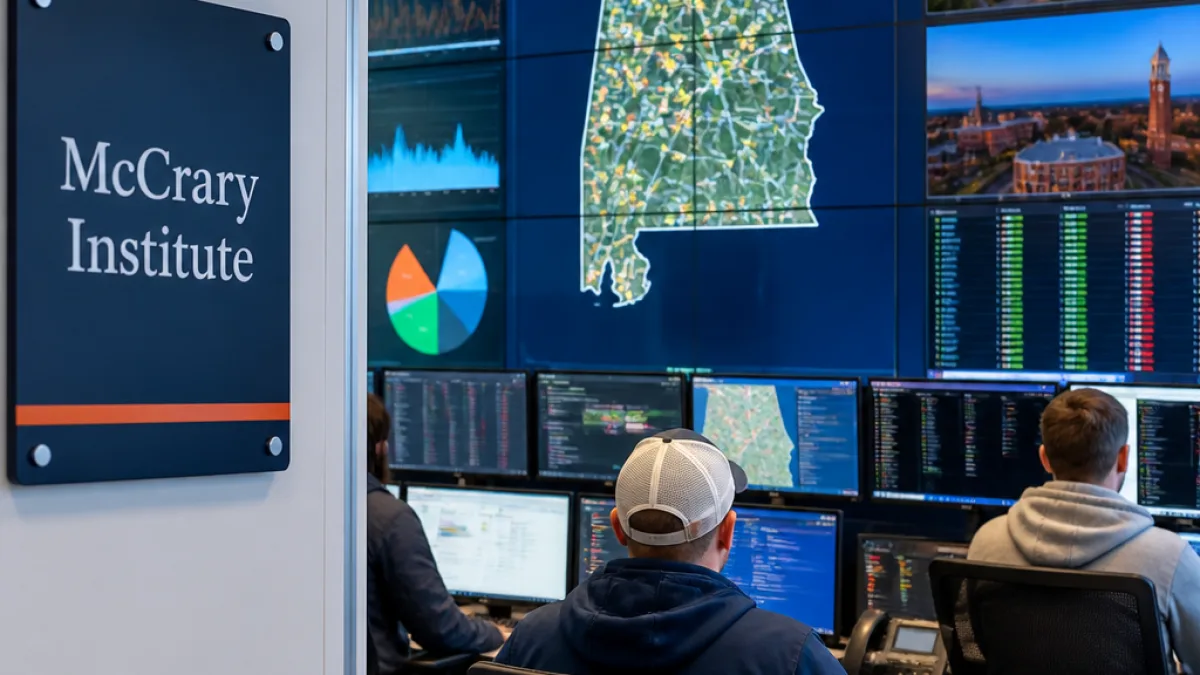
AUBURN — Auburn University is expanding statewide cyber defenses by providing 24/7 network monitoring to more than 140 Alabama cities and counties at no cost, university officials announced this week.
Why small towns are vulnerable
Officials with Auburn’s McCrary Institute for Cyber and Critical Infrastructure Security say smaller local governments are frequent targets because they often lack dedicated cybersecurity staff and resources. The Auburn program is funded through a $19 million federal grant, enabling communities to receive continuous monitoring and real-time support without paying subscription fees.
Nick Sellers, a representative of the McCrary Institute, warned about growing threats and the role of new technologies in escalating attacks.
“When a cyberattack hits a small community, the consequences can go far beyond a frozen computer screen,” Sellers said.
What the service offers
- Round-the-clock monitoring by cybersecurity engineers and Auburn students.
- Real-time guidance and support for responding to incidents.
- No cost to participating local governments thanks to federal grant funding.
The program aims to help local officials prepare for incidents and reduce the impact when attacks occur. Sellers noted that modern cyberattacks can disrupt essential services — including water systems, utility billing and public safety operations — and that collaborative defenses are more effective than each municipality working alone.
Costs and statewide context
National reports underscore the stakes. IBM researchers found the average cost of a data breach topped $10 million last year, a figure Auburn officials cited to emphasize the potential financial fallout for local governments. The McCrary Institute says its monitoring infrastructure focuses on early detection and coordinated response to reduce both operational disruption and recovery costs.
| Item | Figure |
|---|---|
| Communities monitored | 140+ |
| Federal grant funding | $19 million |
| Average cost of a data breach (national) | $10 million |
Auburn officials say the monitoring service is available to Alabama cities and counties interested in joining. Local governments seeking more information were directed to a state resource page for enrollment and program details: slcgp.alabama.gov.
This program represents a partnership approach: students and university engineers gain practical experience while communities receive access to technical capabilities that would otherwise be costly or out of reach. For many small jurisdictions in Alabama, that support could mean the difference between a contained incident and a widespread disruption of public services.