
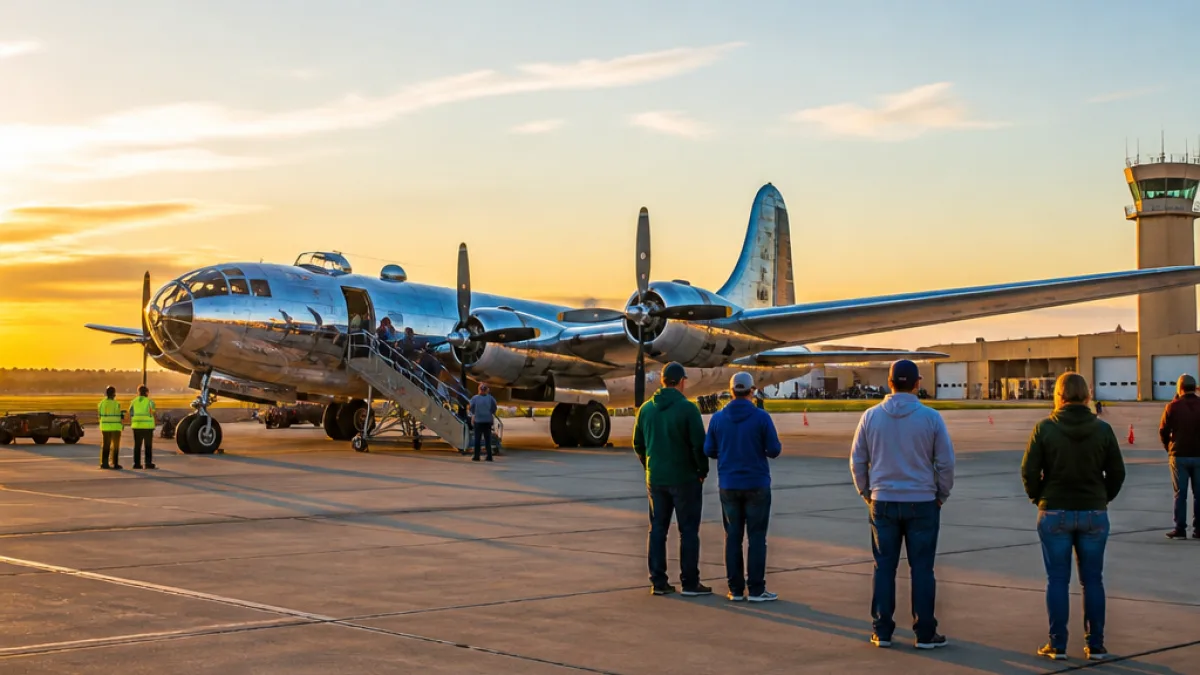
Sioux Falls residents got a rare chance this week to see — and for some, ride in — a living piece of World War II aviation history. The B-29 DOC, one of only two B-29 Superfortress bombers still airworthy, arrived at Sioux Falls Regional Airport (Joe Foss Field) on Sunday for a brief visit.
What’s here and why it matters
Built by Boeing in 1944 and later retired in the 1950s, the bomber underwent an extensive restoration that took more than 16 years to complete. Its appearance in Sioux Falls is both a reminder of the region’s ties to military aviation history and an opportunity for local residents to experience that history firsthand. For aviation fans, history buffs and families looking for an unusual outing, the B-29’s visit is a notable event.
Public rides are limited
The B-29 is scheduled to remain in Sioux Falls from Monday through Wednesday this week. During that short window, a limited number of flight seats are available to the public. Organizers advise anyone interested to seek information and book quickly, as capacity is small and demand is high.
- Aircraft: B-29 DOC (restored Superfortress)
- On-site: Joe Foss Field, Sioux Falls Regional Airport
- Visit dates: Monday–Wednesday (short stay)
- Public rides: Limited seating; advance information and booking recommended
| Detail | Information |
|---|---|
| Year built | 1944 |
| Service ended | 1956 |
| Restoration time | More than 16 years |
| Sioux Falls visit | Monday–Wednesday, limited public flights |
How the bomber flies — from the pilot
"Everybody always asks what it’s like to fly. I tell everybody it’s like a pickup truck on a gravel road. She’s a big girl, a little squirrely. The ailerons, which we use to make turns, are 25 feet long. So when you’re slow and you make a turn, she sort of wallows a little bit. But once you get up above 180 to 200 miles per hour, she flies really tight," B-29 DOC chief pilot Mark Novak said.
The pilot’s description gives a practical sense of what riders can expect: this airplane handles differently than modern aircraft. That living, tactile difference is part of the attraction — not just seeing history on the ground, but experiencing how it felt in the air.
Local context and impact
Events like the B-29’s visit bring small but noticeable impacts to Sioux Falls. At the airport level, they help sustain interest in Joe Foss Field as a site for special aviation attractions and public events. For downtown and nearby businesses, visitors attending flights or tours can add foot traffic to restaurants, shops and hotels. For younger residents and students, the bomber offers a teaching moment about aviation technology and South Dakota’s connections to national military history.
Because seating is limited, residents who want to ride or tour the interior should check the event information listed by the organizers and book as soon as possible. The airport and the B-29 DOC team have publicized schedules and reservation guidance through their channels.
For many in Sioux Falls, this week’s visit is more than an attraction: it’s a short window to touch a piece of history before it continues its nationwide tour. Those who miss out on flights still have the chance to view the aircraft on the ramp and talk with volunteers and crew about the restoration and the B-29’s service life.