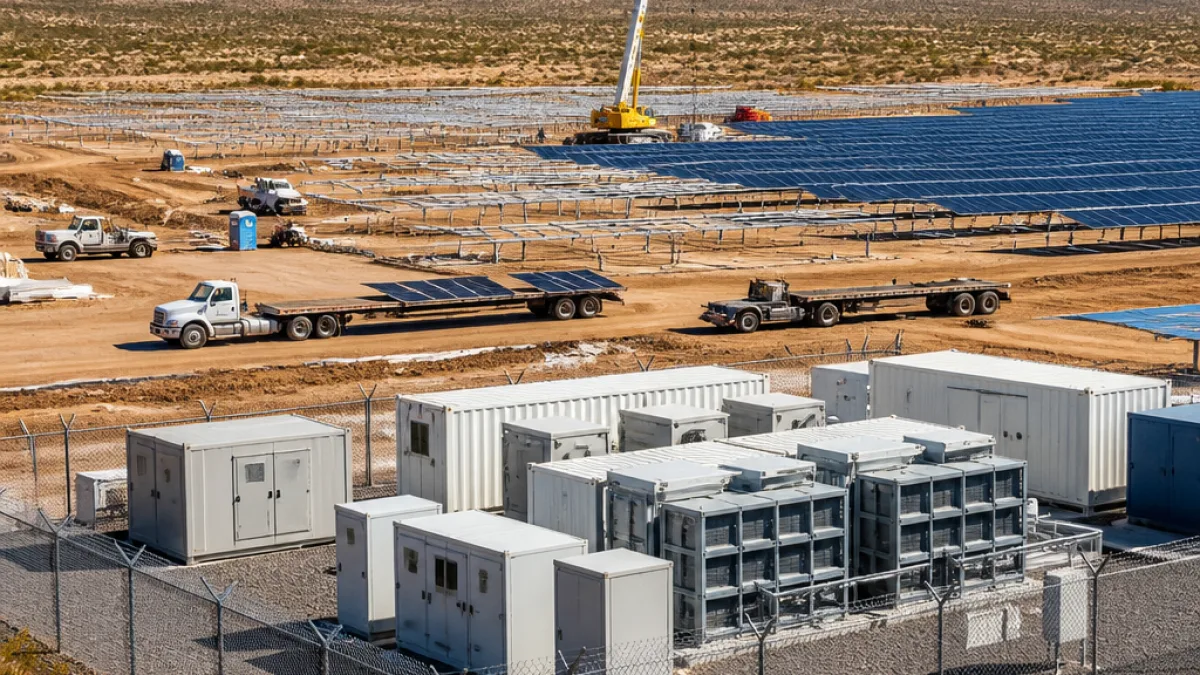
The company Qcells announced this week that it is spearheading delivery of two large solar-plus-storage phases in western Arizona’s La Paz County, a project that underscores the state’s growing role in utility-scale clean energy. The two phases — Atlas V (237 MWdc) and Atlas VI (135 MWdc) — add up to 372 MWdc and are part of the larger Atlas Energy Park, one of the nation’s larger combined solar and battery developments.
Qcells' integrated approach
Qcells said on July 9 that it developed the Atlas sites then divested ownership while continuing to deliver the projects through its self-perform EPC (engineering, procurement and construction) model. The company is supplying domestically manufactured modules, racking and energy storage products and will provide long-term asset management once construction is finished.
"Atlas V and VI are a clear demonstration of Qcells’ ability to deliver fully integrated, utility-scale solar solutions at scale," said Chris Hodrick, CEO of Qcells EPC.
The projects are contracted under long-term power purchase agreements with Southern California Edison, reflecting cross-border power market ties where Arizona-hosted generation helps meet California demand.
Local impact and supply chain highlights
For Arizona, the Atlas work represents both immediate construction activity in La Paz County and a reinforcement of in-state and regional manufacturing links. Qcells noted modules are coming from its Georgia plant, racking from Ohio (FLEXRACK) and energy storage hardware from LG Energy Solutions made in Michigan. The company says that domestic sourcing helps protect tax-credit value and supply certainty for large projects.
- Project capacity: 372 MWdc across Atlas V and VI
- Contract: Long-term PPAs with Southern California Edison
- Scope: Self-perform EPC, modules, racking, storage and long-term asset management
| Phase | Capacity (MWdc) |
|---|---|
| Atlas V | 237 |
| Atlas VI | 135 |
Qcells also described the Atlas work as part of its broader U.S. ambitions: the company is planning to build 11 GW of solar plants and 5.7 GWh of energy storage across the country, including assets already placed in operation. The projects were developed by Qcells and sold to Chrysalis Renewables, backed by Morrison.
Why it matters for Arizona
Large projects like Atlas concentrate construction jobs, require regional transmission planning and shape long-term revenue streams for rural counties where land and solar resources are available. They also tie Arizona into Western grid dynamics: electricity generated here under long-term contracts will help utilities in neighboring states meet renewable energy targets and reliability needs.
As these phases move from development to construction and ultimately operation, local officials and residents will be watching for timelines, local hiring and any grid upgrades tied to the project. Qcells’ pledge of continued asset management underscores that these facilities will be operated with a long-term performance and return profile in mind.
Reporting on energy projects across Arizona shows a trend: private developers increasingly combine domestic supply chains, long-term contracts and storage to lock in federal incentives and satisfy utility buyers. The Atlas phases in La Paz County are a clear, tangible example of that strategy taking shape on the ground.