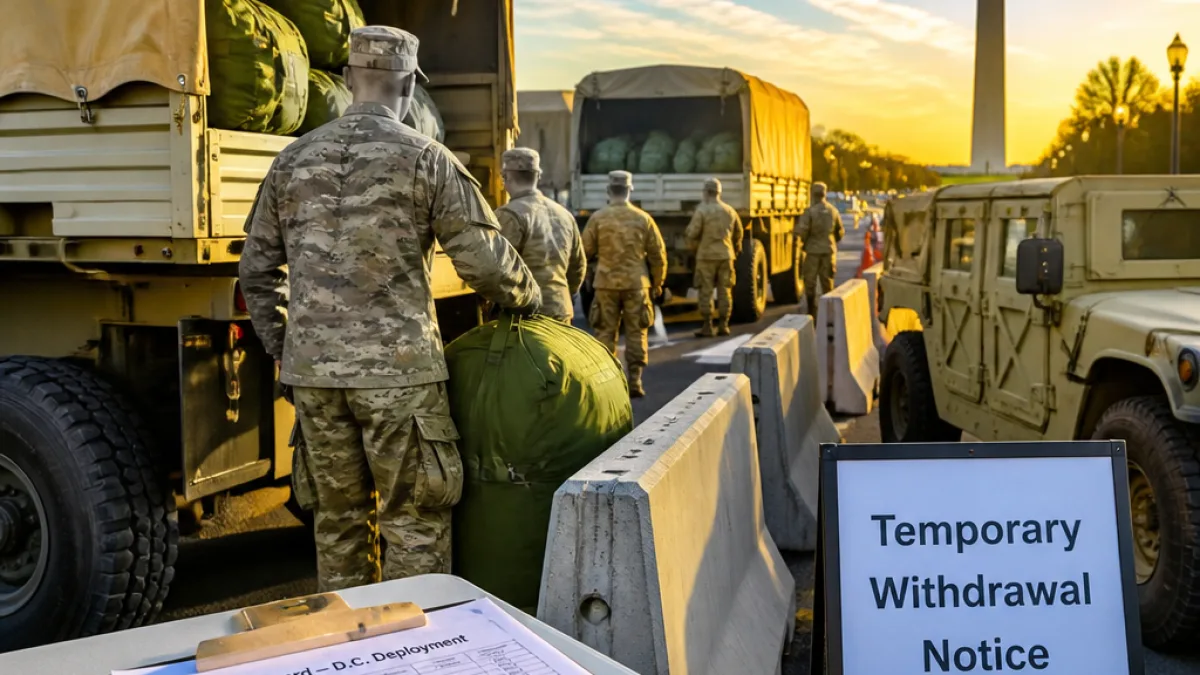
Several state leaders have begun pulling National Guard members from Washington, D.C., after evidence that some troops were carrying out patrols beyond the ceremonial duties they were told to perform, according to reporting that highlights growing unease with a nearly yearlong federal deployment.
Why governors reconsidered their orders
Minnesota Gov. Tim Walz announced an early withdrawal for his guard contingent after members were observed conducting presence patrols in residential neighborhoods distant from the National Mall. Officials in Kentucky, North Carolina, Michigan, Maryland and Hawaii also sent troops with similar, narrowly defined instructions to assist with America 250 events near national monuments, the reporting says.
The units were sent after the White House in August 2025 expanded a federal Joint Task Force in Washington meant to assist law enforcement and perform beautification work. Over the past month, federal authorities increased the number of personnel in the city to more than 5,100, a figure the story says is roughly double earlier levels.
"summer surge"
The deployment, which the nonpartisan Congressional Budget Office has estimated costs about $3 million per day, has drawn criticism from constitutional scholars, legal experts and activists who argue it risks militarizing routine public safety functions and could be used for political ends.
How the mission is being carried out
State guard members listed on the D.C. Joint Task Force public roster were reportedly deputized as special police by the U.S. Marshals Service and issued firearms. Governors who provided troops have maintained that their personnel were intended only for ceremonial and event-support roles tied to America 250.
- Deployment start: August 2025, per the reported timeline.
- Recent force size: More than 5,100 personnel after a recent uptick.
- Estimated daily cost: About $3 million, per the CBO estimate cited in reporting.
Local and regional implications
Though the reporting focuses on actions by governors in other states, the developments have relevance to Washington state readers for several reasons. First, they underscore tensions between state National Guard authorities and federal tasking, a dynamic that can affect future mutual-aid decisions and resource availability during state emergencies. Second, the size and cost of the federal presence in D.C. raise broader questions about spending priorities and oversight of federal deployments.
As governors reassess their contributions, the federal task force remains active. Officials and watchdogs will likely continue to monitor how state troops are used and whether their activities align with the specific orders under which they were sent.
| Item | Reported detail |
|---|---|
| Initial federal deployment | August 2025 |
| Recent force size in D.C. | More than 5,100 |
| Estimated daily cost | About $3 million |
Officials in Washington state have not been cited in the reporting as sending troops to the federal task force. Still, the episode serves as a reminder to policymakers and residents here that National Guard deployments can quickly become matters of national scrutiny when state assets operate under federal coordination in politically sensitive settings.
Reporting for this story relied on coverage of the federal Joint Task Force and statements reported about the decisions by governors regarding their National Guard contingents.