AI sorting replaces household sorting in Hampton Roads' first phase
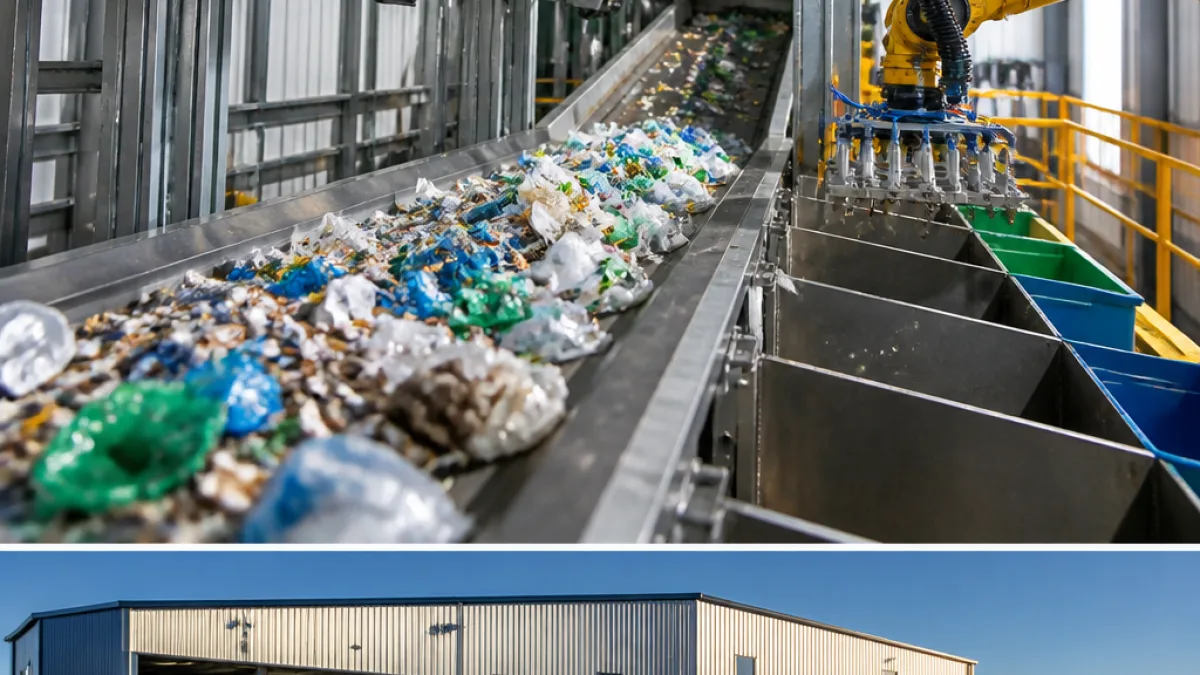
The Southeastern Public Service Authority and AMP Robotics have begun a technology-driven change that will affect how people across Hampton Roads, including Hampton-area residents, handle household waste. As of July 1, Suffolk residents no longer must separate recyclables from trash; mixed waste now can go into a single cart and travel to AMP's Portsmouth facility on Frederick Boulevard where cameras, machine learning and automated air jets pull recyclables and organic material from the stream.
What the facility does and why it matters
The Frederick Boulevard site represents the first phase of a 20-year partnership between SPSA and AMP. After recent upgrades, the plant can process about 108,000 tons of municipal solid waste per year — roughly one-quarter of the region's waste stream, according to SPSA materials made available during the media tour.
The process begins with every garbage truck dumping mixed household waste onto a tipping floor. A front-end loader feeds the load into a machine known as a reducer. Unlike a crusher, the reducer tears open garbage bags so the facility's vision system can "see" the contents.
“Our vision system cannot see if it's still in the bag. It's going to shred it ... so that our vision system can see it,”
AMP site manager Derek Henry told reporters on the tour. Once material is exposed, banks of cameras and proprietary AI software begin identifying items on the conveyor. AMP says its software can recognize at least 16 different materials at once, using commercially available cameras rather than a separate infrared camera per commodity.
Expansion plans and regional reach
A second, much larger AMP facility is under construction on Victory Boulevard at the former Wheelabrator site. That plant is expected to quadruple capacity, allowing all eight SPSA member communities to route trash through the AI-powered process by 2029. If current capacity is 108,000 tons, quadrupling would increase throughput to about 432,000 tons annually.
| Phase | Location | Approx. annual capacity |
|---|---|---|
| Phase 1 | Frederick Boulevard, Portsmouth | 108,000 tons |
| Phase 2 (planned) | Victory Boulevard (former Wheelabrator site) | ~432,000 tons (projected) |
Local implications for Hampton residents
For Hampton-area households, the shift could mean less hassle at the curb: residents may no longer need to rinse or separate recyclables once the larger facility is online and the SPSA system fully adopts the new process. The change also ties into broader statewide and national trends where cities and utilities explore automation to boost recycling rates and recover material that historically was lost to landfill because of contamination in single-stream systems.
- Convenience: Single-cart collection reduces the need to separate materials at home.
- Recovery: AI and robotics aim to recover more recyclables and organics from mixed waste.
- Scale: The planned expansion aims to cover all eight SPSA member communities by 2029.
Officials with SPSA and AMP describe the operation in manufacturing terms. "We're producing a product," Henry said during the tour, underlining that the recovered materials are intended for resale or processing rather than disposal.
The technology raises questions policymakers and local governments will have to address: how recovered materials are marketed, what happens to residues the robots cannot sort, and how costs and contracts evolve as automation replaces some manual sorting labor. Those conversations will play out across Hampton Roads as the Victory Boulevard facility comes online and the program scales to include more communities.
The first phase already demonstrates how municipal services are adapting to new tools. For Hampton residents, the experiment in Portsmouth offers a preview of a waste-management future where cameras, machine learning and jets of air handle much of the work once done at the kitchen sink.