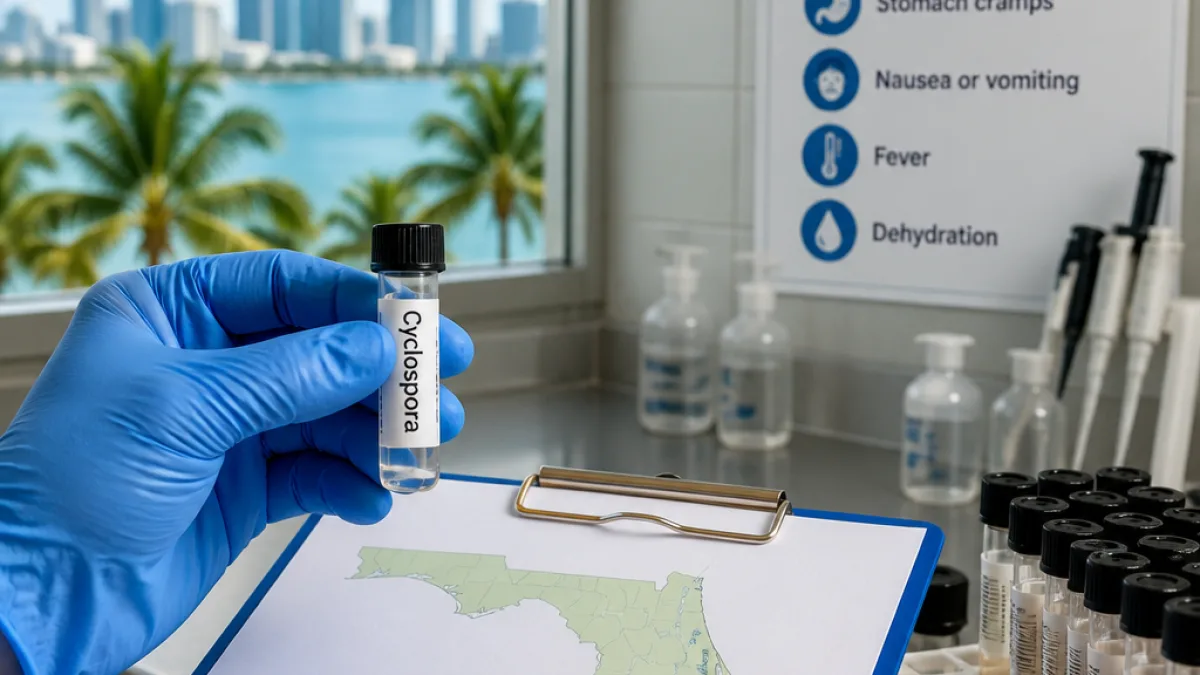
Miami residents should be aware that Miami-Dade County has reported the highest number of confirmed cyclosporiasis cases in Florida this season as state and federal investigators work to identify the source.
The Florida Department of Health's Reportable Diseases Frequency Report shows Florida has 94 confirmed cases of cyclospora infection from May 1 through July 11, with Miami-Dade accounting for 17 of those illnesses. Lee County followed with 14 confirmed cases.
What this means for locals
Health officials say cyclospora, a microscopic parasite, typically spreads through contaminated food or water rather than person-to-person contact. Residents experiencing persistent watery diarrhea, nausea, weight loss or fatigue — symptoms that most commonly begin about a week after exposure but can appear between two and 14 days — should seek medical attention and mention possible exposure to Cyclospora to their clinicians.
The Centers for Disease Control and Prevention is leading the broader U.S. investigation. Nationwide, the outbreak has 1,645 confirmed cases, and more than 5,100 additional reports are under analysis to determine whether they are domestically acquired cyclosporiasis.
"Public health officials are interviewing people linked to this outbreak to find out what foods they ate before getting sick. A specific food item has not yet been confirmed as the source," the CDC said.
Local public-health actions and guidance
The FDOH and CDC investigators are conducting patient interviews to identify common food exposures and are collecting laboratory and epidemiologic data. Officials are urging clinicians to consider testing for Cyclospora in patients with compatible illness and to report confirmed cases to public-health authorities promptly.
- When symptoms appear: Most commonly about one week after exposure; range two to 14 days.
- Typical symptoms: Frequent watery diarrhea, weight loss, poor appetite, nausea, fatigue and bloating; less commonly low-grade fever and vomiting.
- Transmission: Usually via contaminated food or water; not commonly spread directly between people.
County case numbers (selected)
| County | Confirmed cases |
|---|---|
| Miami-Dade | 17 |
| Lee | 14 |
| Broward | 7 |
| Hillsborough | 3 |
State records list additional counties with smaller case counts. Public-health officials remind residents that untreated illness can follow a remitting-relapsing course lasting days to weeks, though it is not usually life-threatening.
The report also notes a recent policy context: Cyclospora was among parasites removed from a mandatory federal reporting list last summer under the previous administration, a change that observers say can affect surveillance and case counts reported across jurisdictions.
As the investigation continues, Miami health officials recommend thorough handwashing, careful handling and preparation of fresh produce, and prompt medical evaluation for anyone with persistent gastrointestinal symptoms. Authorities will provide updates as new epidemiologic links or a specific contaminated food item are identified.