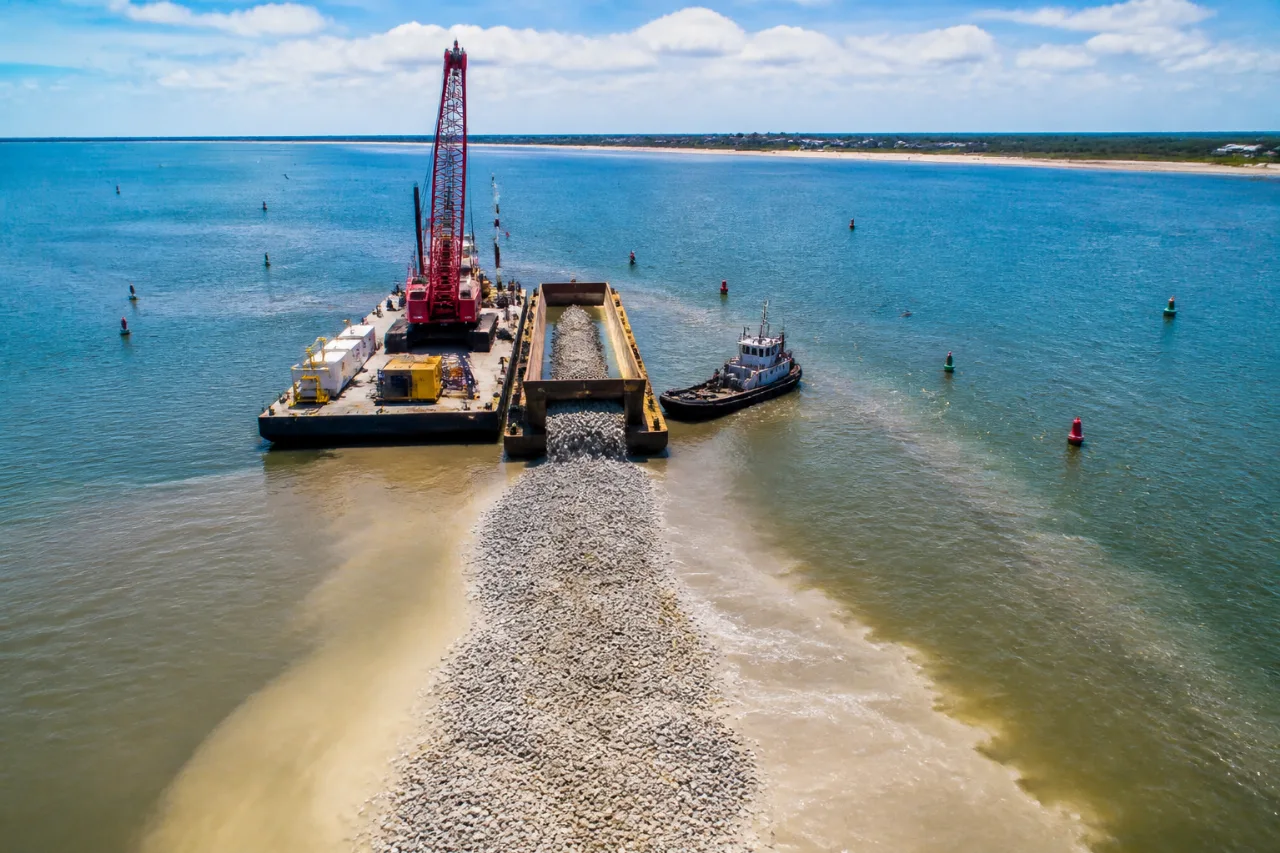
DAUPHIN ISLAND — Crews began placing thousands of tons of washed limestone on the bottom of Mobile Bay on Thursday as part of a 50-acre oyster restoration project intended to expand habitat for young oysters and bolster coastal water health.
Project partners, materials and method
The Alabama Wildlife Federation (AWF) led the operation in partnership with the Alabama Department of Conservation and Natural Resources, Marine Resources Division, along with private partners Vulcan Materials Company, Cooper Marine and JW Marine. Organizers said the planting uses about 4,600 tons of No. 4 washed limestone as cultch — the hard material that provides a surface for free-swimming oyster larvae to attach and begin forming reefs.
- Location: near Cedar Point, Mobile Bay, off Dauphin Island
- Area: roughly 50 acres
- Material: approximately 4,600 tons of No. 4 washed limestone
Three hopper barges transported the rock to the restoration site. Vulcan Materials supplied the stone; Cooper Marine moved it from Tuscumbia; and JW Marine handled the deployment across the designated reef area.
"What you see today is AWF's fourth oyster cultch planting project," said Tim Gothard, executive director of the Alabama Wildlife Federation.
Why cultch matters for Mobile Bay
Officials emphasize that the limestone itself is not a reef but a foundation for one. Young oysters, known as spat, need hard surfaces to attach to; cultch gives them that foothold. Project leaders estimate the rock will remain effective for 10 to 15 years, allowing multiple generations of oysters to establish and accrete reef structure over time.
The planting supports Alabama’s Comprehensive Oyster Restoration Strategy, a framework developed by the state Marine Resources Division in collaboration with the National Oceanic and Atmospheric Administration (NOAA). The strategy prioritizes cultch deployment as a key tool for rebuilding shellfish habitat, improving water filtration and enhancing shoreline resilience.
Local consequences and context
For Mobile-area residents and the seafood industry, expanding oyster habitat has several practical benefits: stronger oyster populations that support commercial and recreational harvests, improved water quality through oyster filtration, and increased natural protection against erosion. Because oysters form habitat for other marine life, successful reef expansion can also support broader bay productivity.
AWF described the Cedar Point planting as its fourth cultch project, part of a multi-year effort to restore oyster habitat around Alabama’s coast. The collaboration between state agencies and private firms illustrates the combined public-private approach being used to meet the goals set out in the restoration strategy.
| Item | Detail |
|---|---|
| Project area | ~50 acres near Cedar Point |
| Cultch material | ~4,600 tons No. 4 washed limestone |
| Partners | AWF, Alabama Marine Resources Division, Vulcan, Cooper Marine, JW Marine |
Organizers say the effectiveness of cultch deployments will be monitored over time as oysters colonize the material and reefs develop. For Mobile Bay communities that rely on healthy fisheries and resilient shorelines, the planting represents a tangible step toward long-term restoration.