
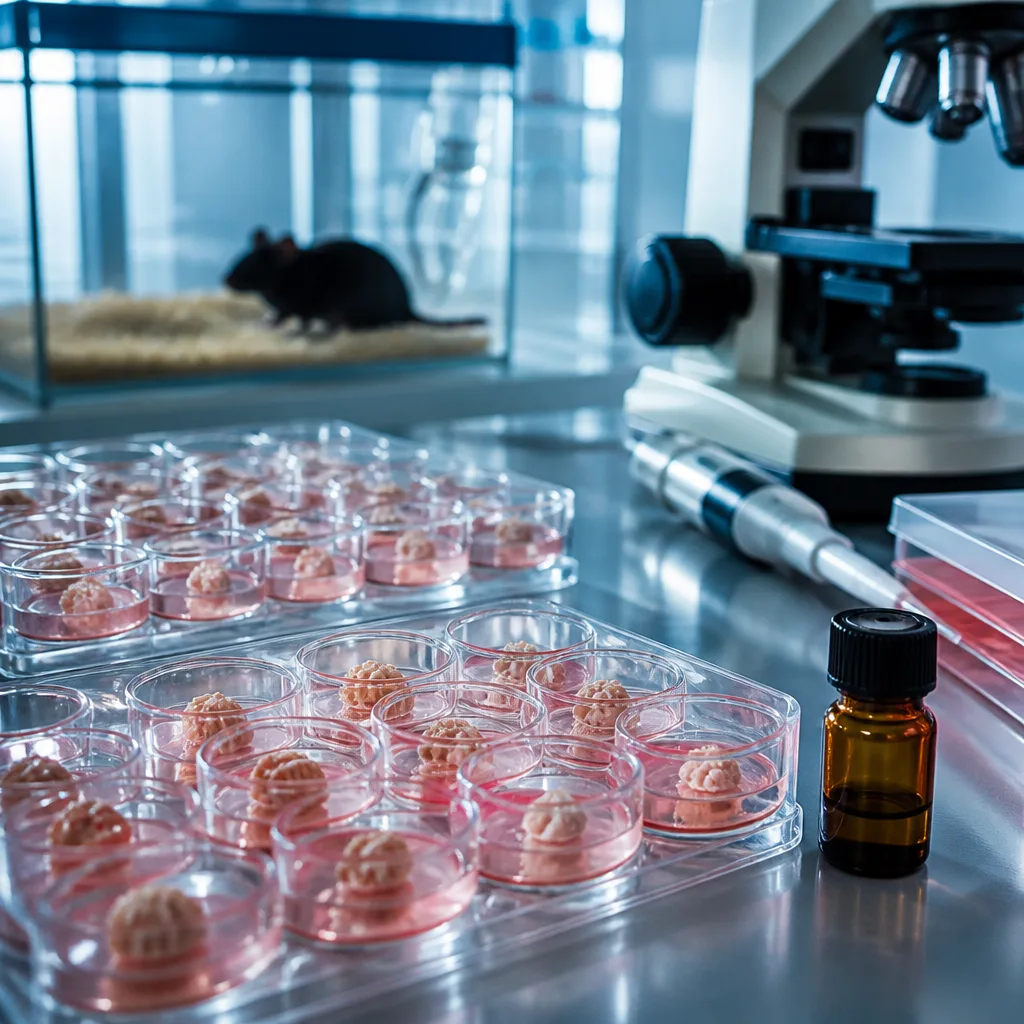
Laboratory researchers report that a brief, ultra‑low‑dose exposure to the cannabis compound THC pushed breast cancer cells toward a less aggressive state in both three‑dimensional organoid models and in mice, reducing measures linked to metastatic potential and tumor initiation.
Targeting cancer cell plasticity
Cancer cell plasticity — the ability of some tumor cells to revert from a differentiated state to a more primitive, stem‑like identity — helps tumors evade conventional therapies and seed recurrence. In a study published in Communications Biology, investigators tested whether modulating the endocannabinoid system (ECS) could constrain that plasticity.
The team administered a four‑day pulse of an ultra‑low dose of THC to lab‑grown 3‑D mammary tumor organoids derived from human breast cancer cells and to mouse models. After treatment, the organoids showed measurable reductions in:
- cell invasiveness
- self‑renewal capacity
- tumor initiation
Receptor signaling appears key
The ECS includes two principal cannabinoid receptors, CB1R and CB2R. The researchers probed receptor involvement using ligands that either activate (agonists) or suppress baseline activity (inverse agonists). Their results pointed primarily to CB2R — a receptor more commonly linked to inflammatory responses — rather than CB1R, which is associated with the psychoactive effects of cannabis.
As part of the experiment the team applied two inverse agonists, identified as SR1 (targeting CB1R) and SR2 (targeting CB2R), to reduce receptor baseline signaling. Despite manipulating both receptors, the anti‑invasive and differentiation‑locking effects appeared to be mediated predominantly through CB2R.
| Receptor | Typical association | Role in study |
|---|---|---|
| CB1R | Psychoactive effects of cannabis | Modulated with inverse agonist SR1; not the dominant mediator |
| CB2R | Inflammatory responses | Primary mediator of reduced invasiveness and self‑renewal |
Context and caveats
The study used organoids — three‑dimensional cell cultures that model tumor architecture — and mouse experiments to probe biological mechanisms. Such preclinical systems are powerful for exploring pathways and candidate interventions but do not substitute for clinical trials in humans. The investigators emphasize that the effect was seen with an ultra‑low‑dose, short‑duration (four‑day) THC pulse; dose, timing and long‑term outcomes remain open questions.
If further research confirms these findings, the approach would represent a shift from cytotoxic strategies that aim to kill dividing cells toward therapies that alter tumor cell identity and behavior, potentially making cancers less prone to dissemination and relapse. However, translating laboratory receptor modulation into safe, effective treatments will require additional animal work, mechanistic clarification, and careful clinical testing.
For now, the study contributes to growing interest in the ECS as a regulator of developmental pathways that cancers can hijack, and it highlights CB2R as a promising target for interventions intended to curb tumor aggression without invoking the psychoactive effects tied to CB1R.