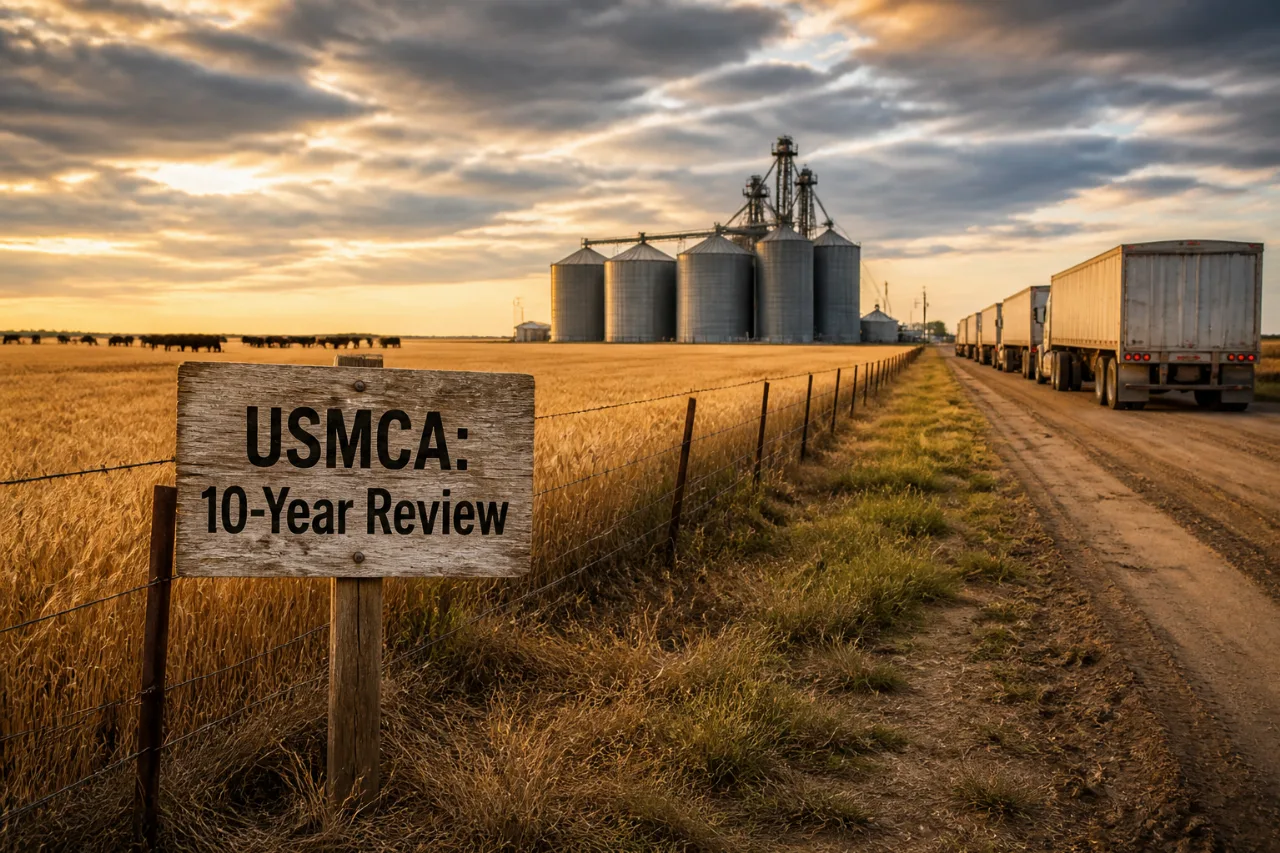
Oklahoma's crop and livestock producers rely heavily on trade with the nation's two southern neighbors. This week, federal officials allowed the United States-Mexico-Canada Agreement (USMCA) to lapse into a formal review cycle, beginning a 10-year window for renegotiation that stops short of immediate cancellation but injects uncertainty into markets important to the state's farm economy.
What changed — and what it means here
The agreement that superseded NAFTA in 2020 will not be automatically renewed. Instead, the three countries now have up to a decade to negotiate long-term terms. For Oklahoma, where agricultural exports are a substantial portion of rural income, that uncertainty matters.
Oklahoma State University Extension specialists say Mexico is particularly vital: it is the state's largest export market for wheat, corn, milo (sorghum) and oilseeds. Large flows of grain and ethanol move north and south across the border, while cattle trade runs both ways.
"All of these things would impact Oklahoma growers if for some reason down the line USMCA got torn up," said Todd Hubbs, grain marketing specialist at the Oklahoma State University Extension.
Hubbs and other extension economists do not foresee an immediate price shock tied to the review. Still, they warn that prolonged uncertainty can translate into lost sales, altered planting and merchandising decisions, and fewer investment signals for value-added businesses in rural Oklahoma.
Pressure from rising costs and global supply
Farmers are already operating under stress from higher input costs. Fuel and fertilizer prices remain elevated — pressures traced in part to geopolitical tensions in the Middle East — while many commodity prices are under pressure due to abundant global harvests last year. Those factors leave growers with slimmer margins and less room to absorb trade disruptions.
- Key crops tied to Mexico: wheat, corn, milo, oilseeds.
- Immediate market effect: limited — no formal withdrawal yet.
- Long-term risk: lost opportunities and uncertainty in cattle and crop markets.
Derrell Peel, an OSU livestock marketing specialist, emphasized the long view for cattle markets: while the U.S. exports feeder cattle to Mexico and Canada, imports are larger, reflecting scale differences among the three countries. He warned that the real damage could be missed opportunities rather than an abrupt price collapse.
"It's probably lost opportunities is really the real impact here and that comes from the uncertainty of just not knowing," Peel said.
What producers can watch next
Producers and buyers in Oklahoma should monitor several developments: any formal notice of withdrawal by a party, specific negotiation proposals that could alter tariffs or sanitary rules, and interim administrative changes that affect transport or documentation. Farmers should also continue to work with extension services and marketing specialists to manage price risk and input costs.
| Crop | Primary export market |
|---|---|
| Wheat | Mexico |
| Corn | Mexico |
| Milo (sorghum) | Mexico |
| Oilseeds | Mexico |
State officials, farm groups and extension economists have pushed for clarity and speedy talks. For Oklahoma's rural communities, the next steps in Washington, Ottawa and Mexico City will shape export demand, farm income and local businesses tied to agriculture for years to come.
Cheyenne Parker, Oklahoma Correspondent