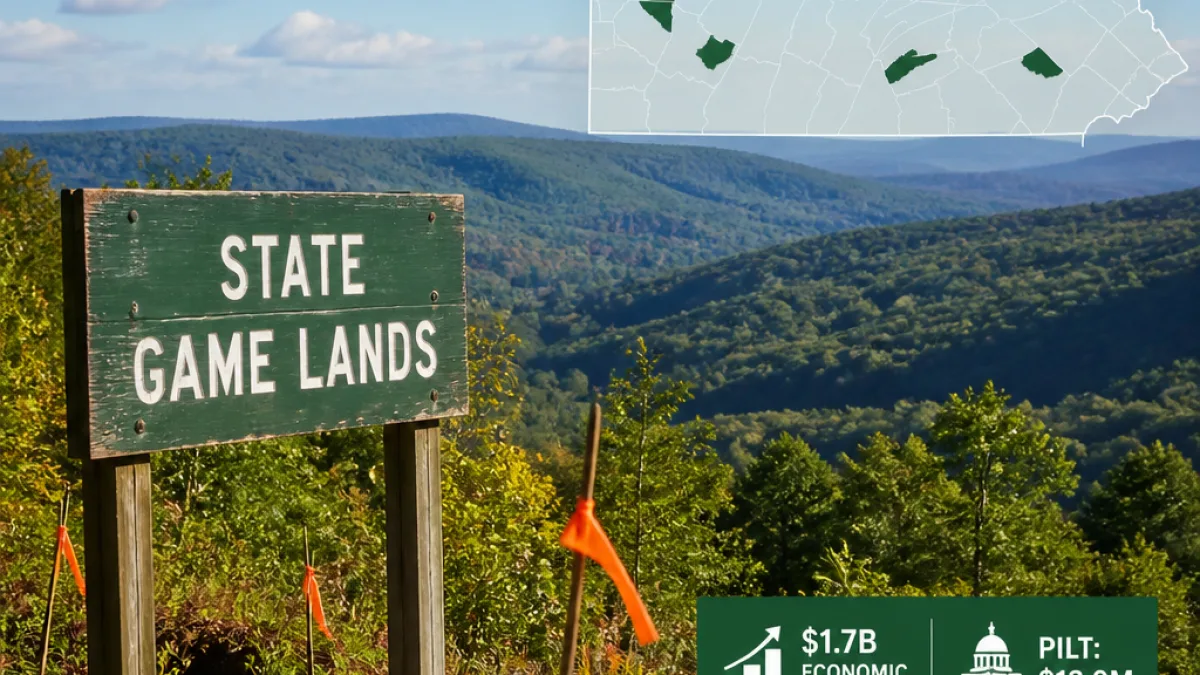
The Pennsylvania Game Commission on July 10 approved several land purchases totaling more than 1,600 acres and released findings from an economic study estimating the statewide impact of its holdings at about $1.7 billion.
How game lands translate into dollars for communities
The commission owns roughly 1.5 million acres across more than 300 state game lands. Those tracts are removed from the traditional property tax rolls but are covered by Payments in Lieu of Taxes, or PILT, that the agency distributes to counties, municipalities and school districts.
| Item | Figure |
|---|---|
| PGC-owned acreage | ~1.5 million acres |
| 2026 PILT distributed | $13,859,457.09 |
| PILT rate (per acre) | $9 per acre |
| PGC share of per-acre payment | $3 |
| State share of per-acre payment | $6 (from gaming revenues) |
At the July meeting the commission also approved new management zones for the state’s wild elk population and unveiled the results of a study prepared by Industrial Economics, Inc., which quantified the economic contributions of state game lands.
Local tax concerns and development context
Officials acknowledged a common concern that public ownership reduces local property tax revenue and could affect economic development. Ken Duren, the Game Commission’s wildlife habitat management real estate division chief, addressed that issue directly during the meeting.
“We hear that us owning land reduces local property tax revenue and can hurt economic development,”
Duren said the agency examined development patterns across millions of acres of privately held land and concluded that public lands — including state game lands — are not necessarily the barrier to development that some residents fear. He noted that the PILT rate is set by the state Legislature and is adjusted automatically every five years.
- PGC holds more than 300 state game lands.
- Payments to local governments in 2026 totaled nearly $13.9 million.
- The per-acre PILT of $9 is funded one-third by the commission and two-thirds by the state through gaming revenue.
Commission leaders compared PILT totals to hypothetical property tax revenue for those same undeveloped parcels and reported that in more developed regions of the state — including parts of northwestern and eastern Pennsylvania — PILT payments are lower than what private owners would pay in local property taxes. The study and discussion come as the commission continues to manage habitat, hunting access and wildlife populations while expanding public holdings.
For counties and school districts, the PILT payments provide a predictable, if smaller, revenue stream than property taxes on developed land. For land-use planners and local officials, the commission’s action and the study’s findings add data to ongoing debates over balancing conservation, recreation and economic development.
The commission did not release a county-by-county breakdown of the new acquisitions at the meeting, but the approvals add to several years of purchases intended to conserve habitat and expand public access to hunting and wildlife viewing across the Commonwealth.
— Maya Kaplan, Pennsylvania Correspondent