
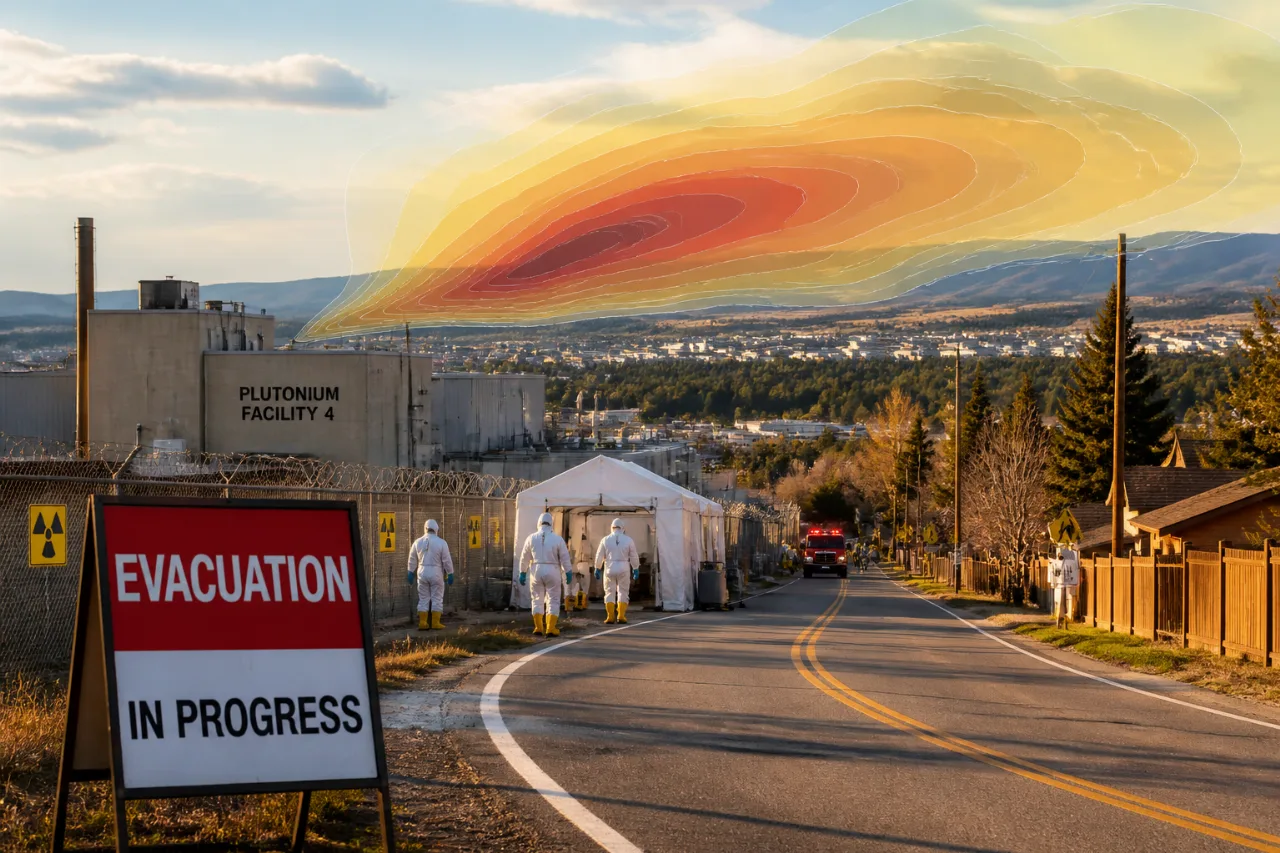
The Energy Department has likely undercounted the potential human and economic toll if plutonium were to escape from the Los Alamos National Laboratory, according to a study published Friday by independent scientists.
More severe outcomes than federal modeling
Federal modeling previously concluded a so-called loss of containment would spread about 1 kilogram of plutonium, resulting in an average of nine cancer deaths in surrounding communities. The new analysis, published in Science and Global Security, finds that under a range of plausible conditions — including after a natural disaster such as an earthquake — outcomes could be much worse.
Researchers modeled particle dispersion from scenarios in which plutonium escapes workstations inside Plutonium Facility 4 (PF-4), ignites and, if critical safety systems fail, ejects radioactive particles into the outside air. The study’s simulations show:
- Hundreds of people could eventually die from cancers caused by inhaling or ingesting plutonium particles in some modeled scenarios.
- In the most serious simulations — when more than 1 kilogram is released — parts of the town of Los Alamos could become unlivable.
- Radioactive particles could travel beyond county and state lines in major releases.
The researchers also presented a high-end estimate that as many as 3,200 people could eventually develop cancer from a large release, resulting in about 1,000 deaths. They estimated land remediation costs could reach about $150 billion in such a scenario.
Model specifics and local stakes
Some of the simulations informing the study modeled a 5.1 kilogram release of plutonium made up of very small particles (about 0.88 micron). Those fine particles can remain airborne and be transported in a plume, increasing the area and number of people exposed.
| Modeled release | Estimated cancers | Estimated deaths | Estimated remediation |
|---|---|---|---|
| ~1 kg (DOE prior estimate) | — | 9 (average) | — |
| Up to 5.1 kg (study simulation) | Up to 3,200 | About 1,000 | Up to $150 billion |
Los Alamos National Laboratory is one of the nation’s central facilities for nuclear weapons research and the manufacture of plutonium pits — the cores of U.S. nuclear warheads. While the probability of a release is widely considered minuscule, the study underscores that the consequences of even low-probability events can be severe.
Questions for officials and next steps
The study raises urgent questions for the Energy Department, the National Nuclear Security Administration and local authorities about emergency preparedness, community protection and long-term land remediation planning. For Los Alamos County and neighboring communities, the findings emphasize the need to review safety systems, disaster response plans and public-health contingencies that would follow any loss of containment.
Officials and residents have long balanced the lab’s local economic role with concerns over safety and environmental risk. This new analysis is likely to renew scrutiny of safety protocols at PF-4 and other lab facilities, and could prompt calls for updated federal modeling, additional public disclosures and new investments in prevention and emergency response.
Until agencies release updated assessments or comment publicly on the study’s methods and findings, county residents and state officials will be left with the study’s conclusions as the most recent independent estimate of potential impacts from a major plutonium release at Los Alamos.
Santiago Baca is the New Mexico correspondent for News Block.