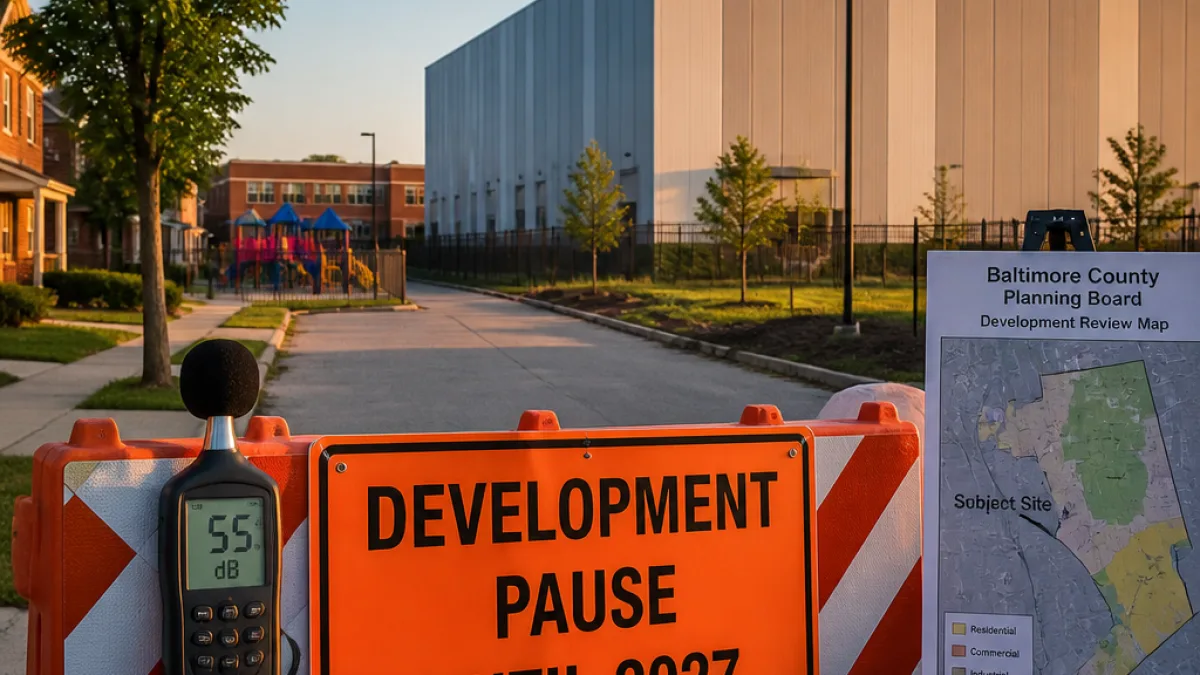
BALTIMORE — Baltimore County staff presented a report to the county Planning Board on Thursday that recommends strict controls on hyperscale data centers after examining economic, public health and environmental impacts.
What changes for residents
The report comes while the county has a development pause on data centers in place through Jan. 1, 2027. Staff are urging rules that would affect where new centers can be built, how loud they can operate and potential community benefits developers might be required to provide.
Key recommendations include banning data centers near schools, homes, parks and day cares, imposing a noise cap to protect nearby neighborhoods and exploring contractual agreements that would direct benefits to local priorities.
- Location limits: Prohibit hyperscale facilities close to sensitive land uses such as schools and residences.
- Noise restriction: Cap backup-generator noise at 55 decibels, compared with reported generator levels that can reach about 105 decibels.
- Water use and costs: Highlight substantial water consumption — more than 500,000 gallons for some centers — and potential increases in energy bills for nearby ratepayers for at least three years.
- Community benefits: Consider requiring developers to sign agreements funding local priorities, such as climate resilience, workforce development and other community programs.
Those recommendations were described during the Planning Board presentation by county staff. The report found that large data centers can drive up electric bills for neighbors and require heavy water withdrawals. Staff suggested addressing those consequences through land-use prohibitions and negotiated developer contributions.
"I think a lot of these are intended to be placed in some already overburdened and underprivileged communities," resident Reed Cahill said at the meeting, adding that the report offered "encouraging signs" about slowing development pressures.
Local context and concerns
Community advocates and civil-rights leaders have flagged equity and environmental impacts. Dr. Danita Tolson with the Baltimore County NAACP told the meeting the staff recommendations are a starting point but that more research is needed to fully assess long-term effects.
Noise and air-quality concerns are central to neighbors' objections. The report noted that diesel backup generators at hyperscale centers can reach noise levels similar to a motorcycle and recommended reducing that impact with a 55-decibel limit to protect residential areas.
Water use was another significant concern. The report documents that some data centers may use more than 500,000 gallons of water, raising local questions about water resources, ecological effects and alleged ties to environmental injustice.
Next steps for county review
The report recommends that Baltimore County explore regulatory changes and binding agreements with developers to address community priorities. Those conversations will take place while the county's development pause remains in effect, giving officials time to draft ordinances or permit conditions.
| Issue | Reported detail |
|---|---|
| Development pause | Through Jan. 1, 2027 |
| Recommended noise cap | 55 decibels |
| Reported generator noise | Up to 105 decibels |
| Reported water use | More than 500,000 gallons |
| Energy-bill impact | Raised for at least three years |
How the county converts these recommendations into formal zoning changes, permit requirements or developer agreements will determine the immediate effects on proposed and future projects. For residents near potential sites, the report signals that county planners are considering stronger protections on siting and operations.
Public comment and further study were highlighted as part of the process. County officials and community groups will continue to weigh the balance between economic development and protecting neighborhoods from noise, water and energy burdens associated with large-scale data centers.