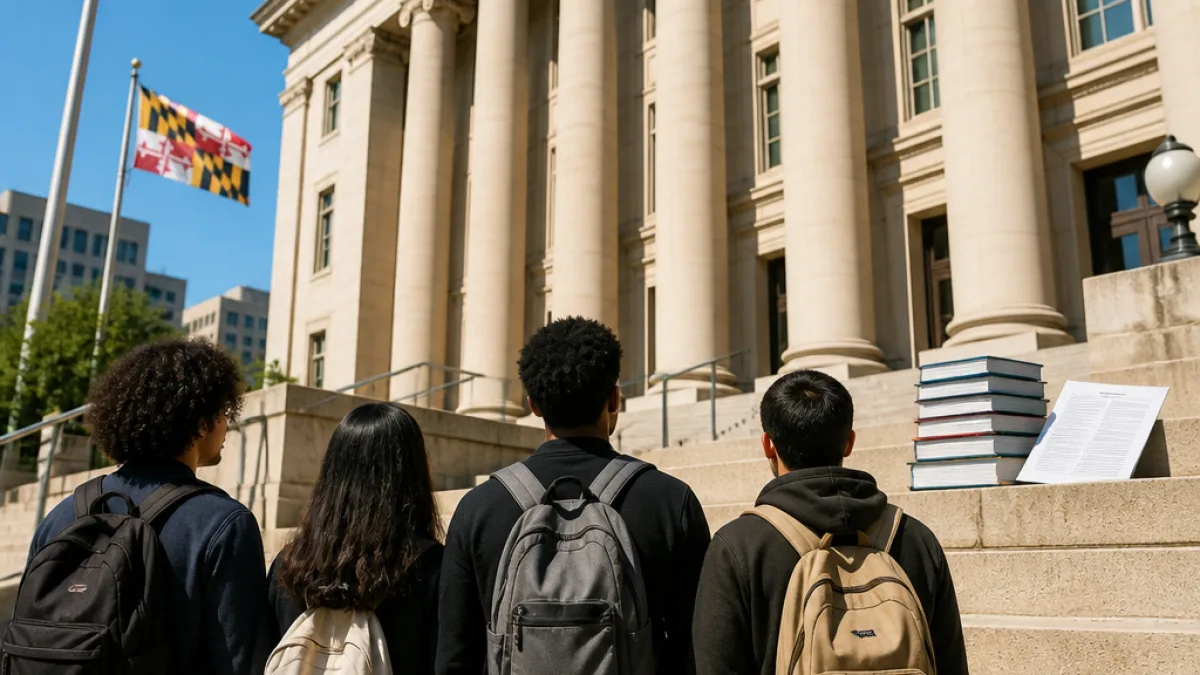
The U.S. Department of Justice this week asked a federal court to bar Maryland from offering in-state tuition rates and certain state financial aid to undocumented students, setting up a legal battle with implications for colleges, students and taxpayers across the state.
The suit, filed July 16, contends Maryland’s statutes and policies give benefits to noncitizens that are not available to some American citizens and therefore violate federal law. The Justice Department asked the court to block a state statute that requires public colleges and universities to charge undocumented students the in-state tuition rate and permits them to receive state financial aid grants and some scholarships.
What this could mean for students and institutions
If the DOJ prevails, eligible undocumented students could lose access to lower tuition rates and state-funded grants they currently receive under the Maryland Higher Education Commission guidelines. The commission says qualified undocumented students are allowed to apply for financial aid and in-state tuition at public institutions.
- About 2,000 undocumented students graduate from Maryland high schools each year, according to the source cited in the lawsuit filing.
- The DOJ estimates the state spends roughly $9 million in a single academic year on the program.
- The department has filed similar lawsuits in about a dozen other states, including Virginia, California, New Jersey, Massachusetts and Minnesota.
The case references the state’s legislative history on the issue: Maryland extended eligibility for state financial aid to undocumented students in 2018. Earlier actions include a 2011 law permitting undocumented immigrants to receive in-state tuition provided they first attended community college, and a 2019 change that removed the community-college prerequisite.
| Year | Action |
|---|---|
| 2011 | In-state tuition allowed if student first attended community college |
| 2018 | State financial aid eligibility extended to undocumented students |
| 2019 | Removed requirement to first attend community college |
Federal argument and reaction
Associate U.S. Attorney General Stanley Woodward framed the suit as enforcement of federal protections for citizens and an effort to limit taxpayer-funded benefits to noncitizens.
"Congress long ago made clear that Maryland cannot deny educational opportunities to American citizens that it gives to illegal aliens in the State," Associate U.S. Attorney General Stanley Woodward said. "By granting illegal aliens in-state tuition, Maryland is not only violating federal law but subsidizing education for illegal aliens, costing Maryland taxpayers roughly $9M for just one academic year. This Department of Justice is committed to fulfilling President Trump's promise that illegal aliens will not obtain taxpayer benefits or preferential treatment over our own citizens."
CBS News Baltimore reached out to the Maryland Attorney General’s Office for comment. The Maryland Higher Education Commission says its current rules allow eligible undocumented students to pay in-state tuition and to apply for certain grants and scholarships.
Next steps and local impact
The lawsuit launches a federal challenge that could take months to resolve. In the interim, colleges and universities in Maryland will monitor the litigation for any court orders that might change how they admit students and assess tuition or distribute state-funded aid.
For families and students, the immediate concerns are practical: whether eligibility will change, how institutions will respond, and what this means for college affordability. State higher-education officials and campus financial-aid offices will be key sources of information as the case progresses.
News Block will follow the case and report updates as the DOJ and Maryland officials make filings and statements.