The U.S. Department of Justice on Thursday asked a federal judge to invalidate Maryland’s program that allows certain immigrant students to pay in-state tuition at public colleges and universities, saying the policy violates a federal statute that bars preferential benefits to people not lawfully present in the United States.
The lawsuit, filed in U.S. District Court in Maryland, names as defendants the state and officials including the Maryland Higher Education Commission and the University System of Maryland Board of Regents. The department cites the Maryland DREAM Act of 2011 and two later amendments, in 2019 and 2024, as the legal bases for the in-state tuition and for expanded eligibility.
What the federal government is arguing
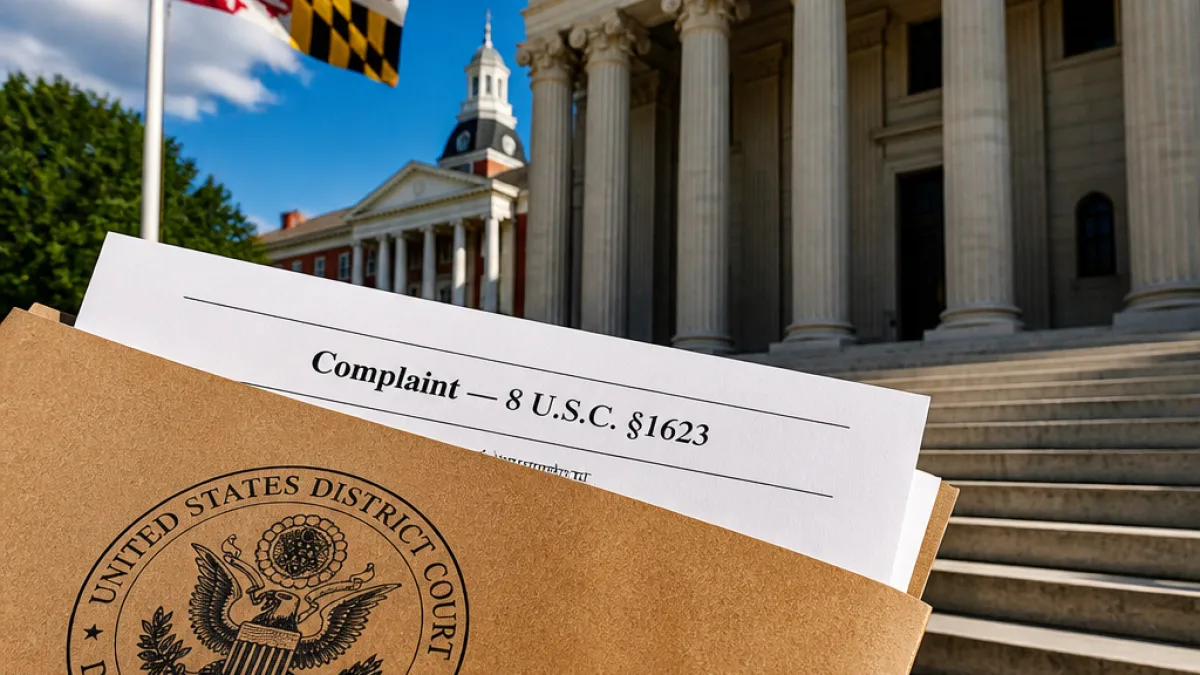
In the 23-page complaint, the Justice Department argues that Congress, through 8 U.S. Code Section 1623, prohibits a state from granting a postsecondary benefit to an ‘‘alien who is not lawfully present’’ if U.S. citizens or nationals are not eligible for that benefit on the basis of residence.
“By granting illegal aliens in-state tuition, Maryland is not only violating federal law but subsidizing education for illegal aliens, costing Maryland taxpayers roughly $9 million for just one academic year,” Associate Attorney General Stanley Woodward said in a statement announcing the suit.
The department has asked U.S. District Judge Stephanie A. Gallagher, who was appointed by former President Donald Trump, to strike down Maryland’s program.
Scale and local impact
The Maryland Higher Education Commission has reported that a portion of the state’s undocumented students receive in-state rates. According to a presentation from the commission, 496 undocumented students were receiving in-state tuition at community colleges and 309 were paying in-state rates at public universities. The state also graduates about 2,000 undocumented students from high school each year, the presentation said.
| Category | Count |
|---|---|
| Undocumented students at community colleges (in-state) | 496 |
| Undocumented students at public universities (in-state) | 309 |
| Undocumented high school graduates per year | 2,000 |
The Justice Department also pointed to the cost impact in its statement. State officials and the university system did not immediately provide comment to reporters following the filing.
Broader context
This action is the latest in a series of federal suits challenging state policies that allow certain immigrants who arrived as children to access in-state tuition. The department has previously won favorable rulings in challenges to programs in Texas, Kentucky, Oklahoma and Nebraska, and has initiated similar lawsuits in other states.
- The suit challenges the 2011 Maryland DREAM Act and subsequent amendments in 2019 and 2024.
- The DOJ relies on federal statute 8 U.S.C. §1623 to argue preemption.
- Maryland residents and students could see changes to tuition eligibility if a court rules for the government.
The case will proceed in federal court, where Maryland officials will have an opportunity to respond to the department’s claims. Any ruling could affect tuition policy not only in Maryland but in other states that have adopted similar measures.