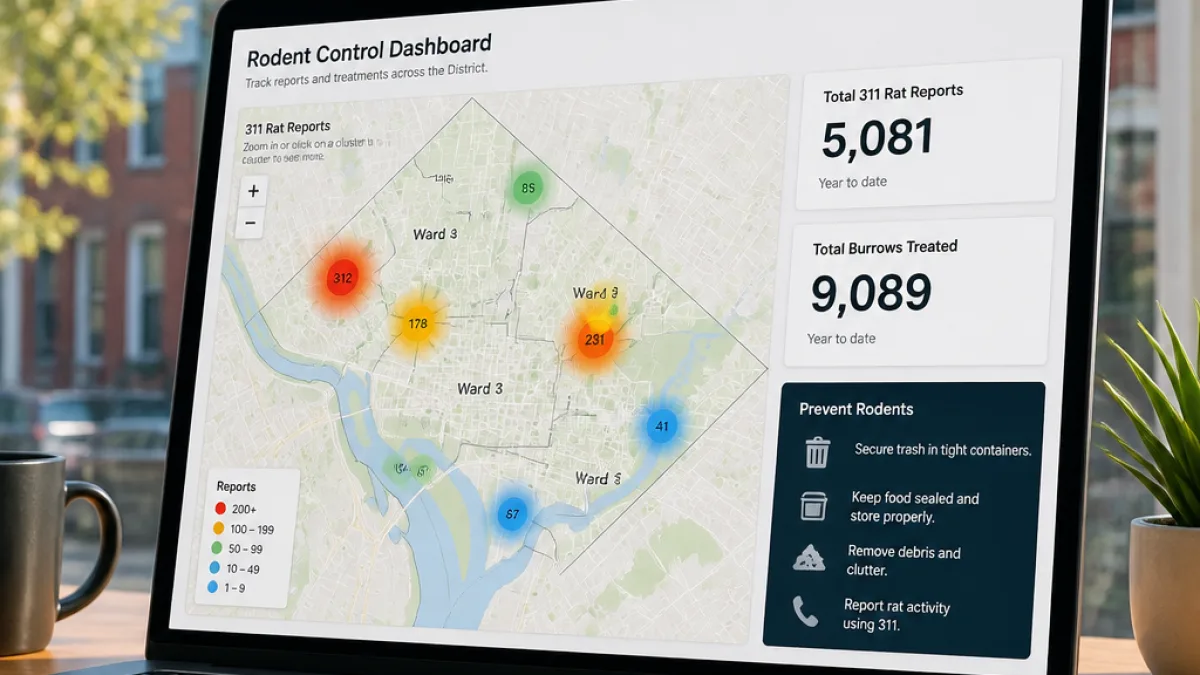
Washington officials this week rolled out a new Rodent Control Dashboard that maps rat sighting reports, tracks burrow identification and treatment, and centralizes the District’s response to an ongoing rodent problem.
What the dashboard shows
The online tool displays the locations of 311 calls about rat sightings, provides ward-level counts for treated burrows and active service requests, and offers information for residents on prevention and the diseases rats can carry. The District Department of Health described the resource as a
"centralized, public tracking tool built to monitor the District’s ongoing rodent control initiatives, active service requests, and community abatement efforts." — D.C. Health
The dashboard complements existing channels: residents and businesses who see rats are still asked to call 311 or visit dc.311.gov to file a service request.
Citywide numbers and neighborhood impact
As of Friday, the dashboard showed 5,081 rat-related calls citywide this year and 9,089 burrows identified and treated across the District. Ward 1 had the highest number of reports, with 1,063 calls and 2,831 burrows treated.
| Geography | 311 reports (YTD) | Burrows identified & treated |
|---|---|---|
| Districtwide | 5,081 | 9,089 |
| Ward 1 | 1,063 | 2,831 |
The dashboard’s ward-level breakdown is intended to help residents, community groups and businesses see where city abatement teams are working and where additional community action may be needed.
How this fits into D.C.’s longer effort
D.C. has tried multiple approaches to curb its rat population. In recent years, the city has experimented with contraception for rodents as part of broader control strategies. The new dashboard aims to add transparency and allow users to monitor both individual service requests and broader abatement trends.
- Report rats: Call 311 or file at dc.311.gov.
- Use the dashboard: View mapped 311 reports, ward summaries and prevention tips.
- Take local action: Residents and property owners can reduce attractants by securing trash, sealing openings and removing standing water.
City officials say the dashboard also contains practical guidance about minimizing rodent attractants and information on diseases rats may carry. For residents, the new site is designed both as an information hub and a transparency tool to see where municipal resources are being deployed.
The launch comes as the city continues routine abatement work across neighborhoods. For community groups and neighborhood associations, the dashboard provides a new way to identify persistent problem areas and to coordinate with city services.
Local public-health and sanitation officials have emphasized that the dashboard is not a replacement for filing a 311 request when a rat is seen; rather, it is a public-facing companion that makes the data behind those requests more accessible.
News Block’s coverage will monitor updates to the dashboard and track how the tool shapes neighborhood abatement efforts in the coming months.