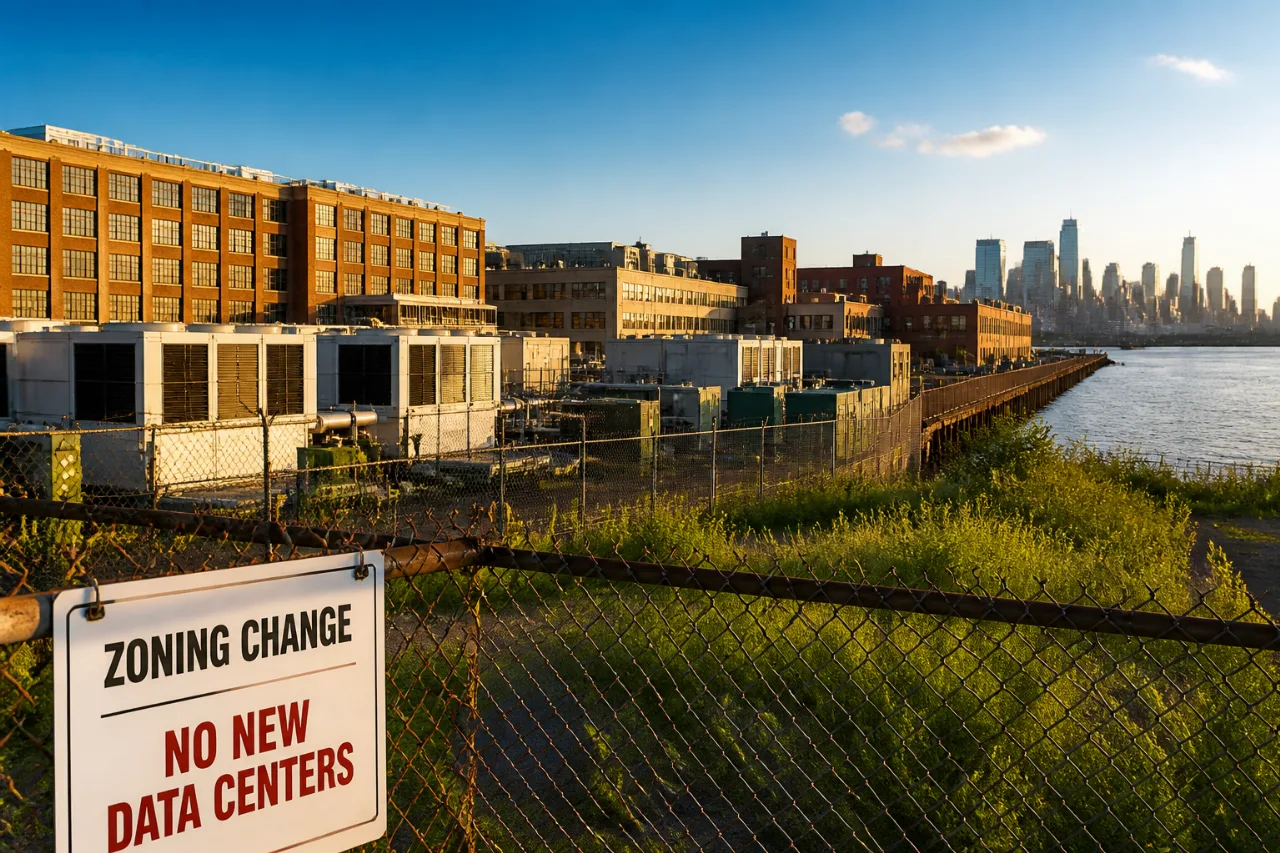
Jersey City residents will see a new limitation on industrial development after the Planning Board unanimously approved zoning changes on June 30 that ban new standalone data centers and "cyber hotels" in the city's industrial districts.
What changed and where it applies
The amendments to the land use development ordinance revise the list of permitted uses in industrial districts, removing "cyber hotel and data center" as allowable uses and tightening the definition of "warehouse" to explicitly exclude data centers. The city's industrial districts run mainly along the Hackensack River and the southern portion of Greenville.
The zoning update was initiated by the administration of Mayor James Solomon, and the Planning Board passed the measure by a unanimous vote. Any data center operations already inside Jersey City will be grandfathered under the new rules.
Why the city acted
Municipalities across New Jersey have been rethinking data center approvals amid concerns over:
- increased electricity demand and higher utility costs,
- large water needs for cooling systems,
- noise and other impacts on nearby neighborhoods, and
- overall quality-of-life effects for residents.
The Jersey City amendments follow that trend. A city-created report notes the municipality currently has a small number of data centers, all of which are components of larger, mixed-use or office towers rather than standalone facilities.
"Any existing data centers will be grandfathered in under the changes," the report states.
Where existing data centers are located
According to the city report, there are five data center presences in Jersey City, all concentrated Downtown and housed inside larger developments. The identified locations include:
| Address | Type |
|---|---|
| 25 Christopher Columbus Drive | Data center component within mixed-use/office tower |
| 210 Hudson Street | Data center component within mixed-use/office tower |
| 1 Evertrust Plaza | Data center component within mixed-use/office tower |
| 111 Town Square Plaza | Development containing two data center facilities |
Context within New Jersey and beyond
The move comes as more than 80 data centers operate elsewhere in New Jersey, according to South Jersey Climate News, and more than 4,300 data centers are active across the United States, with Virginia leading the country at 609 facilities. Jersey City’s action restricts new, standalone facilities while allowing data center components within mixed-use buildings to remain.
For residents, the zoning change narrows the kinds of industrial projects that can be proposed in certain parts of the city. Developers seeking to build standalone data centers in the affected districts will no longer be able to pursue those projects under the current ordinance; projects that already include data center space inside larger developments are unaffected so long as they remain existing uses.
The Planning Board vote reflects a local policy choice to prioritize infrastructure capacity and neighborhood conditions as Jersey City contends with demand driven in part by growth in AI and cloud services nationwide.