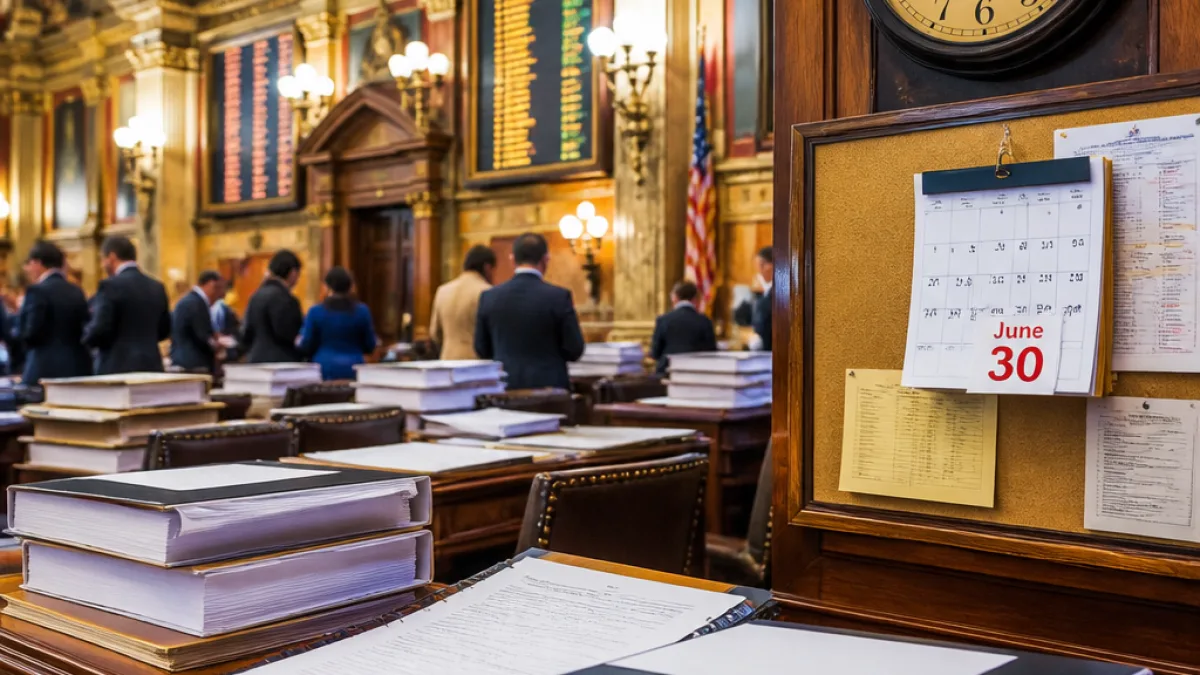
The Pennsylvania General Assembly missed the June 30 constitutional deadline for adopting a state budget for the fifth consecutive year, leaving lawmakers racing this week to finalize appropriations and policy changes before state agencies face prolonged funding uncertainty.
Weekend sessions aimed at a delayed deal
Senate leaders called an "off-the-floor" Senate Appropriations Committee meeting for Friday evening, with voting sessions planned Saturday and Sunday and the House set to return for session on Sunday. Lawmakers said they will consider a mix of spending and policy items, including changes to education tax credits, data center tax incentives and potential regulation of skill games.
With Massachusetts Gov. Maura Healey signing that state's $63.4 billion budget on July 9, Pennsylvania is one of only two states still without an approved budget, joining South Carolina. The delay has heightened concerns about timely payments and planning for agencies that rely on state funds.
Why the deadline keeps slipping
Political and structural factors underlie the recurring deadline misses. Pennsylvania's legislature often operates under divided control and represents a geographically and economically diverse Commonwealth: two large metropolitan areas, numerous mid-sized cities and extensive rural regions. That mix complicates efforts to agree on a general fund that satisfies competing priorities.
Historical patterns also play a role. Since 1977, the governor's office has shifted between Democrats and Republicans with near parity. The state's recent streak of late budgets coincides with Democratic gubernatorial administrations, and analysts note past budgets under Democratic governors have been more likely to be enacted after the June 30 deadline.
Items on the negotiating table
- Education tax credits — proposals to expand or reform programs that redirect tax dollars for private-school scholarships.
- Data center tax incentives — debates over equipment tax credits and whether to retain, modify or eliminate them.
- Regulation of skill games — potential legislation to define and control devices and establishments that some lawmakers contend skirt existing gaming laws.
Legislative leaders have folded policy decisions into budget negotiations in recent years, complicating the talks by tying revenue and spending choices to tax reforms and credits.
| Detail | Fact |
|---|---|
| Constitutional budget deadline | June 30 |
| Consecutive years missed | 5 |
| Other state without a budget | South Carolina |
| Recent signed budget cited | Massachusetts — $63.4 billion |
The practical stakes are immediate: state-funded programs may face cash-flow pressures and uncertainty about grant and contract payments. Local governments, school districts and social service providers often rely on predictable state disbursements to balance their own budgets and plans.
Lawmakers said they hoped the planned weekend activity would yield votes to move budget bills forward. For residents and institutions across the Commonwealth, the outcome will determine whether the state can restore normal funding operations or must extend stopgap measures and contingency plans.
Reporting from Harrisburg continues as negotiations unfold and votes are scheduled.