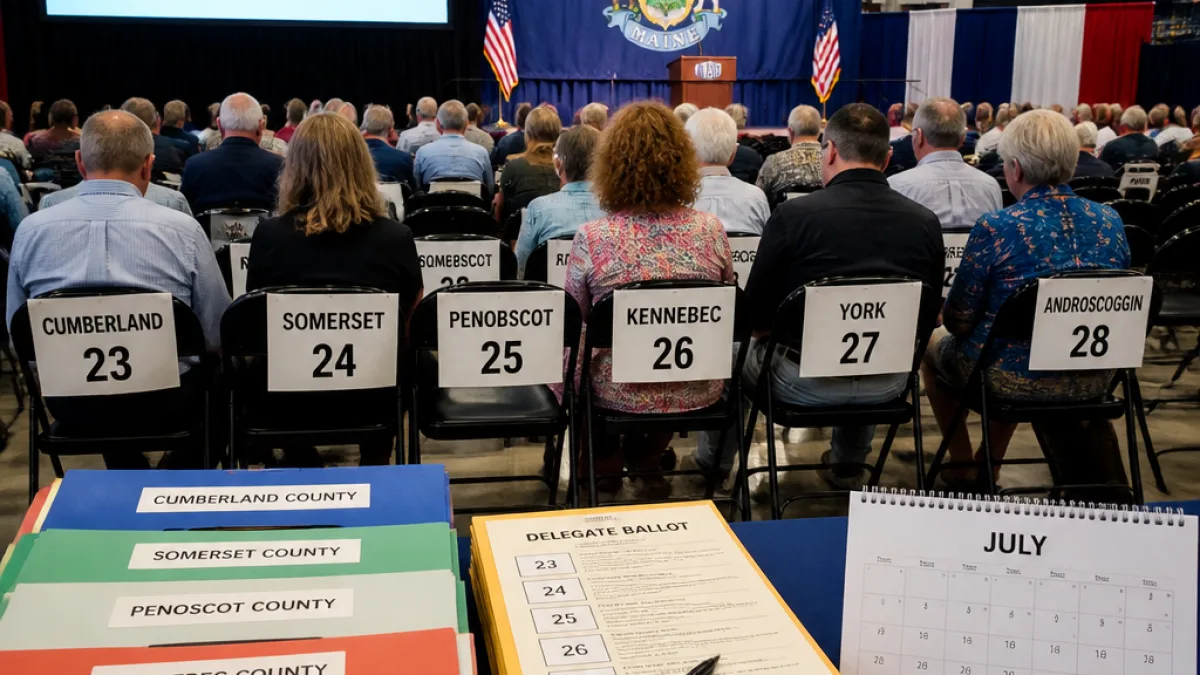
AUGUSTA — Maine Democrats on Friday released formal rules that will determine who replaces Graham Platner on the November ballot, setting a one-day convention for Saturday, July 25 at the Cross Insurance Center in Bangor.
Key dates and the path to Bangor
The state committee’s rules establish a compressed timeline for candidates and local party organizers: candidates must file with the party chair and submit necessary paperwork by 5 p.m. on July 15. Prospective county delegates must declare by the same date as local caucuses and delegate selection meetings are expected to follow that weekend.
Of the 601 total votes that will be cast at the convention, 500 belong to delegates chosen locally by county committees; the remaining 101 are allocated to members of the party’s state committee and executive committee. Delegates are formally unpledged and may vote for any candidate at the convention regardless of local preferences.
County weight and delegate distribution
The rules mirror the party’s usual proportional delegation process, which magnifies the influence of more populous counties. That means county-level organizing will be decisive in a short timeframe.
- Local county meetings must elect a large share of the convention’s delegates, with some counties choosing many delegates in a single meeting.
- Campaigns are already working to influence who gets chosen as local delegates — a move that could shape outcomes long before the convention floor votes begin.
- The party will use an elimination-round method at the convention rather than a single ballot or ranked-choice system to determine the nominee.
| Item | Number |
|---|---|
| Total convention votes | 601 |
| County-selected delegate votes | 500 |
| State committee & executive committee votes | 101 |
| Example: Cumberland County delegates | 149 |
| Example: York County delegates | 84 |
| Example: Penobscot County delegates | 44 |
| Example: Piscataquis County delegates | 4 |
What this means locally
The compressed schedule places pressure on county Democratic committees to organize delegate selection meetings rapidly and on prospective candidates to collect signatures and build grassroots support in under two weeks. Because delegates are unpledged, campaigns that can mobilize at the county level may sway the convention through successive elimination rounds rather than rely solely on broad, statewide name recognition.
For voters and activists in communities across Maine, the process elevates the importance of attending local caucuses and participating in county committee meetings this month. The party’s decision concentrates the decision-making power into a single day in Bangor, making local turnout and organization the decisive factor in who will challenge U.S. Sen. Susan Collins in November.
More details about candidate filing and local caucus schedules are controlled by the state party; prospective candidates and delegates must meet the July 15 filing deadline to participate in the July 25 convention.
— Fiona Merrill, News Block