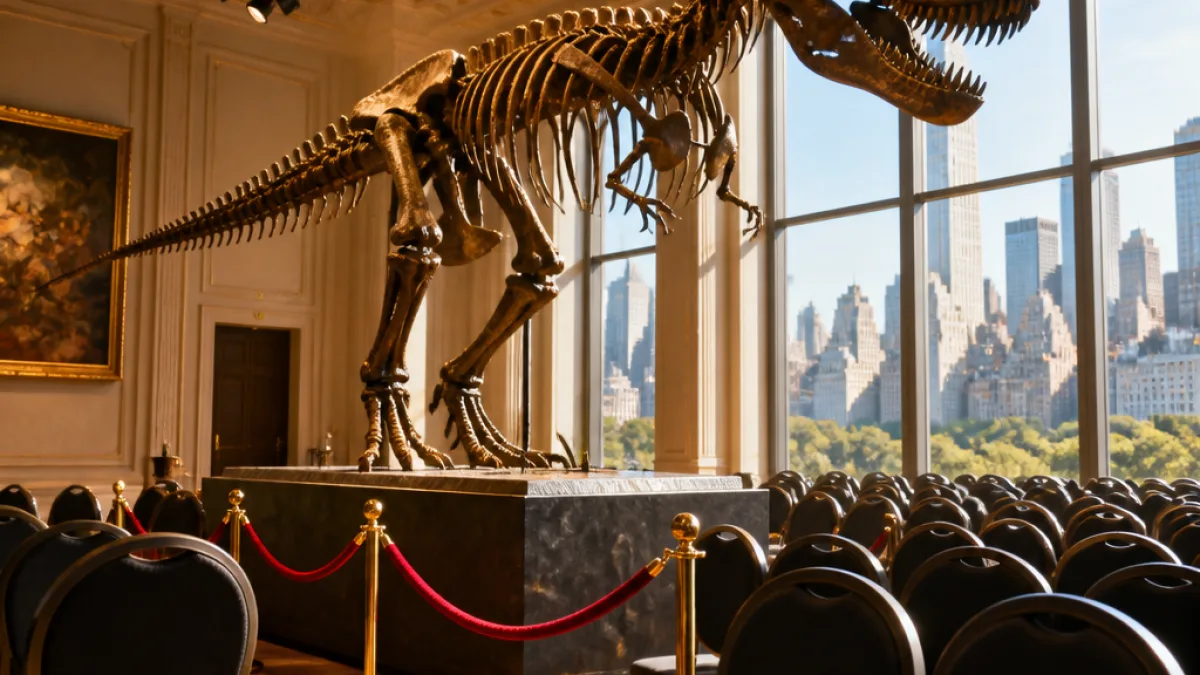
The Tyrannosaurus rex skeleton nicknamed “Gus” is set to be sold at auction in New York this week, with Sotheby’s listing a $19 million starting bid and estimating a final price in the range of $20 million to $30 million. The sale brings a rare paleontological specimen to the city’s auction block and raises questions about access to scientifically important fossils.
Discovery and composition
Sotheby’s says the skeleton was recovered from private land in Harding County, South Dakota, beginning in 2021. Excavators from Theropoda Expeditions collected nearly 1,000 individual pieces through a dig that continued into 2023. The assembled skeleton measures about 38 feet long and stands roughly 12.5 feet tall.
“Gary had for years roamed around his 6,500 acre property and seeing T. rex teeth and little bits of fossils and such, and he realized that there was probably something really important under the ground,” said Cassandra Hatton of Sotheby’s in a video describing the find.
Age, completeness and provenance
Sotheby’s dates the animal to the late Cretaceous, about 67 million years ago. The auction house describes Gus as one of the largest and most complete T. rex specimens discovered, and it attributes the specimen’s nickname to the ranch owner, Gary “Gus” Licking, who died during the excavation process and did not see the fully assembled skeleton.
How this sale fits a broader trend
Auction sales of dinosaur remains are uncommon but not unprecedented. Notable past auctions include:
- The 1997 sale of the T. rex known as Sue, which fetched $8.4 million and was acquired by groups that placed it at Chicago’s Field Museum.
- The 2024 sale of Apex, a stegosaurus that sold for $44.6 million, the highest public price recorded for a dinosaur fossil to date.
Practical questions for museums, collectors and the public
The presence of Gus at a major New York auction highlights several practical matters for local institutions and visitors:
- Institutions considering acquisition will need to weigh scientific value against purchase and conservation costs.
- Private buyers may place the specimen in a collection with limited public access.
- The sale underscores the role of provenance and landowner permissions when fossils are excavated from private property.
| Item | Detail |
|---|---|
| Starting bid | $19,000,000 |
| Estimated sale price | $20,000,000–$30,000,000 |
| Length / Height | 38 feet / 12.5 feet |
| Geologic age | ~67 million years (Late Cretaceous) |
The auction will take place at Sotheby’s New York office. As with past high-profile fossil sales, the outcome could influence how scientific specimens are dispersed between public institutions and private hands. Scientists, museum officials and the public will be watching whether a buyer keeps the skeleton accessible for research and display.
Reporting from New York City.