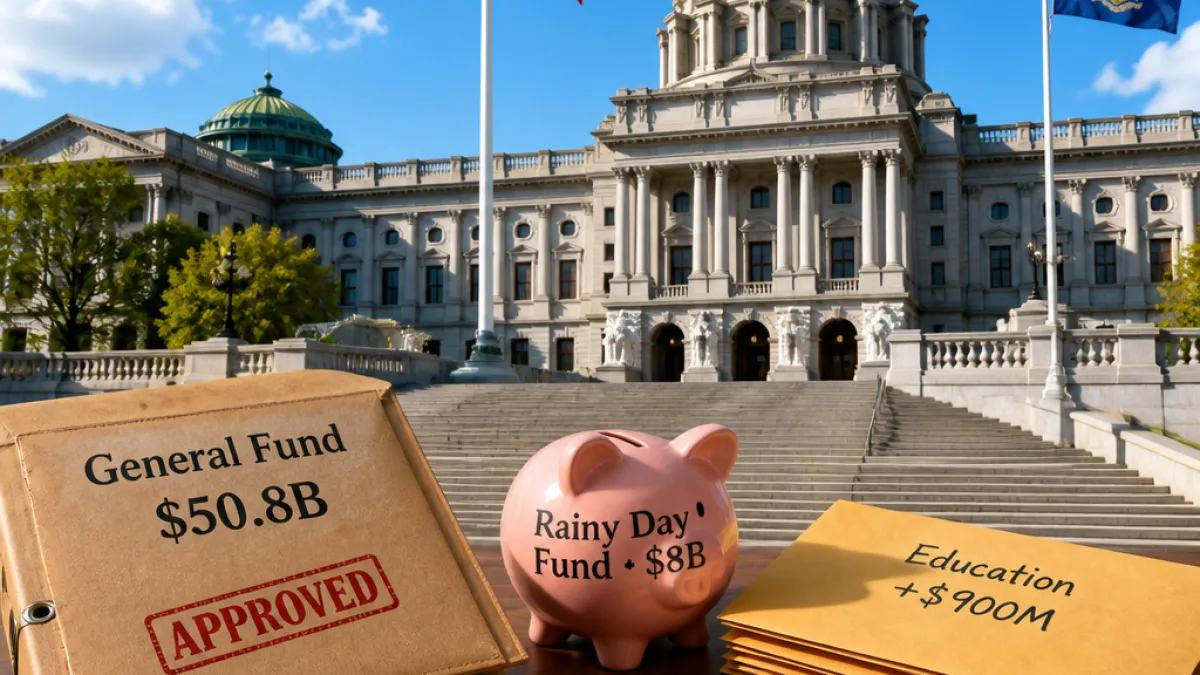
HARRISBURG — Gov. Josh Shapiro on Sunday signed a $50.8 billion general fund budget that directs substantial new dollars to schools, provides pension adjustments for many retirees and keeps the Commonwealth’s nearly $8 billion rainy day fund intact — while sidestepping several contentious policy debates.
Key provisions and how the state balanced the books
The spending plan, finalized after closed-door negotiations and late committee action on a rare weekend session, will channel more than $900 million to education and include a pension increase for thousands of retired school, state and emergency response workers, many of whom retired before 2001. The measure also requires data centers to report annual energy and water consumption to state officials.
| Item | Detail |
|---|---|
| Overall size | $50.8 billion |
| Education increase | More than $900 million |
| Rainy day fund | Nearly $8 billion preserved |
| Accounting moves | Transfers from special funds, agency balances, delayed payments |
Republican leaders emphasized the importance of maintaining reserves. To preserve the rainy day fund, the budget pulls more than $500 million from off-budget special funds, taps unused agency bank accounts and delays about $1.3 billion in payments to Pennsylvania’s Medicaid managed care organizations, according to legislative summaries released as the bills advanced.
“This budget allows the commonwealth to fight yet another day,”
Senate Appropriations Chair Scott Martin, R-Lancaster, said on the Senate floor prior to a 44-6 vote that sent the main spending bill to the House. The House gave final approval later Sunday by a 167-35 margin.
What lawmakers say and what it means for Pennsylvanians
Supporters from both parties framed the package as a compromise necessary in a divided government. House Appropriations Chair Jordan Harris, D-Philadelphia, told reporters after a committee vote that the plan would ensure Medicaid enrollees continue to receive health care services, saying, in effect, that timing adjustments would not interrupt coverage.
- The budget increases basic and special education aid to target lower-funded districts.
- Pension offsets will affect retirees who left service before 2001.
- Nonbudget policy items such as regulation of skill games were not resolved in this deal.
For counties and school districts, the package’s education boost and targeted grants could ease local budget pressure and influence how districts plan for the coming school year. At the state level, leaving the rainy day fund largely intact signals a priority on financial stability even as lawmakers rely on one-time accounting moves to square the books — a choice that could shape next year’s budget negotiations.
Lawmakers advanced the bills amid criticism that the process was opaque: negotiators worked out the agreement behind closed doors and details remained in flux until committees cleared the measures late Saturday. The full legislature acted almost two weeks after the June 30 statutory deadline, extending uncertainty for agencies and local governments that depend on state appropriations.
Shapiro and legislative leaders pitched the budget as both protective of taxpayers and responsive to core needs. Still, by postponing difficult policy decisions — and by using transfers and delayed payments to balance accounts — the plan leaves unresolved questions for the next fiscal cycle about revenue, spending priorities and how to address policies left out of this agreement.
Residents and local officials seeking specifics about how the budget affects their school district or county should consult state appropriations notices and contact lawmakers’ local offices for detailed allocations and implementation timetables.
Maya Kaplan is the Pennsylvania correspondent for News Block.