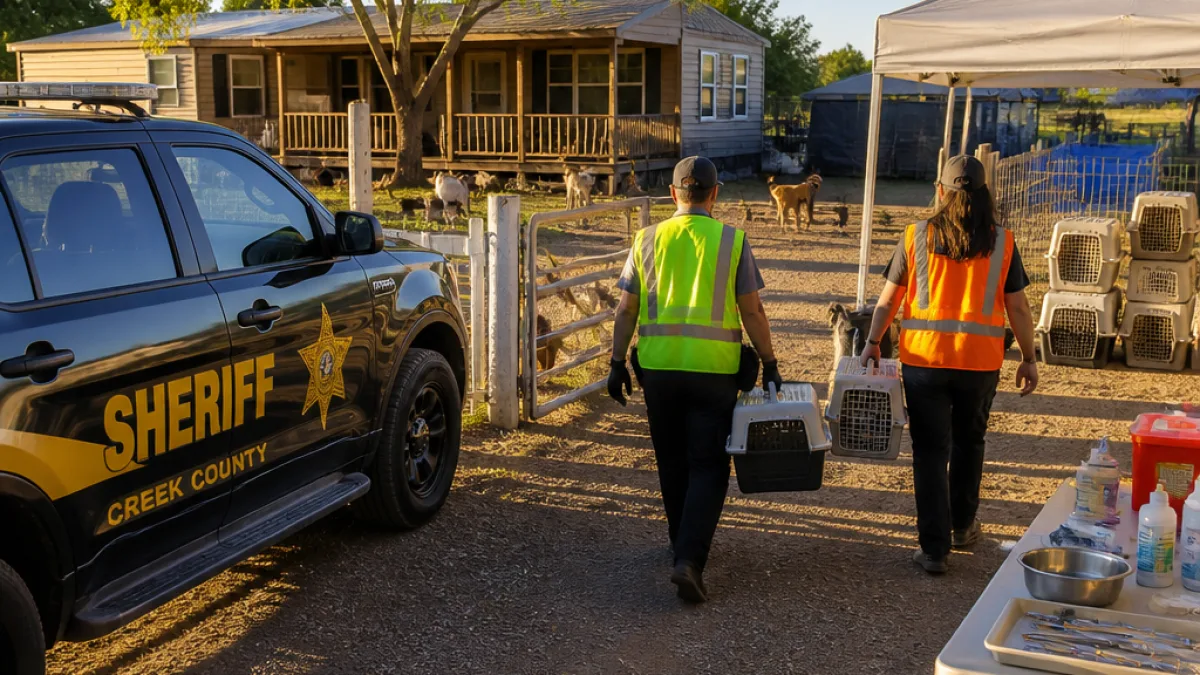
CREEK COUNTY — The Oklahoma Alliance for Animals has begun a coordinated response with the Creek County Sheriff’s Office to address what rescue leaders estimate could be more than 100 dogs living on a single property near Depew.
Rescue steps in after initial concerns
The situation first drew attention in June after another local rescue raised alarms about the number and care of dogs on the property. The sheriff’s office determined the animals currently have access to food, water and shelter and that many appear to be in adequate condition, so the case does not meet the legal threshold for seizure, the rescue said.
Under an agreement with the property owner, the Oklahoma Alliance for Animals (OAA) has begun a phased plan to reduce the population growth and care for animals that need attention. The nonprofit said it removed 10 dogs initially — those in need of medical care or too young to safely endure the current summer heat outdoors.
“We know some people will feel this isn’t happening fast enough. We understand that. But meaningful, lasting change often comes through cooperation and that's exactly what we have here. One thing that stood out to us today was the relationship between the owner and these dogs. Every single one was called by name and they responded with wagging tails and excitement. They are loved. The problem here has never been a lack of love...It has been a lack of res”
The rescue highlighted that the core problem is a lack of spay and neuter practices: many of the dogs are intact, allowing the population to expand rapidly. OAA’s plan prioritizes sterilization of females first, followed by males, and identifies adoptable animals for rehoming when the owner agrees to relinquish them.
What the plan includes
- Immediate removal of dogs needing medical care or those too young for outdoor survival in summer conditions.
- Spay operations for every female dog on the property, then neutering of males.
- Evaluation for adoption of animals the owner chooses to surrender.
- Keeping older, long-term pets on the property when they are bonded with the family or are not adoptable due to semi-feral behavior.
OAA said some residents and animal advocates have expressed frustration at the pace of change. The rescue responded that working cooperatively with the owner and authorities offers a route to sustainable improvement, rather than a one-time removal that might not solve the breeding issue.
| Phase | Action | Immediate goal |
|---|---|---|
| Phase 1 | Remove dogs needing care; relocate very young pups | Protect vulnerable animals from heat and illness |
| Phase 2 | Spay females | Stop further litters |
| Phase 3 | Neuter males; place adoptable dogs | Reduce population and find homes |
The rescue noted that several dogs will remain on the property: older animals that have lived there for years and some semi-feral dogs that are not suitable for adoption. Officials emphasized the animals appear to be loved and named individually by the owner, which shaped the decision to pursue a cooperative solution.
For Creek County residents who wish to help or report concerns about animal welfare, local rescues recommend contacting county animal control or the Creek County Sheriff’s Office to ensure assessments align with legal standards and veterinary guidance. Spay-neuter programs and community vaccination clinics remain key tools in preventing similar situations from developing in rural areas.
The Oklahoma Alliance for Animals continues to coordinate care on the property and will provide updates as they proceed with sterilizations and placements, according to the rescue.