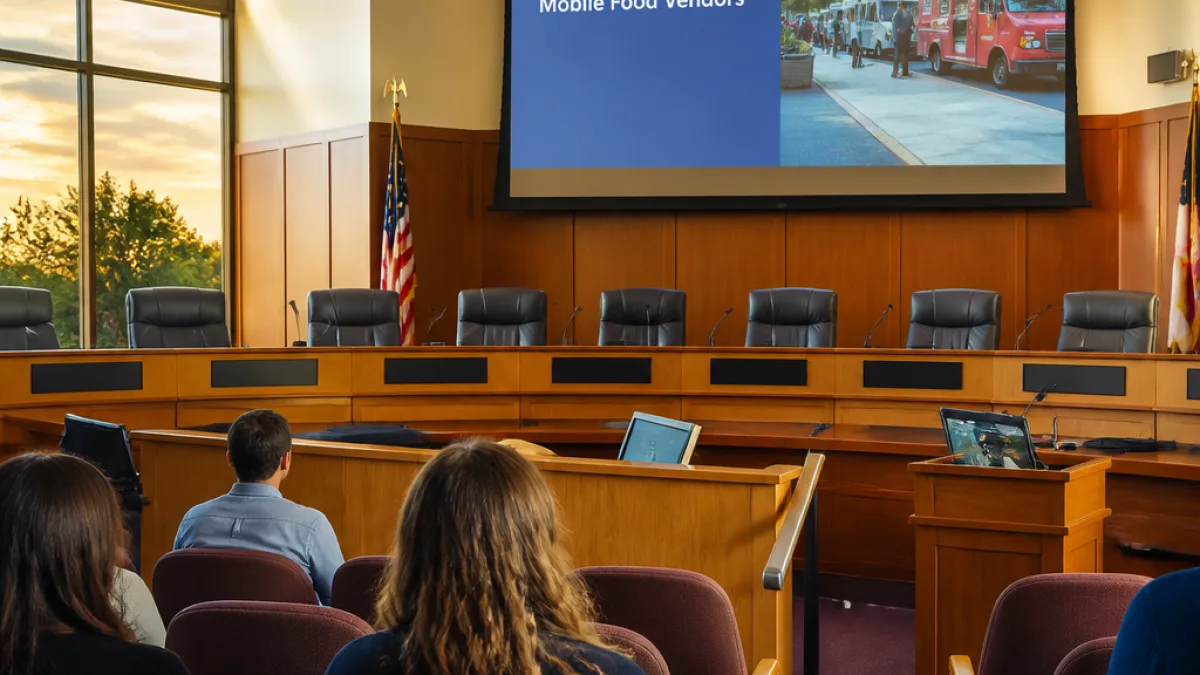
The Santa Rosa City Council has approved a study session to examine how the city regulates unpermitted street food vendors, a move prompted by concerns about grease disposal and broader questions about enforcement authority under state law.
What this means for residents and vendors
Council members said the review will help clarify what the city can and cannot require when dealing with mobile food vendors, including the balance between public health protections and the rights of entrepreneurs who operate food trucks and sidewalk stands in neighborhoods such as Roseland.
Planning and Economic Development Director Gabe Osburn told the council that recent changes in state law have limited local government powers over mobile vending. "State law has provided allowances over the years," Osburn said. "There's been two pieces of legislation that have really went after local jurisdictions for heavily enforcing on mobile food vending."
"The purpose of bringing this item forward was really to get a better understanding of the limitations and obstacles that code enforcement does face," Council Member Eddie Alvarez said, adding the goal of supporting entrepreneurs and generating tax revenue.
Scope of the upcoming review
The study session will convene city staff alongside representatives from Sonoma County Health and law enforcement. Officials said they will review existing city, county and state regulations to determine whether new local rules are both necessary and feasible.
- Primary concerns prompting the review: grease disposal and public health risks
- Geographic focus: neighborhoods with dense vendor activity, including Roseland
- Participants: city planning and code enforcement, county public health, law enforcement
Local context and next steps
California legalized sidewalk vending in 2018 and later decriminalized many vending violations, shifting enforcement from criminal penalties to public health oversight. That legal framework constrains how aggressively cities can regulate mobile food vending, officials said.
Council members unanimously approved the study session after Alvarez requested the discussion. He emphasized support for vendors who follow rules while addressing the challenges code enforcement faces when dealing with unpermitted operations.
| Stakeholder | Role in review |
|---|---|
| City Planning & Economic Development | Lead coordinator; assess ordinance possibilities |
| Sonoma County Health | Advise on health and safety standards |
| Law enforcement | Provide enforcement perspective and limitations |
The session is intended to help city officials understand the legal limits and practical obstacles to enforcement before deciding whether to draft new local rules. Any further action by the council would come after those findings are presented.