
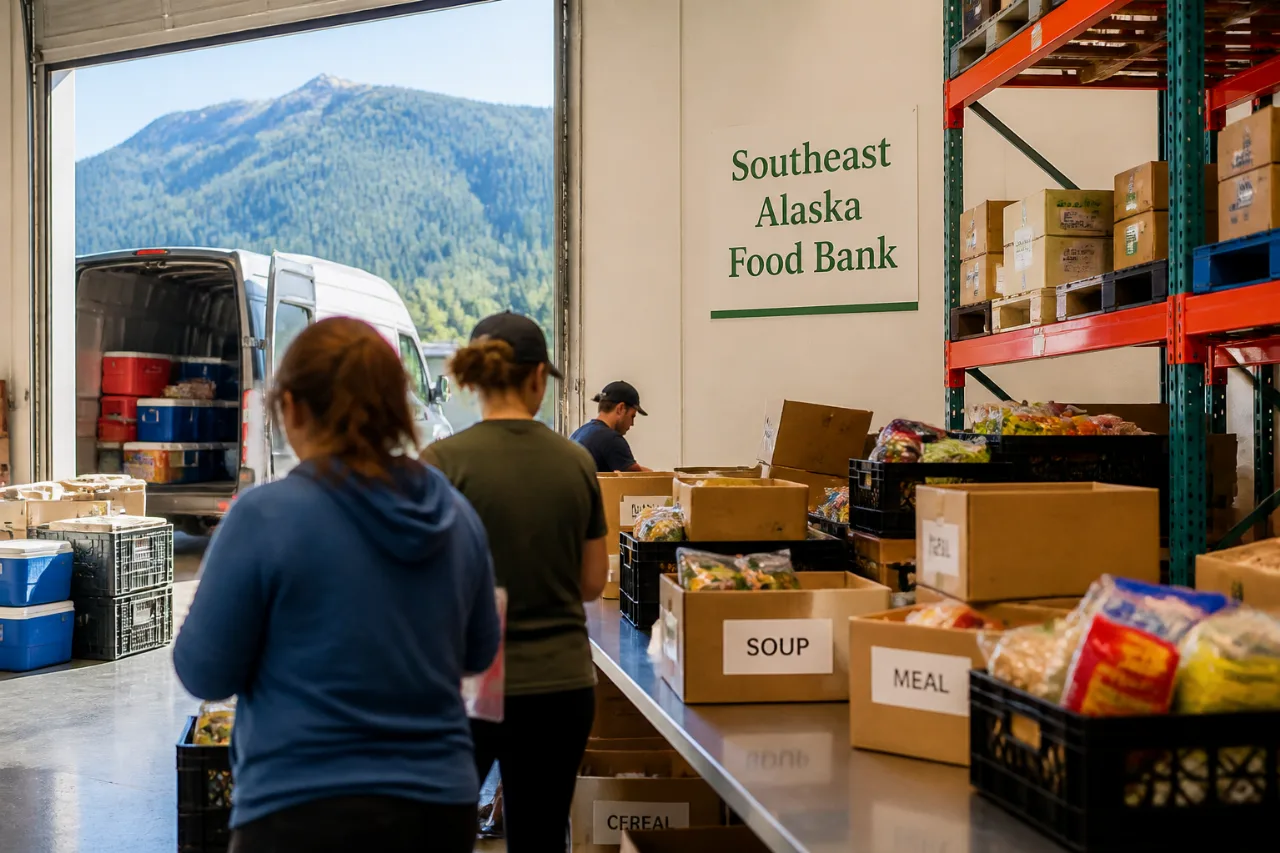
Food bank expands reach across Southeast communities
The Southeast Alaska Food Bank in Juneau distributes food to approximately 40 member agencies across the region and runs a weekly public pantry that is open to anyone, its executive director told KTOO in a recent interview.
Dan Parks, who leads the organization, described a dual model: the food bank supplies partner organizations such as shelters, housing programs and community nonprofits, and it also operates a direct-access pantry for individuals and families in need.
"It's not so straightforward," Parks said of who can access food through the bank and its partners.
The food bank makes deliveries Monday through Thursday throughout the week to its network of member agencies. The weekly public pantry is held every Thursday from 3 to 5:30 p.m. and requires no questions or qualifications to receive assistance, Parks said.
- Member agencies receive redistributed food and then serve their target populations (for example: shelters, mental health organizations, housing programs and churches).
- Public pantry is open to anyone — no paperwork or eligibility checks — and operates weekly.
- Distribution schedule runs Monday through Thursday to agencies, with the public pantry on Thursdays.
Parks recounted his path to the role as typical of many nonprofit workers in Juneau: he originally came to the capital as a guide, later worked for Southeastern Alaska Independent Living, and then joined the food bank in a logistics position before taking the helm. The organization’s reliance on partnerships and community distribution networks is central to how it reaches people across Southeast Alaska.
What the operation means for Juneau and the region
By serving member agencies across the region, the food bank amplifies limited resources and helps a range of programs from emergency shelters to long-term housing services respond to local needs. The public pantry offers a low-barrier option for residents facing immediate food insecurity, an important complement to agency-based distribution.
For community members seeking to learn more or to access services, the food bank’s public pantry hours and its role as a distributor to partner agencies are the clearest entry points. Those partner organizations include the Glory Hall, JAMHI, AWARE and Housing First, among others mentioned by Parks during the interview.
| Service | Details |
|---|---|
| Member agencies served | About 40 organizations across Southeast Alaska |
| Public pantry | Thursdays, 3:00–5:30 p.m.; open to anyone |
| Distribution days for agencies | Monday–Thursday each week |
The food bank’s model — combining wholesale redistribution to agencies with a weekly low-barrier pantry — allows it to address both ongoing, programmatic needs and immediate, individual crises. That hybrid approach matters in a region where transportation, housing instability and seasonal employment can all affect food access.
Parks’ account underscores the role of small, locally rooted nonprofits in filling gaps in the social safety net across Alaska’s dispersed communities. For residents seeking to access food or for community members looking to support local efforts, the food bank’s public pantry times and its network of partner agencies provide practical places to start.