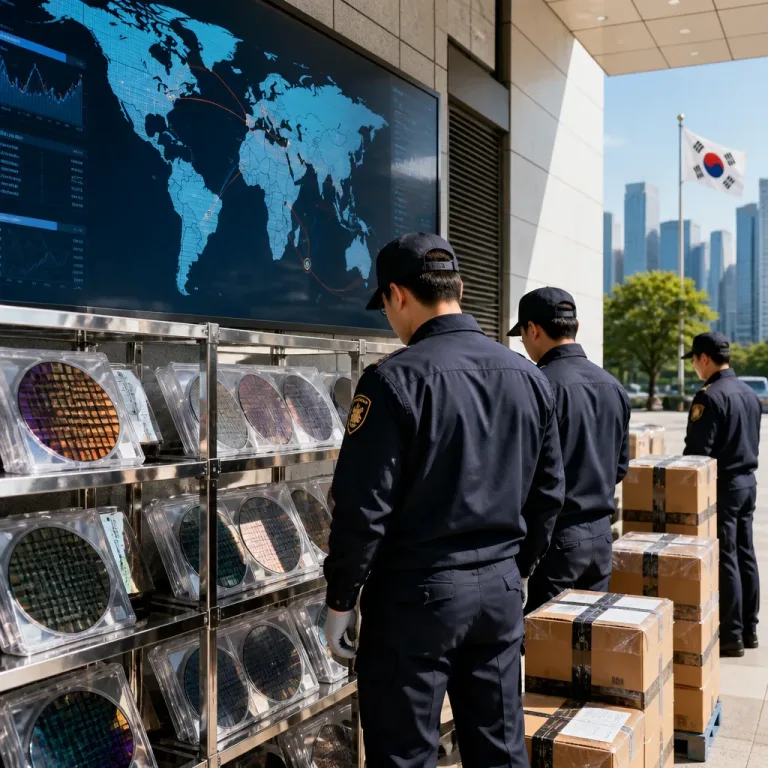

Goldman Sachs published a long-range scenario that envisions 5,288 SpaceX AI missions by 2031, a projection that, if even partly realized, would reshape demand for the most scarce elements of the semiconductor supply chain: high-bandwidth memory (HBM), advanced packaging and leading-edge wafer production.
What the forecast says — in plain terms
The investment bank’s note imagines Starship launches carrying between 30 and 50 AI satellites each, with those satellites forming part of space-based data centers, Starlink services and dedicated AI payloads. The report frames each satellite as containing roughly one rack equivalent of a GB300-class AI system. Because modern AI accelerators rely on multiple HBM stacks — notably eight HBM stacks per Nvidia accelerator in the latest architectures cited — a single launch could demand thousands of HBM stacks before counting conventional DRAM and flash storage.
Why memory, not GPUs, becomes the choke point
Over the past several years chipmakers have invested heavily to expand capacity, but industry observers already saw HBM, packaging and leading-edge production as bottlenecks. The Goldman Sachs scenario intensifies that pressure by multiplying the number of systems that would need advanced memory components. In this framework, memory manufacturers capable of producing leading-edge HBM — the note highlights Micron Technology as one of only three companies in that space — could see demand stretching well beyond the current data-center market.
- Projected missions: 5,288 SpaceX AI missions by 2031
- Satellites per launch: 30–50
- HBM per accelerator: 8 stacks
Industry implications and contradictions
The report’s scale raises immediate logistical and commercial questions. One internal tension the note flags: the long-term cost advantages that underpin its scenario depend in part on SpaceX and Tesla building bespoke chips. If that happens at scale, it could reduce the role of incumbent accelerator makers such as Nvidia, even as demand for HBM surges. In other words, the bottleneck shifts but does not disappear: more custom silicon could lower dependence on certain vendors while increasing stress on memory and packaging vendors.
| Item | Reported figure |
|---|---|
| Projected missions by 2031 | 5,288 |
| Satellites per Starship | 30–50 |
| HBM stacks per accelerator | 8 |
For U.S. technology and semiconductor policy, the scenario matters because memory supply chains are concentrated and capital intensive. Building out HBM production and the complex packaging that integrates memory with accelerators requires sustained investment and time. Even if Goldman Sachs’ launch and in-orbit data-center assumptions prove optimistic, the note underscores how demand for AI infrastructure can migrate and magnify pressure points across different parts of the chip ecosystem.
Investors and policymakers should treat the projection cautiously but cannot ignore its implications: expanding AI beyond terrestrial data centers into space — whether for latency, resilience or other strategic reasons — would not only change where compute sits but would accelerate shortages in the most specialized components of the semiconductor stack.