The Illinois State Board of Education has published a comprehensive guidance document outlining how artificial intelligence tools may be used in classrooms and on school campuses — a response to a law passed by the legislature last year that required the board to provide guardrails for AI in K-12 settings.
What the guidance says
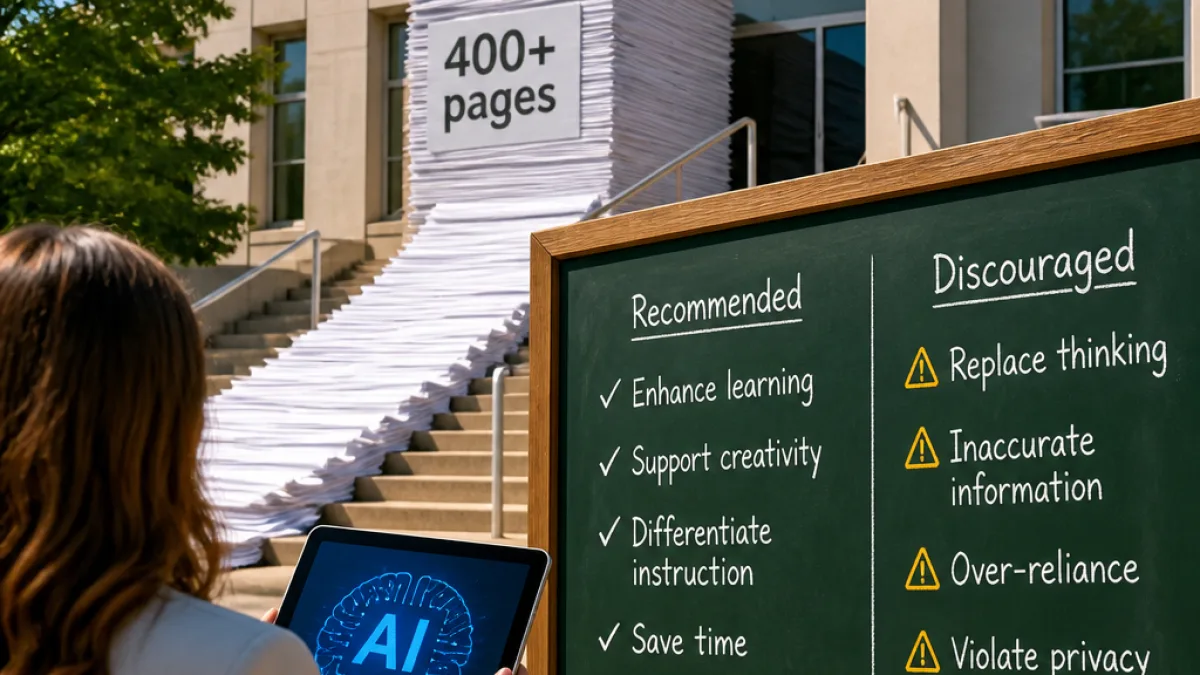
The document, which spans more than 400 pages, gives examples intended to help teachers who want to incorporate AI into lesson planning and instruction, while also flagging specific practices administrators and educators should avoid.
- Purpose: Provide practical examples and approaches for teachers and school administrators to use AI tools responsibly.
- Scope: Classroom instruction and campus use — not a mandate to adopt AI.
- Origin: Released in response to a bill from lawmakers, including State Rep. Laura Faver Dias, D‑Grayslake, who pressed for guidance after hearing concerns from teachers across Illinois.
Examples for educators
The guidance offers concrete illustrations of beneficial uses of AI, such as enhancing instructional materials and increasing student engagement. It also identifies problematic practices. One example cited as inappropriate is using loosely written prompts to generate rubrics and lesson plans without teacher oversight.
| Suggested uses | Examples to avoid |
|---|---|
| Refining instructional materials; supporting engagement | Relying on vague prompts to auto‑produce rubrics and lesson plans |
| Administrative examples included for campus-level policy | Unsupervised classroom use without local guardrails |
Not a mandate, but a resource
Officials emphasized that the state board is not requiring schools to adopt AI tools. Instead, the guidance is intended as a resource administrators and teachers can use to develop local policies and practices that reflect classroom realities and community expectations.
State Rep. Laura Faver Dias urged the board to act after hearing from educators and schools across Illinois. The board’s document responds to that legislative direction by offering practical examples and clarifications to help districts navigate the emerging technology.
Local implications
Districts will now need to review the guidance alongside existing local policies on technology, privacy and curriculum. School leaders deciding whether to incorporate AI into classrooms will have material they can adapt into district policy, professional development and parent communications.
For teachers and administrators, the document provides both tools to consider and specific warning signs to avoid. As districts weigh adoption, schools will also decide whether to require staff training, update acceptable-use policies or set limits on classroom applications.
The State Board’s guidance arrives as schools across Illinois continue to confront how best to balance innovation and student protection. Educators who raised concerns during the legislative process will likely look to the new document as a starting point for conversations about classroom practice and district-level rules.