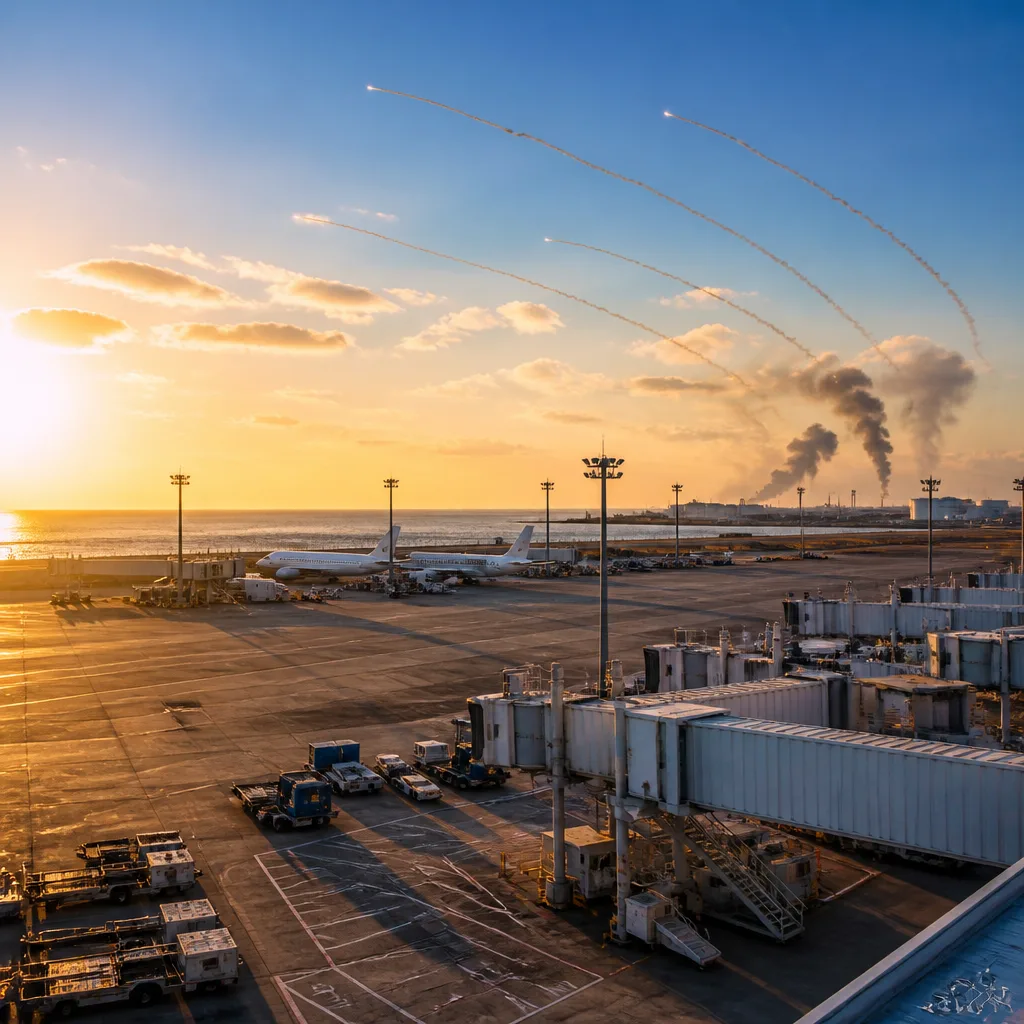
Flights were suspended and civilians ordered to shelter after Iran struck Kuwaiti territory early Saturday following a seventh consecutive night of American strikes on Iranian military and logistical targets.
Regional fallout reaches Kuwait
The assaults prompted Kuwait Airways to temporarily adjust schedules after operations at the country's international airport were halted because of what Kuwaiti authorities described as "hostile missile and drone attacks". Iranian missiles were also reported to have hit an oil facility and a power station in Kuwait, local officials said.
"Due to the regional security situation and to ensure the safety of our passengers and crew," Kuwait Airways said it had rescheduled flights.
Tehran additionally asserted strikes against U.S. military assets in nearby Bahrain, naming damage to aircraft hangars and fuel tanks at the Sheikh Isa Air Base. Bahrain reported it had intercepted and destroyed a number of the incoming aerial threats and warned residents to avoid debris, calling deliberate attacks on civilians and private property a violation of international humanitarian law.
Maritime danger in the Strait of Hormuz
Iran said it had expanded operations to maritime traffic in the Strait of Hormuz, claiming its forces halted four vessels and reporting that two oil tankers caught fire and exploded after transiting what Iranian state media described as a mined route. The U.S. military disputes that account, calling the reports false.
Separately, Iranian officials said roughly 10,000 people were left without water after a U.S. strike damaged a desalination plant in Jask county — an allegation that underscores increasing concerns about harm to civilian infrastructure amid the tit-for-tat strikes.
What happened this week
According to official statements collected during the escalation:
- The U.S. carried out a seventh straight night of strikes on sites Iran characterizes as military and logistical.
- Iran broadened its response beyond Israel, launching missiles and drones toward Gulf countries including Kuwait and Bahrain.
- Air travel in and out of Kuwait was disrupted as authorities prioritized passenger and crew safety.
| Actor | Reported action | Reported effect |
|---|---|---|
| United States | Multiple nighttime strikes on Iranian targets | Damaged Iranian sites; Iran reports civilian infrastructure impacted |
| Iran | Missile and drone strikes into Kuwait; maritime operations in Hormuz | Airport operations suspended; oil facility and power station hit; tankers reported ablaze |
| Kuwait Airways | Rescheduled flights | Operations paused at international airport |
The situation remains fluid and heavily contested: Iranian state accounts of maritime incidents and damage to U.S. bases have been disputed by U.S. military sources, while Gulf governments are racing to assess threats to civilian infrastructure and commerce. International organizations and diplomats have urged restraint, but the recent strikes on bridges, desalination facilities and other nonmilitary targets have raised alarms about the humanitarian and economic consequences if the exchange continues to widen.
For Americans, this escalation carries tangible implications: increased risk to U.S. forces and allies in the region, threats to global energy shipments that pass through the Strait of Hormuz, and potential disruptions to civilian services in affected Gulf states. Policymakers in Washington face pressure to balance force protection and deterrence with the risk that further strikes — particularly ones affecting civilians — could draw the United States deeper into a broader regional conflict.
As officials on both sides release competing accounts, the immediate priorities for the international community will be verifying damage claims, protecting civilian populations, and preventing commercial maritime traffic from becoming further entangled in the hostilities.