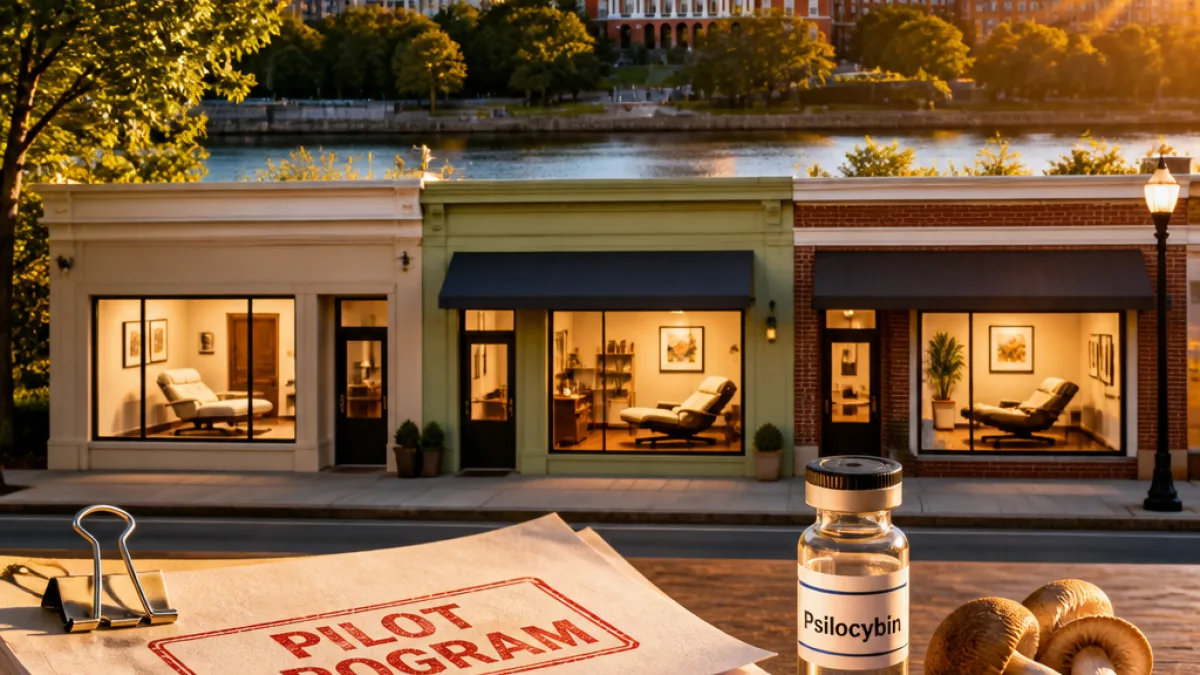
The Massachusetts House of Representatives voted to create a state-sanctioned, five-year pilot program for psychedelic-assisted therapy, inserting the measure as an amendment to an economic development omnibus bill that passed the House by 148–2 on July 8.
What the pilot would do
If enacted, the proposal would require the Department of Public Health to develop and implement a pilot allowing up to three licensed mental health clinics to provide monitored care using naturally occurring psychedelics such as psilocybin. The pilot would be limited to clinical settings and explicitly exclude commercial interests.
- Duration: Five years.
- Authorized sites: Up to three licensed mental health clinics.
- Prohibited participation: subsidiaries, affiliates or members of cannabis organizations, psychedelic molecule development companies, or pharmaceutical companies.
- Conditions tracked: outcomes for depression, anxiety, PTSD and substance use disorder.
Data, oversight and funding
The Department of Public Health would be tasked with drafting regulations for patient assessment and program oversight and coordinating with research institutions to expedite federally authorized research on psychedelic-assisted therapies. Participating clinics would be required to track patient outcomes tied to diagnoses and treatments so the state can refine clinical protocols and finalize regulatory frameworks.
The amendment also establishes a Medical Psychedelics Fund to finance access for people in need, modeled on New Mexico’s psilocybin treatment equity fund, according to the measure.
“There were plenty of skeptics who doubted the Commonwealth was ready to lead on this issue. This vote proves them wrong.”
Why it matters for Massachusetts
Lawmakers framed the pilot as a cautious, clinical pathway to research-informed access for patients with serious mental-health conditions following the 2024 defeat of Question 4, a broader psychedelic legalization and decriminalization ballot initiative. The narrower model aims to produce clinically useful data and guard against commercialization at an early stage.
The decision could shape care options in the state and influence how regulators balance access, safety and industry involvement. Advocates are divided: some say limiting services to a handful of clinics is overly restrictive and creates barriers to access, while others argue the clinical model provides safer, evidence-based care for patients with complex conditions.
| Measure | Detail |
|---|---|
| House vote | 148–2 (July 8) |
| Pilot length | Five years |
| Authorized sites | Up to three licensed clinics |
| Conditions tracked | Depression, anxiety, PTSD, substance use disorder |
For counties across Massachusetts, the pilot’s limitations mean access will initially be concentrated in a small number of clinical sites, likely centered near larger population centers. The Department of Public Health’s rulemaking process and how the Medical Psychedelics Fund is structured will determine whether underserved patients gain meaningful access.
As the bill moves through the legislative process, watch for the final language in the omnibus bill, any changes in the Senate, and the DPH’s timeline for drafting regulations and selecting participating clinics.