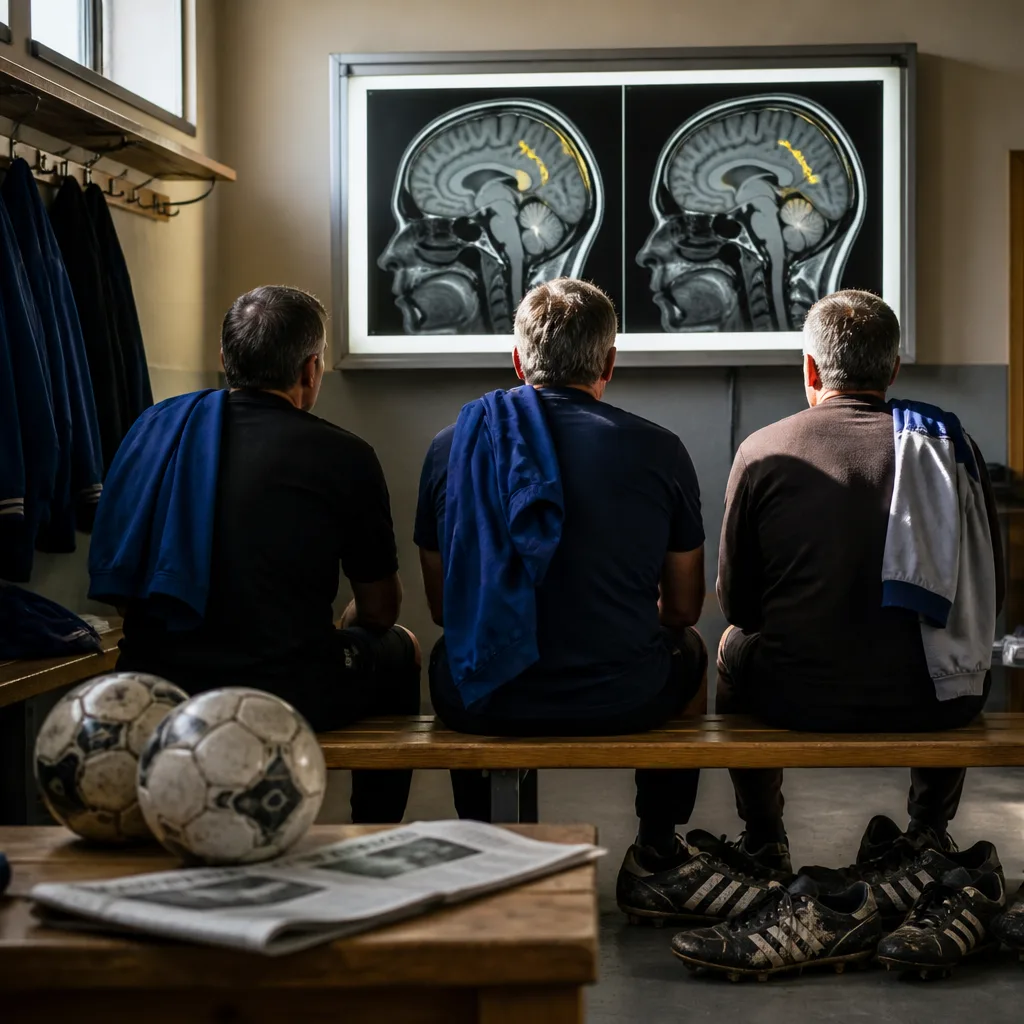
Retired professional soccer players in midlife showed structural brain differences and more self-reported psychological symptoms compared with people who did not play contact sports, according to research presented July 2026 at the Alzheimer’s Association International Conference in London.
Key findings from the study
The research assessed 142 former professional players — 126 men and 16 women aged between 30 and 60 — using questionnaires, clinical measures and brain imaging. Investigators did not find consistent, measurable deficits on routine cognitive tests across the group, but magnetic resonance imaging revealed reduced gray-matter volume in regions linked to memory, attention, decision-making and emotional regulation. Participants who had played professionally also reported higher levels of anxiety and depression and rated their own thinking and decision-making more poorly than comparison participants who had not played contact sports.
“We don’t know if this is something that’s due to playing soccer for a long time and those repetitive head impacts, or is it something that is intrinsically different for people who decide to play soccer professionally and who are good at soccer,”
The comment was made by Caleigh Lynch, a research technician at Imperial College London and the UK Dementia Research Institute Centre for Care Research & Technology, who presented the initial results. The abstract with these findings has not yet been submitted to a peer-reviewed journal, and investigators described the report as an early look at potential associations rather than proof of cause.
What the findings mean and what they do not
The study highlights two important points for clinicians, players and the public:
- Imaging changes can appear before measurable cognitive deficits: Structural differences on scans were present in midlife even when routine cognitive testing did not show widespread impairment.
- Association is not proof of causation: The patterns observed could reflect long-term effects of repetitive head impacts such as heading the ball, or they could relate to other differences between those who become professional players and the general population.
Researchers acknowledged the challenge of establishing direct cause-and-effect for sports-related brain injury. Definitive diagnosis of chronic traumatic encephalopathy (CTE), a condition linked to repeated head impacts, presently requires post-mortem examination to identify abnormal protein deposits and other specific brain pathology.
Study details and limitations
The sample was relatively small and limited to former professionals aged 30–60. Investigators used multiple assessment tools but noted that more work is needed, with larger samples, longitudinal follow-up and peer-reviewed analysis, to determine whether the imaging and symptom patterns predict future clinical decline or are attributable to soccer-specific exposures.
| Measure | Result reported |
|---|---|
| Participants | 142 former professionals (126 men, 16 women), ages 30–60 |
| Cognitive testing | No significant, consistent group-level deficits found |
| Brain imaging | Lower gray-matter volume in regions tied to memory, attention, decision-making, emotional regulation |
| Self-reported symptoms | Higher rates of anxiety, depression and lower self-rated thinking/decision-making |
The authors cautioned that the report is an initial analysis and that the abstract had not yet entered the formal peer-review process. They emphasised the need for careful follow-up work to determine whether the observed differences represent early signs of neurodegeneration or other factors.
Context and consequences
Most research on sports-related brain injury has focused on tackle American football and contact sports such as rugby. This study adds to a growing literature suggesting that repetitive head impacts in soccer may also be associated with brain changes and psychological symptoms earlier in life than previously appreciated. If future research confirms a causal link, the findings could influence coaching, player protection strategies, youth sport policy and clinical monitoring of former players.
The report does not provide treatment recommendations. It does underscore the importance of ongoing research, cautious interpretation of early findings, and transparent communication among athletes, medical professionals and sporting organisations about potential risks associated with repetitive head impacts.
This article summarises initial research findings presented at a scientific meeting. The results are preliminary and have not yet been published in a peer-reviewed journal.