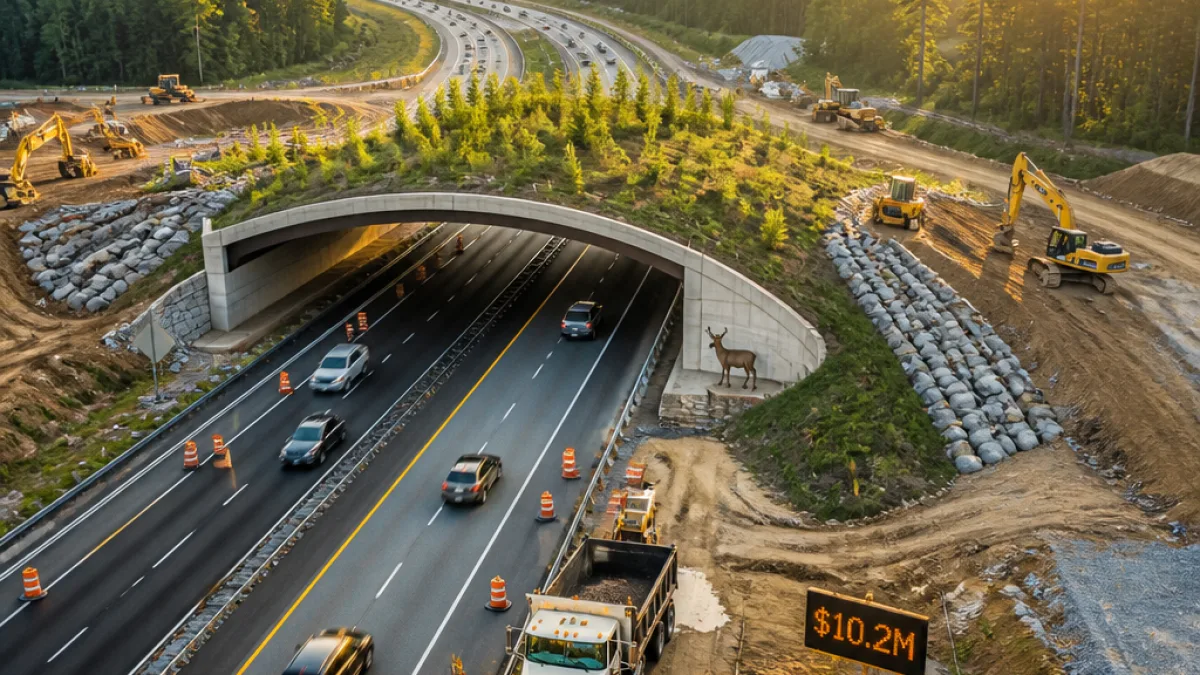
The North Carolina General Assembly’s newly passed budget includes a historic commitment of $10.2 million every two years to build and expand wildlife crossings across the state, officials said.
Why the funding matters
Lawmakers approved the funding after data showed widespread human and animal harm from collisions with wildlife. Between 2022 and 2024, the state recorded roughly 63,000 wildlife-vehicle collisions. Those incidents injured about 2,866 people and resulted in 23 fatalities, according to state reporting cited by transportation and conservation officials.
The new appropriation more than quintuples the initial, smaller effort funded in 2023, when lawmakers set aside $2 million for wildlife-crossing projects. The Department of Transportation will receive the funds and is responsible for planning and constructing the crossings.
"Every project has its own dollar amount," David Uchiyama, an NCDOT spokesperson in western North Carolina, said about how the new money will be assigned.
Scope and examples
Wildlife crossings can vary widely in scale and design. They include small, ground-level structures sized for amphibians and reptiles as well as large vegetated bridges designed for deer, elk and bears. Departments and conservation partners routinely tailor projects to local species and geography.
One example already in use is the Corridor K project in Graham County, where planners created a crossing over NC-143 to help wide-ranging animals move safely through mountain terrain. NCDOT regularly consults with independent groups and the North Carolina Wildlife Resources Commission on project design and location.
- Funding amount: $10.2 million every two years.
- Previous allocation: $2 million in 2023.
- Collision data (2022–2024): ~63,000 incidents; 2,866 injuries; 23 deaths.
How the money will be used
Transportation officials said the new budget lacks a single, statewide spending plan; instead, the NCDOT will apply the funds to independent projects and use them to leverage matching contributions from partners. Smaller installations — such as grated culverts or frog-friendly tunnels — can be funded alongside costly overpasses or long-span bridges in areas with larger mammals.
| Project type | Typical species | Scale |
|---|---|---|
| Grated culverts or tunnels | Salamanders, small amphibians | Low cost, site-specific |
| Underpasses | Foxes, raccoons, coyotes | Moderate cost |
| Vegetated overpasses/bridges | Deer, elk, bears | High cost, large-scale |
Officials say the investment aims to reduce crashes that endanger both motorists and wildlife, improve connectivity for animal populations and cut long-term costs associated with repeated collisions on the state highway system. The NCDOT has not yet released a list of planned projects or a timetable for deployment of the new funds.
As North Carolina confronts growth in roads and vehicle miles traveled, the new funding marks a notable policy shift toward integrating wildlife safety into transportation planning.