
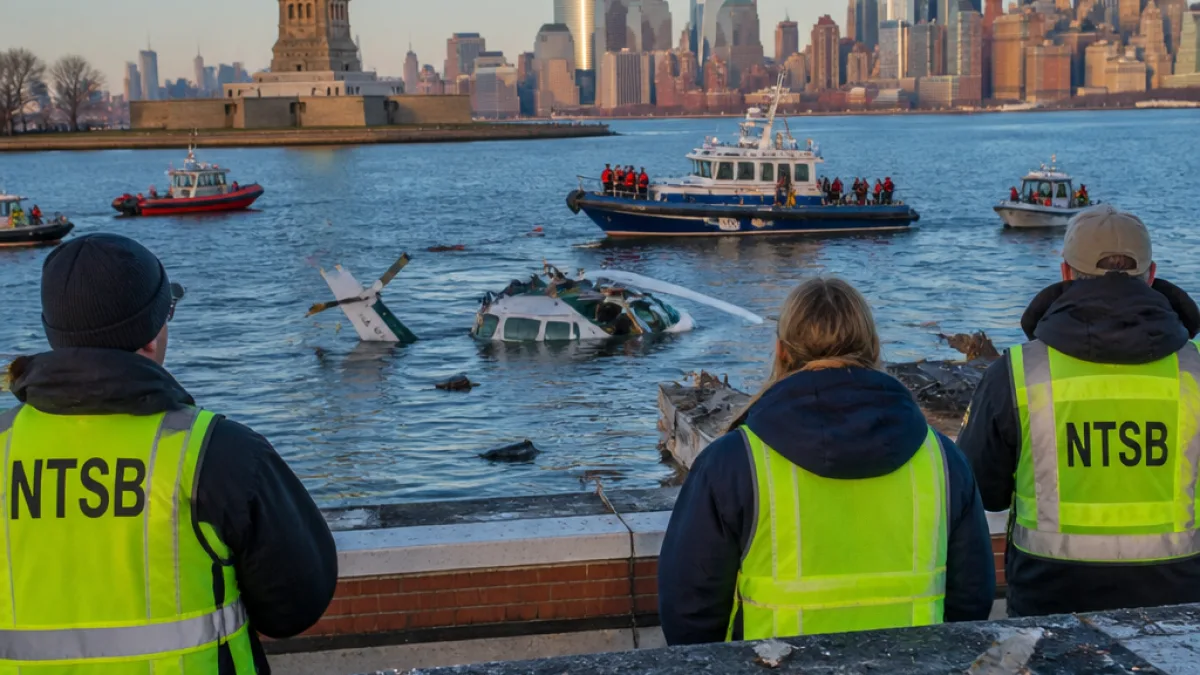
Federal investigators have concluded a bird strike most likely triggered the helicopter crash in the Hudson River that killed six people last April, a finding that underscores risks for low‑altitude sightseeing flights along New York’s waterways.
What the NTSB reported
The National Transportation Safety Board said Thursday that remains of a bird were found in the wreckage of the Bell 206L‑4 that went down on April 10, 2025. The helicopter left lower Manhattan just before 3 p.m. for a tour that passed the Statue of Liberty and followed the Hudson River. The crash occurred about 17 minutes into the flight as the aircraft was returning south along the river near New Jersey.
Investigators recovered pieces of the helicopter’s main rotor blade and a severed bird wing on rooftops and ground locations as far as 2,000 feet from where the main wreckage was recovered. Sampling to identify the avian material was performed by the Smithsonian Institution’s feather identification lab and later confirmed at the NTSB laboratory.
"The geese were big and there were many of them. When the helicopter went bang, I immediately thought it was a bird strike,"
The collision killed a family of five from Spain — including three children — and the pilot. The tour operator, New York Helicopter Charter Inc., suspended operations after the accident.
Local impact and safety questions
The NTSB’s finding raises questions for regulators and operators about risk mitigation measures for helicopter tours that routinely fly at low altitudes over the harbor and river corridors. Bird strikes are a recognized hazard for aircraft; when they involve main rotor components at low altitude, pilots have little time to respond.
- Aircraft: Bell 206L‑4 tour helicopter
- Date of crash: April 10, 2025
- Fatalities: Six (family of five from Spain and the pilot)
- Significant evidence: Rotor blade fragments and a severed bird wing found up to 2,000 feet away
| Event | Date/time |
|---|---|
| Flight departed lower Manhattan | Just before 3 p.m., April 10, 2025 |
| Crash into Hudson River | About 17 minutes into flight |
| NTSB report released | July 16, 2026 |
The NTSB typically issues safety recommendations when investigations identify systemic hazards or mitigation opportunities. In this case, potential measures could include altered flight paths, stricter weather and wildlife advisories, or operational limits during periods of high bird activity. The report did not, however, attach newly proposed rules; it focused on the evidence linking the crash to avian remains and rotor damage.
For residents and visitors who use or live near the harbor, the finding is likely to prompt renewed attention to how sightseeing flights are regulated and insured. For the families of the victims, the report confirms a likely cause but also renews questions about how to reduce similar tragedies.
Investigations like this can take months or years to conclude all causal and contributory factors. The NTSB’s identification of bird remains and rotor damage marks a significant step in the agency’s effort to understand what happened and to recommend ways to prevent comparable accidents.
— Ava Rosenberg, New York Correspondent