
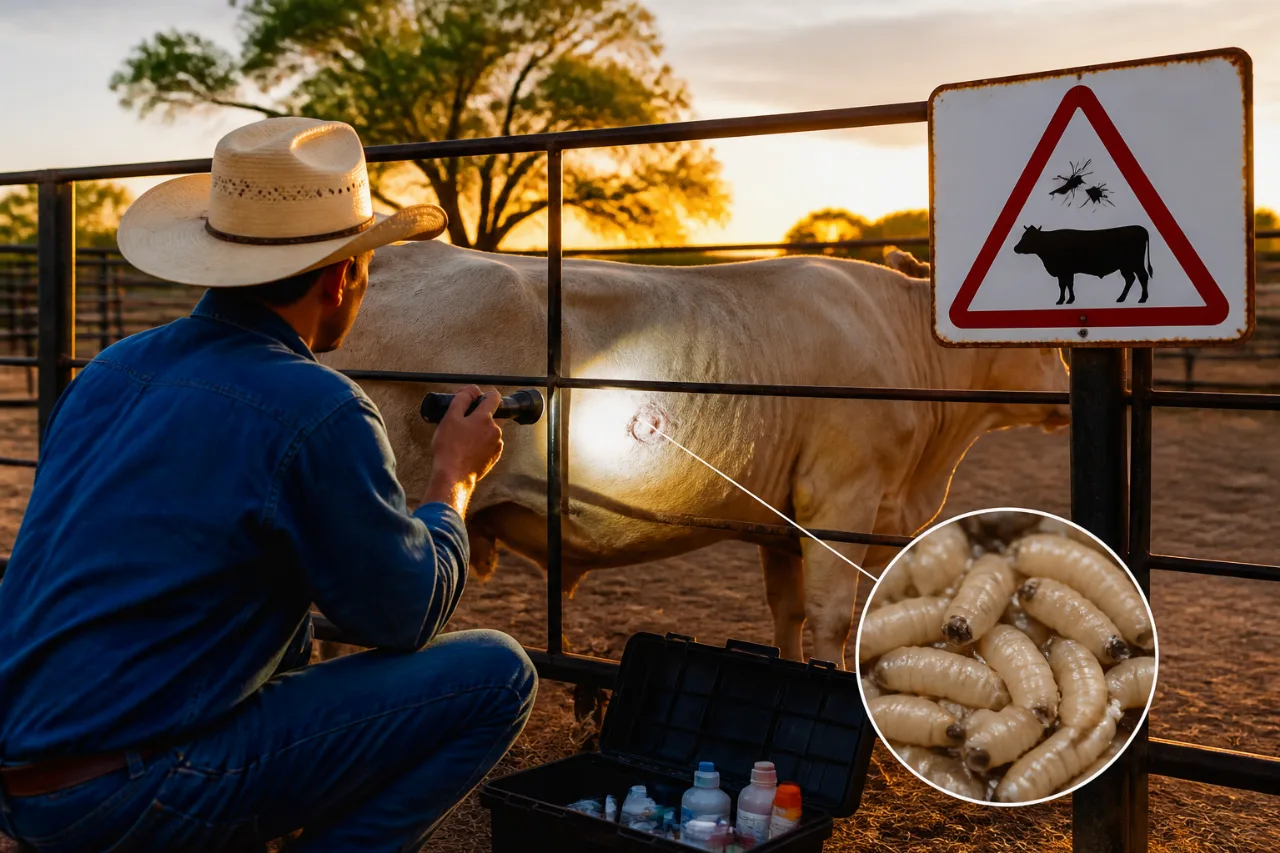
Federal and local animal-health officials say the New World screwworm has re-emerged in the United States, with officials confirming more than 30 infestations in southern and southwestern Texas and southeastern New Mexico. Among those, veterinarians have identified two infections in dogs, prompting renewed warnings for pet owners, farmers and wildlife managers to monitor wounds closely and seek prompt treatment.
What the parasite is and why it matters
The screwworm is not a fly in the ordinary sense: the threat comes from its larvae, which feed on living tissue rather than the dead material favored by most fly maggots. A female fly lays eggs into open wounds or body openings; after hatching, larvae can burrow into flesh and feed for about a week before dropping away to mature into adult flies.
Official concern has focused on cattle because of the potential economic impact to the U.S. beef industry, which officials value at $113 billion. But veterinarians emphasize that the larvae can infest any mammal, including wildlife, cats, dogs and, on rare occasions, people. Newborn animals and those with recent surgery or open wounds are especially vulnerable, according to veterinary guidance.
How to spot an infestation and protect animals
Authorities and shelter veterinarians advise regular, thorough checks for cuts, bite marks and other wounds — even small lesions such as tick bites can become sites for egg-laying. Signs owners should watch for include:
- visible maggots or movement in a wound;
- a foul or putrid odor at a wound site;
- restlessness or anxiety in an animal;
- focused licking, chewing or inspection of a particular area.
“Even a tick bite can host an infestation,” said Aaron Grady, executive director of the Houston Humane Society shelter, during a recent webinar on the screwworm.
Melissa Stansell, a veterinarian with the Austin Pets Alive! shelter, noted that animals may become hyper-fixated on a wounded area. Prompt veterinary assessment is essential if owners suspect infestation; maggots must be removed and wounds treated to stop larvae from continuing to feed.
Geography and surveillance
Public-health responses have focused on the southern border regions where the pest has moved north from Panama in 2024 and advanced through Mexico in 2025. The detections in Texas and New Mexico mark a concerning return to U.S. livestock and companion animals more than a half-century after the species was largely eliminated from the country.
| Region | Confirmed instances |
|---|---|
| Texas and New Mexico | More than 30 (including 2 in dogs) |
Animal-health agencies and humane organizations continue surveillance, outreach and education. For owners in affected areas, the guidance is straightforward: inspect animals frequently, protect and promptly treat wounds, and consult a veterinarian if anything unusual is seen.
This report focuses on observed cases and public advisories; it does not provide medical guidance for individual cases. Anyone concerned about a potential infestation should contact their veterinarian or local animal-health authority for specific instructions.