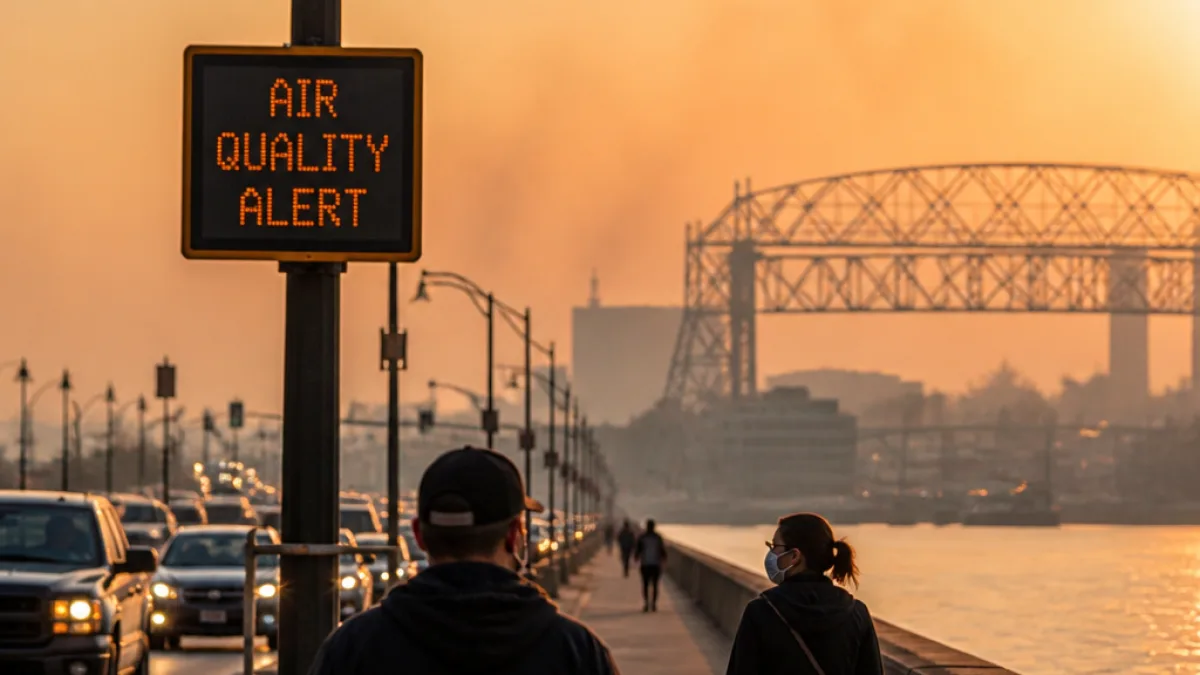
Wildfires burning in northern Minnesota have prompted the Minnesota Pollution Control Agency to issue an air quality alert covering large parts of the state, with northeast Minnesota expected to reach the maroon — hazardous category for air quality.
Scope and timing of the alert
The advisory took effect Tuesday morning and remains in place through 11 a.m. Friday for many communities, the MPCA said. Areas specifically named by the agency include the Twin Cities metro, Brainerd, Alexandria, Hinckley, St. Cloud, Winona, Moorhead, International Falls, Two Harbors, Hibbing, Ely and Duluth, as well as the Tribal Nations of Mille Lacs, Prairie Island, Leech Lake, White Earth, Red Lake, Grand Portage and Fond du Lac.
Health impacts and guidance
The MPCA warned that smoke-driven fine particle pollution can aggravate respiratory and cardiovascular conditions and may cause symptoms even in healthy people. Fine particles can be inhaled deep into the lungs and enter the bloodstream, increasing risk of bronchitis, asthma attacks, heart attacks and strokes.
“The air will seem hazy or smoky and you won’t be able to see long distances. The air will smell strongly of smoke,”
In areas expected to reach the maroon level, including Two Harbors and the Grand Portage Tribal Nation, the agency said the air will be hazardous to everyone and that most people may experience irritated eyes, coughing, chest tightness or shortness of breath. Officials advised avoiding any outdoor activity in those zones.
- Who should take extra precautions: people with heart or lung disease, older adults, children and pregnant people.
- Recommended actions: stay indoors, reduce physical activity, keep indoor air as clean as possible and follow local advisories.
- When to seek care: seek medical attention for severe difficulty breathing, chest pain, fainting or sudden dizziness.
Why the smoke is severe
Officials attribute the poor air to smoke from active fires in northern parts of the state. The MPCA said fine particulate matter from wildfire smoke is the primary concern, and that levels in northeast Minnesota are projected to reach the most dangerous category for air quality.
| Air quality tier | Expected effect |
|---|---|
| Maroon (Hazardous) | Air hazardous for everyone; avoid all outdoor activity |
Local public-health and emergency agencies typically advise limiting outdoor exertion, using properly fitted N95 or equivalent masks if you must be outdoors, and creating cleaner indoor air spaces by keeping windows and doors closed and running air filtration if available. Residents should monitor updates from the MPCA and local health departments for changes in the alert area and duration.
The alert highlights immediate public-health risks across counties and Tribal lands and underscores how wildfire activity in the region can quickly affect communities statewide. Officials urge Minnesotans to take the advisory seriously while smoke persists.