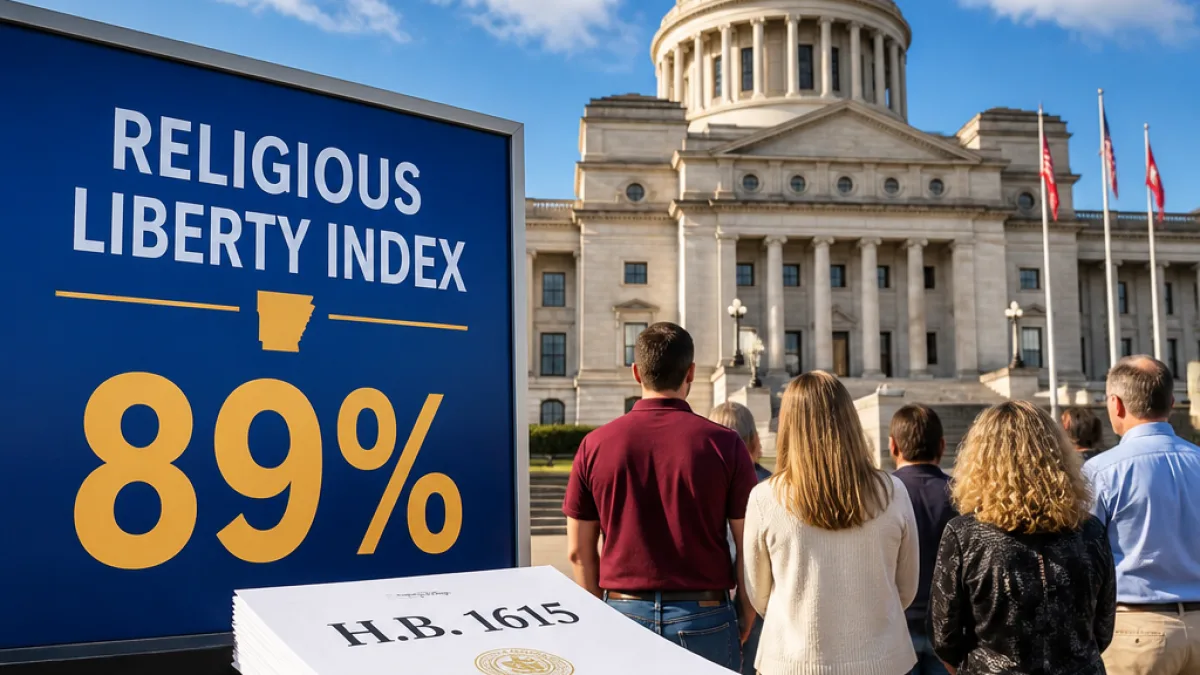
Arkansas leads the nation in legal protections for religious exercise, according to the 2026 edition of the annual Religious Liberty in the States index released by First Liberty Institute. The report assigns states scores based on a slate of statutory and constitutional safeguards, and this year Arkansas earned the top spot with a score of 89%.
How the ranking was determined
The index, prepared by First Liberty’s Center for Religion, Culture and Democracy, tallies 50 legal protections across six policy areas — government, healthcare, economic life, religious life, and family and education — and groups them into 20 measurable safeguards. States receive a percentage score reflecting how many of those protections they have in place.
Arkansas’ score of 89% produced an overall rating the report classifies as “excellent,” one of only two states to reach that threshold in 2026. Tennessee ranked second with a score of 85%. By contrast, New York placed last, protecting just 26% of the measured safeguards — a gap of 63 percentage points between Arkansas and New York.
| State | Index score |
|---|---|
| Arkansas | 89% |
| Tennessee | 85% |
| New York | 26% |
What pushed Arkansas to the top
The report attributes Arkansas’ jump from sixth place in 2025 to first this year largely to the enactment of H.B. 1615, a state law that shields individuals and institutions from being compelled to participate in wedding ceremonies that conflict with their religious beliefs. First Liberty said that change, along with other statutory protections, moved Arkansas into the report’s highest category.
- Score improvement: Arkansas rose from sixth to first in one year.
- Key law: H.B. 1615 cited as a major contributor to the top ranking.
- National context: Only two states reached the report’s “excellent” category in 2026.
The RLS provides a checklist-style assessment of legal safeguards; it does not measure public opinion or religious practice, but rather the presence or absence of specific legal protections. That approach makes the index a tool for lawmakers, attorneys and advocacy groups tracking how state law shapes religious exercise.
For Arkansas, the ranking is likely to feed into ongoing state debates about the balance between anti-discrimination protections and religious exemptions. Supporters of broad religious exemptions argue such laws protect conscience rights for individuals and faith-based organizations. Critics raise concerns that sweeping exemptions can leave other state interests, such as equality and access to services, unprotected.
State officials have highlighted the new ranking as evidence the state is providing robust legal shelter for faith-related conscience claims. Legal observers say the practical effects of the laws will continue to be sorted out in courts as challenged measures are litigated and interpreted.
The First Liberty report is one of several national indexes that attempt to compare state legal environments; methodologies and criteria vary, so rankings should be read alongside other sources for a fuller picture of legal and social climates.
As Arkansas moves forward with its recently enacted measures, the state’s top placement in the 2026 Religious Liberty in the States index will likely shape both political messaging and future legal disputes within the state and beyond.