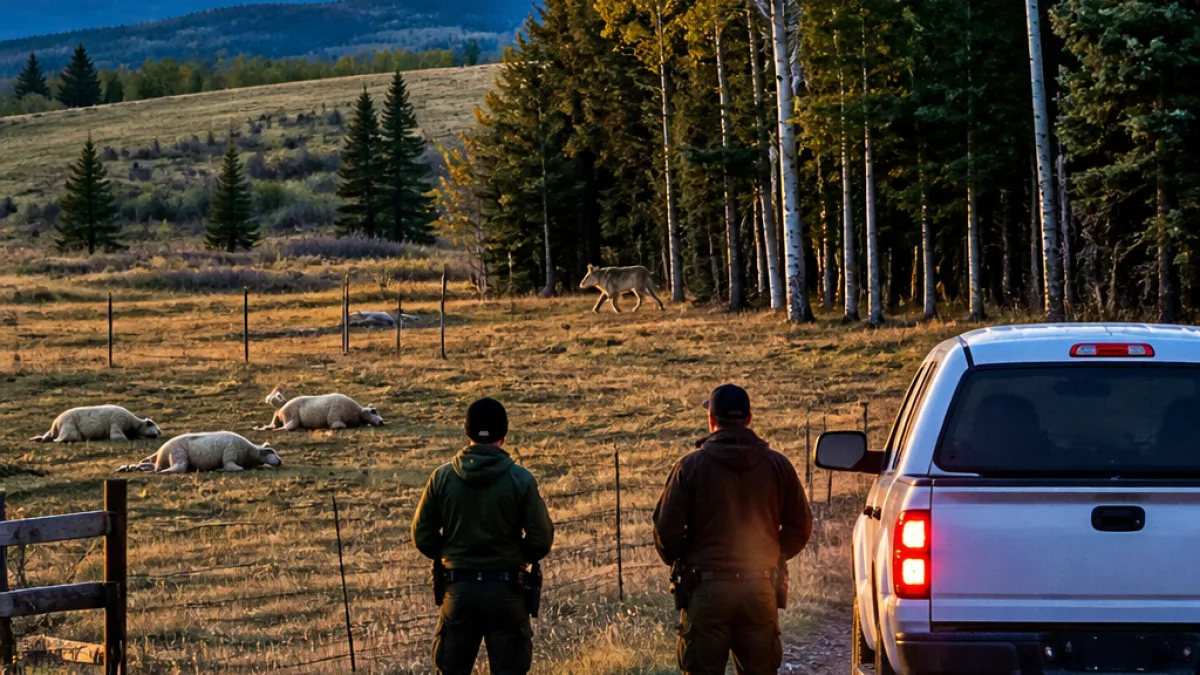
COLORADO — Colorado Parks and Wildlife says a gray wolf shot by state wildlife staff on June 12 in Routt County had a documented history of repeatedly attacking livestock and would likely have continued to do so if not removed.
Agency says nonlethal steps tried before lethal removal
In its report, the agency said the uncollared animal was responsible for at least 22 sheep deaths over the past year, including two separate depredations in the days immediately before state staff found and killed the wolf at the site of its most recent attack. Colorado Parks and Wildlife (CPW) said staff had been tracking the animal since last year and at one point believed they had shot it; the animal, however, survived and later disappeared.
CPW Director Laura Clellan said the decision to use lethal force was difficult but justified by the wolf’s repeated history of depredation and the consultations the agency undertook with the livestock producer. The report states that the producer had implemented nonlethal conflict-reduction steps identified during on-site assessments by CPW field staff, and that no obvious attractants would have drawn the wolf to the area of its latest depredation.
“The decision to pursue lethal actions is never an easy one, but the circumstances around this wolf’s repeated depredation history made this a difficult but necessary decision.” — Colorado Parks and Wildlife Director Laura Clellan
CPW said it consulted with the U.S. Fish and Wildlife Service and determined that lethal removal in this instance was appropriate and lawful under the circumstances. The agency attempted to take the animal the night before June 12 but said officers could not get a clear shot until the following day.
Context and statewide implications
The wolf was one of more than a dozen gray wolves that have died in Colorado in the past two years, a number that reflects the growing complexity of managing a recovering predator population alongside working ranches. Gov. Jared Polis said the animal had multiple opportunities to avoid further conflict but chose to continue depredating, making the removal necessary.
“This elusive wolf had a number of chances but sadly chose to continue to depredate, which necessitated this challenging management decision,” Gov. Jared Polis said.
State officials emphasized that nonlethal tools remain the priority for conflict mitigation even as they carry out targeted lethal removals in limited circumstances. The CPW report notes that staff and producers worked to deploy all ‘‘viable and reasonable’’ nonlethal techniques identified through site assessment and consultation.
- Date of removal: June 12 (Routt County)
- Confirmed livestock losses: At least 22 sheep over the past year
- Collar status: Uncollared wolf
For ranchers and communities near wolf recovery areas, the episode underlines the continuing challenge of balancing a restored native predator with the protection of domestic animals. CPW’s report reiterates that each incident is investigated and handled individually, with lethal action considered only after other options have been evaluated.
What this means locally
Routt County ranchers, wildlife managers and conservationists are watching how the state’s wolf program addresses recurring depredations. The removal in this case followed a documented pattern of repeated attacks on a single operation, prompting state staff to act after a period of monitoring and consultation with federal authorities.
| Item | Detail |
|---|---|
| County | Routt County |
| Confirmed depredations | At least 22 sheep in past year |
| Removed | Shot by CPW staff on June 12 |
Colorado’s wolf recovery remains a developing policy issue: state officials say they are committed to maintaining a viable, self-sustaining wolf population while working to minimize conflicts with domestic animals, using nonlethal methods as a first priority. At the same time, the state must respond when individual animals persistently threaten livestock.
As the state continues to track wolf activity and update its management strategies, producers in affected areas should maintain communication with CPW field staff about available nonlethal deterrents and compensation processes for verified losses.
— Reporting by Ethan Maxwell, Colorado correspondent at News Block.