CHARLESTON, S.C. — The death of U.S. Sen. Lindsey Graham has set in motion a rapid, legally framed process that will determine who represents South Carolina in the U.S. Senate for the remainder of the term and on the ballot this fall.
What changes for voters and officials
Under state law, Gov. Henry McMaster must appoint a temporary successor to serve through January. Separately, South Carolina will hold a special Republican primary to choose the party’s nominee for the Nov. 3 general election. Those dual tracks — an interim gubernatorial appointment and a compressed nominating calendar — create both political competition and logistical challenges for election officials.
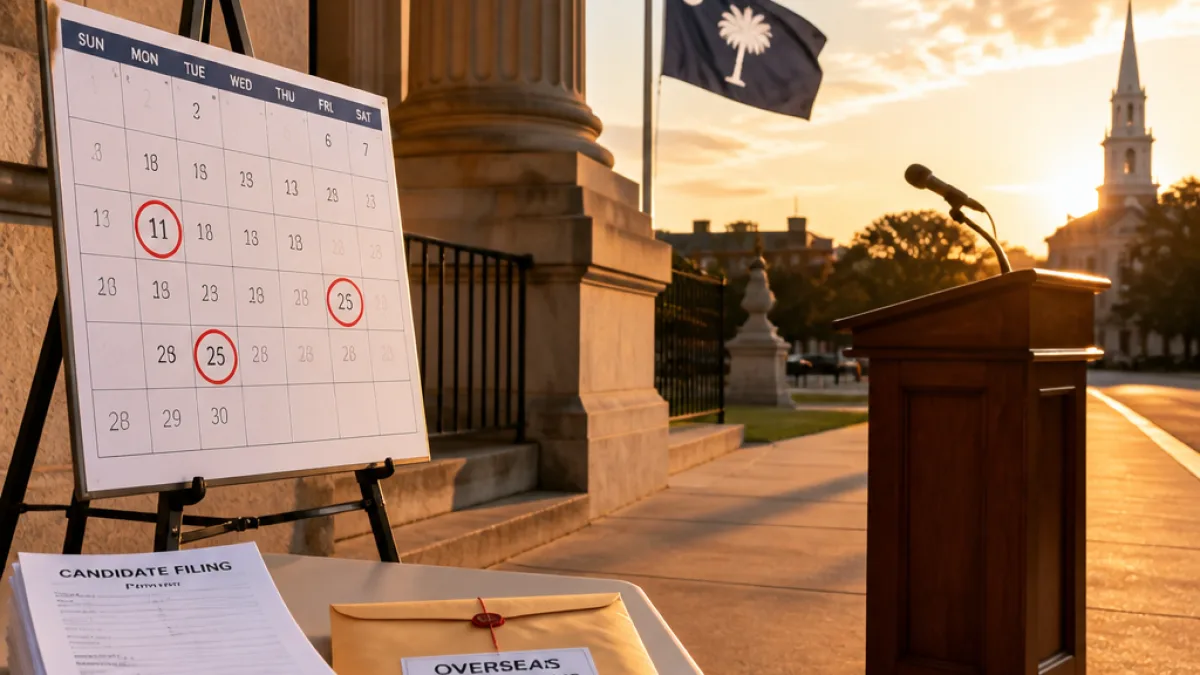
The compressed schedule laid out by state election rules calls for a one-week filing period to begin on the second Tuesday after the senator’s death. Based on that calculation, the filing would open July 21. The special primary would be scheduled for the second Tuesday after the close of the filing window — calculated as Aug. 11 — with any necessary runoff set two weeks later, Aug. 25. From that point, the eventual nominee would have slightly more than two months to campaign for the Nov. 3 general election.
| Event | Date (as calculated) |
|---|---|
| Filing period opens (one week) | July 21 |
| Special primary | Aug. 11 |
| Runoff (if needed) | Aug. 25 |
| General election | Nov. 3 |
Federal ballot deadlines complicate the schedule
Election experts and state officials are weighing the impact of a separate federal requirement: military and overseas ballots must be sent at least 45 days before a federal election. By that rule, absentee ballots for the November general election should have been dispatched by June 27. That timing predates the possible nominating calendar now in play, raising questions about how the state will comply with federal law while also conducting a valid in-state nominating process.
Federal Election Commission officials had not returned requests for clarification at the time state election officials began planning the special primary. The looming conflict places pressure on South Carolina’s election administrators and likely will prompt legal review or coordination with federal authorities.
Political scramble begins
Graham’s seat — a rare open Senate race in a deeply conservative state — immediately drew interest from several Republican figures who had recently been active in statewide contests. Those named as possible contenders include state Attorney General Alan Wilson, who won his party’s recent nomination for governor, and other statewide or congressional figures such as Lt. Gov. Pamela Evette, Rep. Nancy Mace and Rep. Ralph Norman. Their potential candidacies underscore how quickly the scramble for the seat began within GOP circles.
- Governor McMaster will name a temporary senator to serve until January.
- A special Republican primary and possible runoff are scheduled for August under state timing rules.
- Federal 45-day overseas ballot rules may require accommodations or legal guidance.
The senator’s death was followed by a preliminary medical examiner report attributing his sudden passing to an aortic dissection. In the immediate hours after officials announced his death, political conversations across the state shifted to succession and the compressed nomination process that now faces voters and candidates alike.
For residents, the immediate impacts are straightforward: South Carolina will have an appointed interim senator in Washington while the party and state prepare to select a nominee on an accelerated timetable. For election officials and legal advisors, the coming weeks will involve reconciling state scheduling with federal absentee-voter protections and ensuring the ballot process meets all applicable laws.
News Block will continue to monitor developments from the governor’s office, the South Carolina State Election Commission and federal authorities as filing windows open and candidates declare their intentions.