
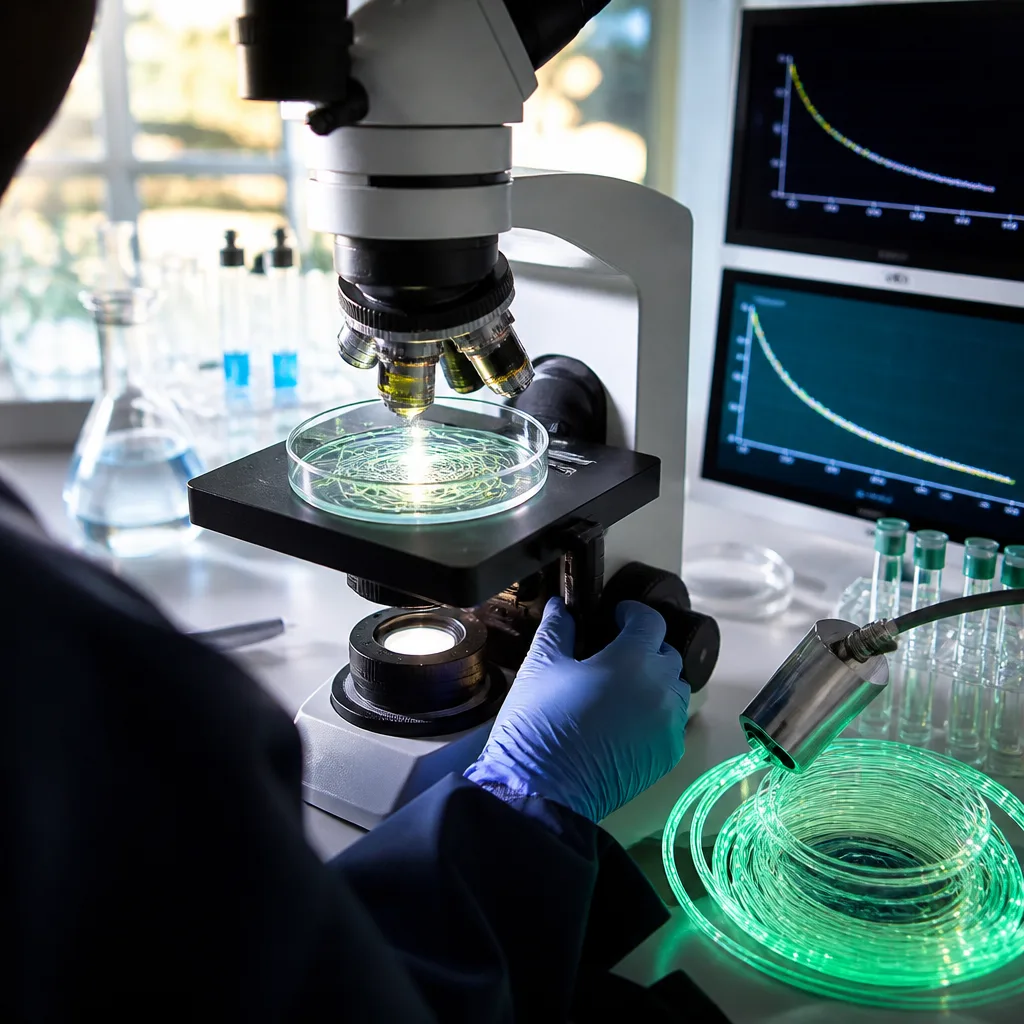
Researchers have observed a surprising effect: shining light on fluorescent carbon-based nanotubes suspended in water can make them move more slowly, behavior the team says results in part from a form of light-driven quantum friction.
Direct observation of light-induced slowdown
The experiments, reported in Nature and led by scientists at Ruhr-University Bochum, tracked individual carbon-mesh nanotubes about 100,000 times thinner than a human hair as they diffused in an aqueous solution. The team measured a falling diffusion constant as illumination increased — in other words, the brighter the light, the less freely the nanotubes wandered through the liquid.
Mechanism: excitons couple to surrounding water
Microscopic analysis linked the slowdown to the creation of excitons inside the illuminated nanotubes — paired quasiparticles made of an electron bound to a vacancy or 'hole'. The authors argue that these excitons interact with and transfer momentum to nearby water molecules, producing a drag force on the nanotube that resembles friction arising from quantum fluctuations at an interface.
"This discovery of light-induced quantum friction fundamentally changes our understanding of interfacial processes," said Sebastian Kruss of Ruhr-University Bochum.
What the experiments ruled in and out
Key observations that shaped the interpretation included a consistent decrease in diffusion with rising light intensity and the disappearance of the effect in nanotubes where the fluorescence-generating electronic excitations were absent. Those contrasts support a connection between optical excitation and the emergent drag.
- Observed: Reduced diffusion constant with increased illumination.
- Linked to: Generation of excitons inside fluorescent nanotubes.
- Absent when: Electronic excitations responsible for fluorescence were not present.
| Phenomenon | Observed Relationship |
|---|---|
| Light intensity | Higher intensity → lower diffusion |
| Exciton presence | Correlated with slowdown |
| Non-fluorescent samples | No measurable effect |
Context and implications
Scientists describe this effect as a form of quantum friction, a drag that arises when fluctuating charges or electronic excitations in a solid couple to motion in an adjacent fluid. The phenomenon has been under theoretical and experimental scrutiny only in recent years; these new measurements provide direct, optical control of the coupling and a way to probe interfacial momentum transfer at the nanoscale.
Beyond fundamental interest, the finding could matter for technologies that operate in liquid environments at small scales — from targeted drug delivery using nanocarriers to sensing platforms and optical manipulation of particles. If light can be used to tune frictional forces, researchers may gain a new tool to control nanoscale transport and interactions without mechanical contact.
Limitations and next steps
The study focused on a particular class of fluorescent carbon nanotubes in water; the generality of the effect across different materials, solvents and geometries remains to be mapped. Future work will be needed to quantify the momentum transfer mechanisms in detail and to test whether similar light-induced drag appears under different optical wavelengths, intensities and nanostructures.
The experiments add a novel chapter to the long-standing study of light–matter interaction, highlighting how optical excitation can sometimes act not as a source of extra motion or heating but as a subtle brake on nanoscale motion.