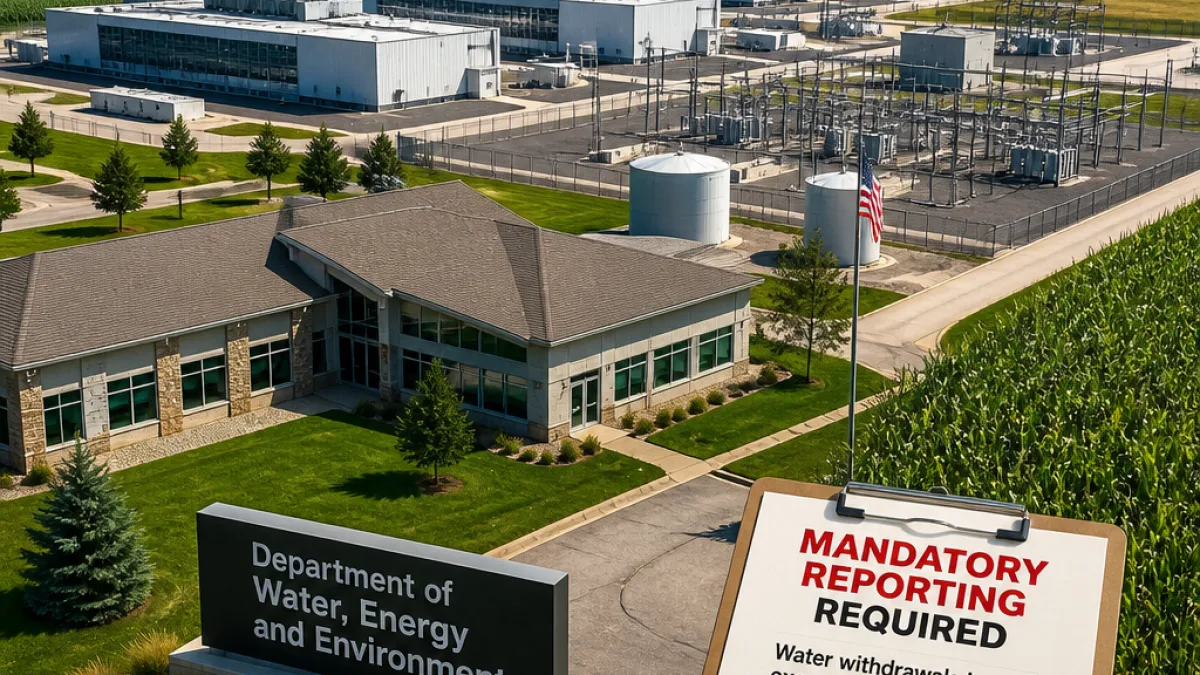
The Nebraska Legislature has approved a law that will require data centers to report their annual water use and power demand to state officials, a shift state leaders say is needed to improve long-range planning in a state where water availability can vary dramatically.
The Department of Water, Energy and Environment will collect the information. Jesse Bradley, director of the department, said the new reporting requirement will help officials identify remaining information gaps and guide future decisions.
"The legislation is a great start," Jesse Bradley said, speaking about the new disclosure requirements.
What changes for Nebraskans
Under the law, companies building or operating data centers in Nebraska must disclose detailed figures about how much water they withdraw and how much electrical demand they place on the grid. That data will give regulators a clearer picture of cumulative impacts as new facilities locate in the state.
For residents and local water managers, the new reporting offers two practical benefits:
- Better tracking of local and regional water withdrawals tied to industrial users.
- Improved capacity to plan for drought and competing needs between agriculture, municipalities and industry.
Why water matters for data centers
Data centers need cooling systems to maintain operating temperatures for servers and other equipment. Some of those systems use large amounts of water—especially evaporative cooling—while other systems, like air-cooled closed loop chillers, can operate for years without water replenishment but often increase electricity use.
The trade-off matters because electricity production itself can demand water. State officials have said the combined effects of greater electricity and water demand make comprehensive data collection important for accurate planning.
Current transparency gaps
Until now, much of what officials and the public knew about data center water use came from companies that volunteered figures. Nebraska did not have an official count of how many data centers are in the state, and reported water use varies significantly between companies that disclose numbers.
| Company/Location | Reported 2025 Water Use |
|---|---|
| Google (Nebraska data centers) | 732 million gallons |
| Meta (Sarpy County data center, 2020–2024) | 26.7–37.5 million gallons per year |
Those figures underscore both the scale of some operations and the variability between facilities depending on size and cooling technology.
Local concerns and next steps
Local residents, researchers and regulators have raised concerns that rapidly expanding data center construction could strain water supplies, especially in agricultural regions already experiencing extremes of drought. With the new law, state officials will be able to analyze reported data and determine what additional rule-making or safeguards might be necessary.
Jesse Bradley said the department will review the incoming data to identify remaining gaps. Officials have framed the law as an initial step toward better-informed water and energy planning rather than a final solution.
For Nebraskans who live near proposed or existing data centers, the law will mean more public-facing information on how those facilities draw on local water and power resources — data that local elected officials and water managers can use in future permitting and planning discussions.
— Peter Novak, Nebraska Correspondent