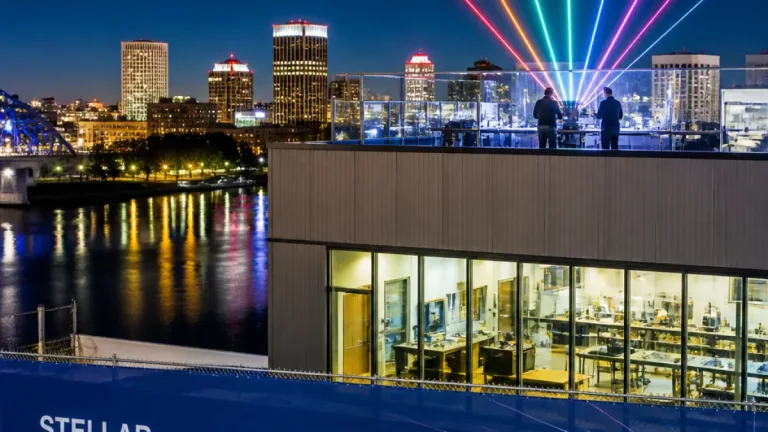
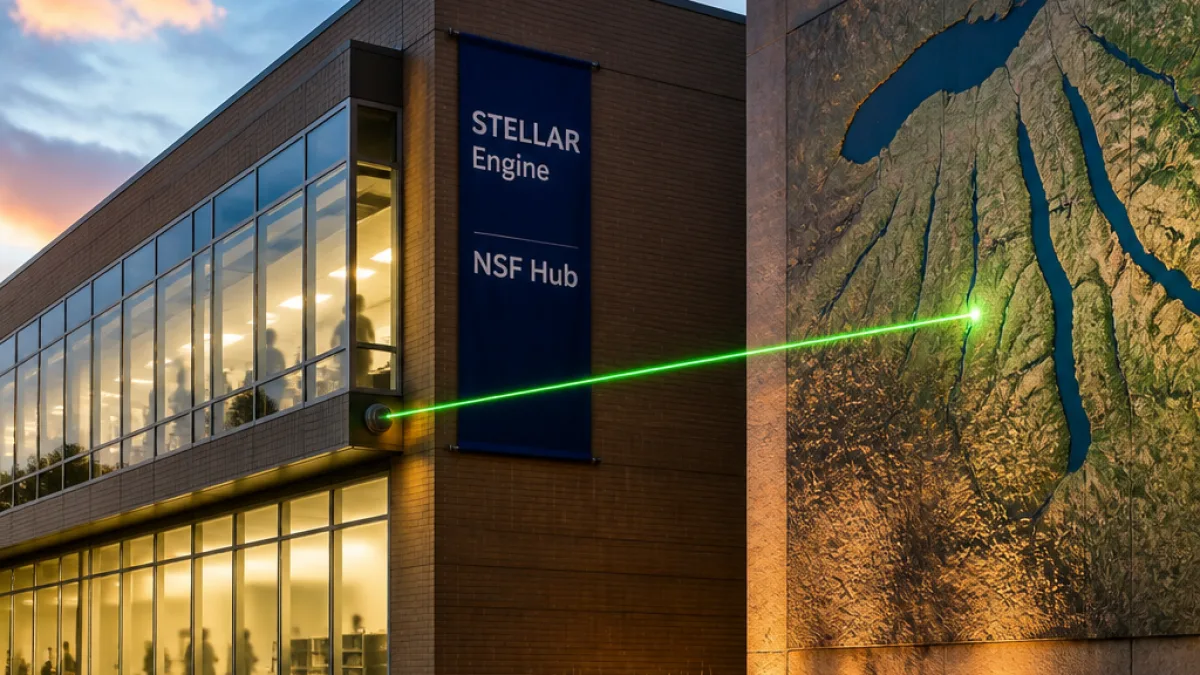
The National Science Foundation has selected Rochester and the Finger Lakes region to host a new national engine for laser technology, awarding $15 million over two years to the University of Rochester–led coalition to launch the NSF STELLAR Engine.
What the award means locally
The federal grant, which will be matched by $16 million in New York State support spread over six years, is intended to build a competitive regional cluster focused on laser science, applications and manufacturing. Local partners include the Institute of Optics and the Laboratory for Laser Energetics at the University of Rochester, Rochester Institute of Technology, Monroe Community College, NextCorps, Greater Rochester Enterprise and AmeriCOM, among others.
Officials say the coalition has secured buy-in from more than 90 organizations across industry, higher education, startups, state and local government, venture capital and nonprofits. The project — STELLAR (Science, Technology and Engineering for Laser and Laser Applications Research) — is one of 12 newly funded NSF Regional Innovation Engines nationwide spanning 20 states.
Why lasers matter here
Lasers underpin a vast portion of the global economy, with applications in consumer electronics, communications, healthcare and defense. The announcement notes that much of laser production has shifted overseas, and the STELLAR Engine is framed as a step to strengthen U.S. manufacturing and technology leadership in that space.
- Federal funding: $15 million over two years from NSF.
- State match: $16 million from New York spread across six years.
- Regional partners: URochester, RIT, MCC, NextCorps, GRE, AmeriCOM and others.
“NSF Engines investments in critical technologies and future industries will transform America’s innovation infrastructure for decades to come,” said Brian Stone, performing the duties of the NSF director.
Local consequences and next steps
For Rochester, the award signals renewed attention to the region’s historic strengths in optics and photonics. Institutions such as the Institute of Optics and the Laboratory for Laser Energetics are expected to play central roles in research and workforce training. The STELLAR Engine also aims to support business expansion, attract new companies and encourage manufacturing activity tied to lasers.
Leaders have framed the initiative as not only a research effort but also a regional economic strategy: expanding educational pipelines, scaling startups and creating manufacturing opportunities in the Finger Lakes and Southern Tier. The coalition’s mix of higher education, economic-development organizations and industry partners is designed to move discoveries from labs to market.
| Item | Amount / Detail |
|---|---|
| NSF award | $15 million (two years) |
| New York State support | $16 million (six years) |
| Partner organizations | 90+ (industry, academia, government, nonprofits) |
The grant places Rochester among a small number of nationally recognized innovation engines. For residents, the promise is practical: new training and job pathways in advanced manufacturing and photonics, potential startup growth, and strengthened ties between local colleges and regional employers. City and regional officials will now work to translate the funding into programs, facilities and partnerships that deliver measurable results for workers and businesses in the years ahead.