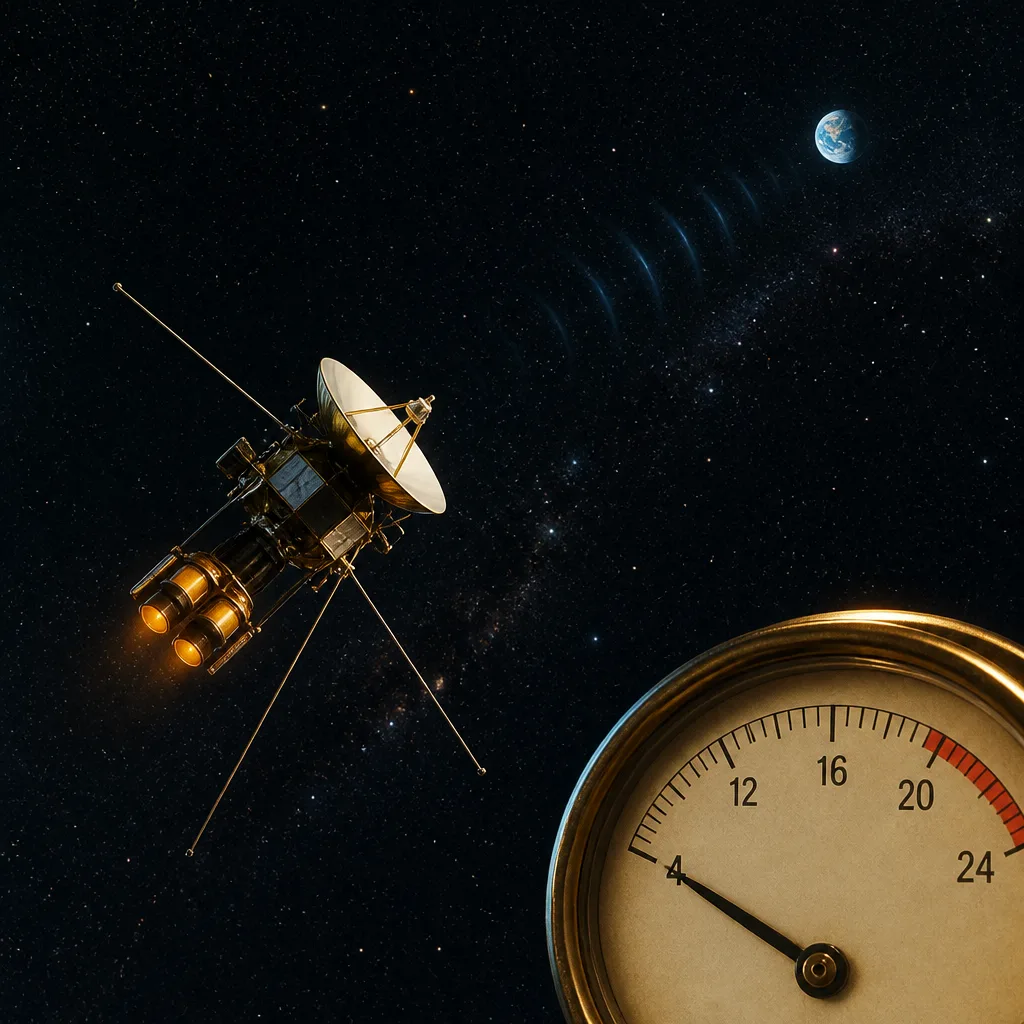
Voyager 1, launched from Earth in 1977, continues to return measurements from beyond the heliosphere, but mission operators are increasingly forced to choose which experiments remain powered as the spacecraft’s nuclear electric output diminishes.
Endurance defined by electrical limits
Built for a planetary tour, the twin spacecraft that left Cape Canaveral in 1977 now serve as time capsules and remote laboratories. The mission’s original science suite comprised 10 instruments (11 investigations, counting radio science). As of 2026, only two instruments on Voyager 1 remain active: the magnetometer and the plasma wave subsystem, according to NASA’s live instrument status.
Power, not distance, is the gating factor
The Voyagers were never solar-powered; sunlight is far too weak where they travel. Each spacecraft produces electricity from radioisotope thermoelectric generators that convert heat from the decay of plutonium-238 into usable power. That technology enabled the spacecraft to perform close flybys of the outer planets and then keep transmitting as they sailed outward. Today the generators lose roughly 4 watts per year, a slow but decisive drain that dictates which scientific capabilities can remain online.
- Original payload: 10 instruments (11 investigations)
- Active instruments on Voyager 1 in 2026: 2 — magnetometer and plasma wave subsystem
- Approximate RTG decline: 4 watts per year
From planetary encounters to interstellar measurements
Voyager 1 achieved close encounters with Jupiter in 1979 and Saturn in 1980. Its trajectory took it out of the plane of the planets after a Titan flyby, and it subsequently transitioned into an interstellar mission by endurance. NASA announced that Voyager 1 crossed the heliopause — the boundary where the solar wind yields to interstellar plasma and fields — on Aug. 25, 2012, making it the first human-made object to directly sample that region.
| Event | Date |
|---|---|
| Voyager 2 launch | Aug. 20, 1977 |
| Voyager 1 launch | Sept. 5, 1977 |
| Jupiter encounter | 1979 |
| Saturn encounter | 1980 |
| Heliopause crossing (Voyager 1) | Aug. 25, 2012 |
| Will be one light-day from Earth | Nov. 18, 2026 |
What’s at stake
As the power budget narrows, each watt removed from an instrument represents lost scientific opportunity. The trade-offs are operational as well as scientific: controllers must preserve core systems needed to keep the probe communicating while deciding when to shut down experiments whose data value has to be balanced against dwindling electrical margins. The spacecraft will cross another milestone on Nov. 18, 2026, when it reaches one light-day from Earth — at that point, a radio signal requires 24 hours for a round trip at light speed.
The situation underscores the design choices and constraints of long-duration missions: radioisotope power enables exploration far from the Sun but provides a steadily declining supply. Voyager 1’s continuing measurements have already transformed our view of the boundary between the Sun’s influence and interstellar space; how many more discoveries remain will be determined in part by a few watts of decaying heat and the operational decisions that follow.