Uncontested races define this year’s filing results
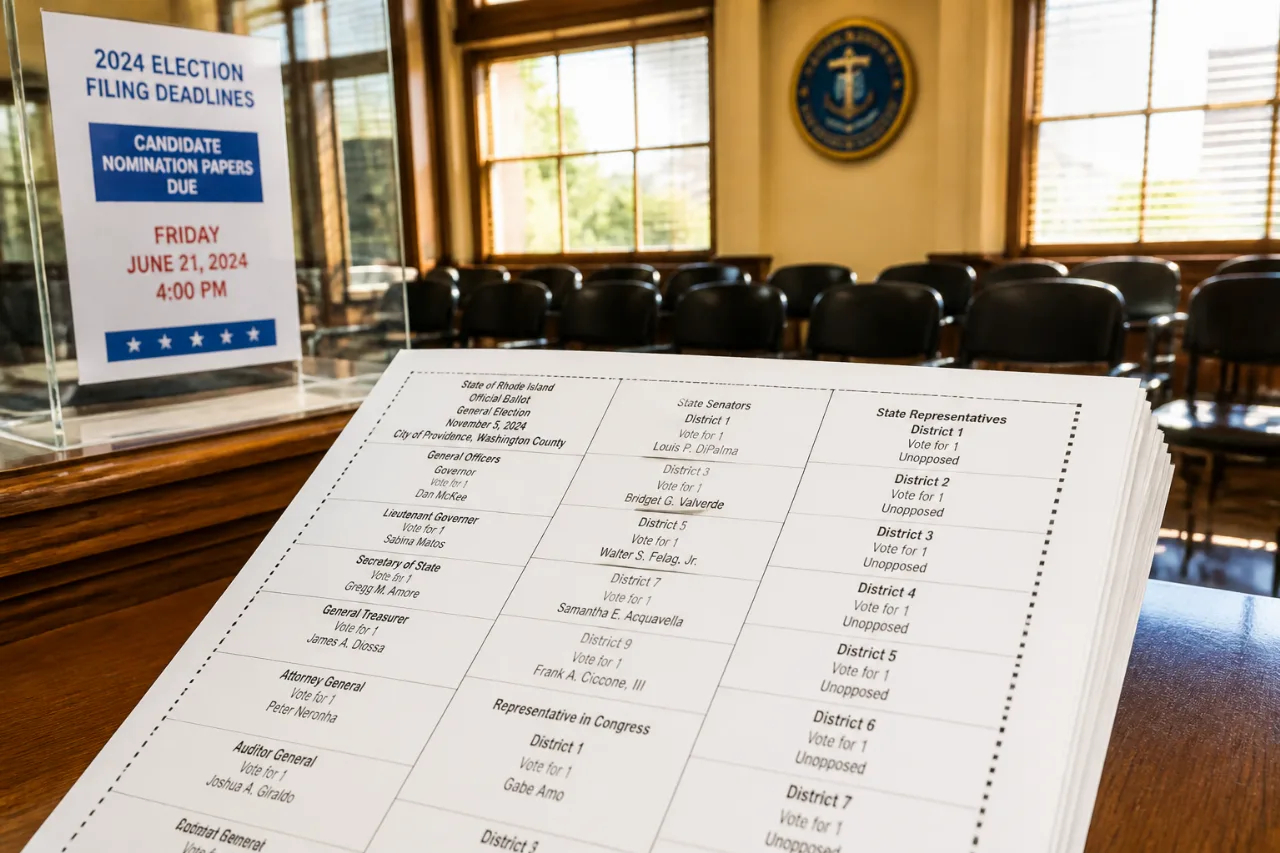
When the candidate filing window closed last month in Rhode Island, the result for many voters was a ballot with fewer choices than usual. Of the state’s 75 House seats, just 32 drew challengers. In the Senate, only 13 of 38 seats were contested. Those numbers reflect a long-running pattern: Rhode Island’s legislative races are often decided by the filing deadline rather than the voters.
How Rhode Island compares to the nation
National tracking by Ballotpedia shows that roughly 34.8% of state legislative incumbents ran unopposed in the 2024 general election — near a decade-long average. Rhode Island, however, stood apart: in 2024, 64.1% of its incumbent legislators faced no challenger, nearly double the national rate. That gap underscores a state-level dynamic that reduces electoral competition year after year.
| Measure | Rhode Island | National (2024 average) |
|---|---|---|
| Incumbents unopposed (2024) | 64.1% | 34.8% |
| House seats with challengers (this filing) | 32 of 75 | — |
| Senate seats with challengers (this filing) | 13 of 38 | — |
Why so few challengers? Pay, paperwork and party maps
Academic research points to several predictable causes, and Rhode Island’s situation lines up with those explanations. Lawmakers here receive $20,922 a year for what many describe as a demanding, part-time job that typically provides little staff support. That limited compensation makes a run for the General Assembly less attractive as a career path, discouraging potential candidates who must balance fundraising, outreach and the realities of full-time work or family obligations.
Ballot access also imposes an early hurdle: prospective candidates must gather roughly 50 to 100 signatures in a narrow window just to qualify. That front-loaded requirement filters the field before campaigns begin, favoring incumbents who already have name recognition and local networks.
Finally, the partisan map amplifies the effect. Democrats hold 98 of the General Assembly’s 113 seats, with Republicans occupying 14. In recent cycles, Democratic incumbents were far more likely to be unopposed: Ballotpedia’s 2024 data show 69.2% of Democratic incumbents ran without opponents, compared with 27.3% of Republican incumbents. In heavily one-party districts, the primary or the filing decision often becomes the de facto election.
Local consequences and practical impacts
Uncontested seats matter beyond the calendar. They limit voter choice, reduce opportunities for policy debate and weaken incentives for incumbent responsiveness. Constituents may find it harder to hold officials to account when the alternative is a write-in campaign or no option at all. For communities seeking new approaches to local problems, the absence of challengers slows the churn that sometimes brings fresh ideas into the State House.
- Low legislative pay reduces the pool of potential candidates who can afford to serve.
- Short signature-gathering windows favor incumbents and those with established networks.
- Dominant party majorities discourage opposition in safe districts.
Addressing the trend would require changes that are structural and political: increasing compensation and staff support, easing ballot access procedures, encouraging civic organizations to recruit and train candidates, or pursuing redistricting reforms that produce more competitive seats. Each option would involve trade-offs and political will that have been difficult to marshal.
For now, Rhode Islanders should expect many names on this fall’s legislative ballot to be incumbents with few — if any — challengers. That reality shapes not only the final vote tallies, but the nature of accountability and representation across the state.