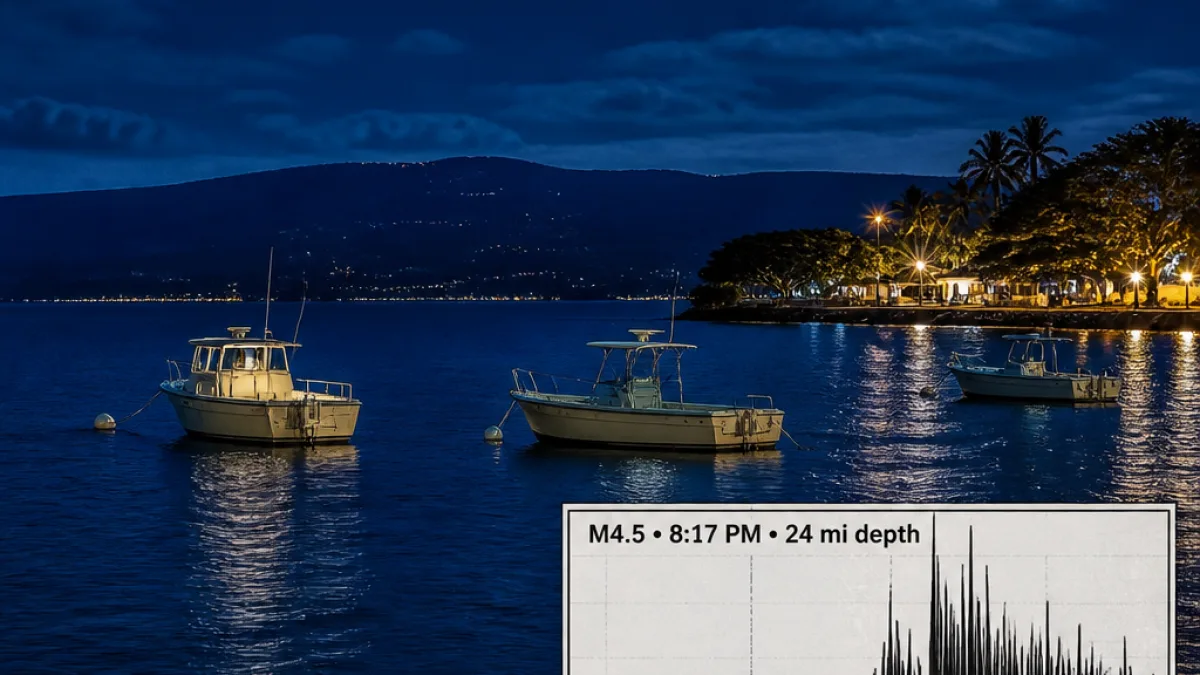
A magnitude 4.5 earthquake shook the waters off the southwest coast of Hawaii island Thursday night, the U.S. Geological Survey reported, rattling residents across the Big Island and drawing more than 200 responses to the agency’s “Did you feel it?” survey.
Where and when it happened
The USGS said the quake struck at 8:17 p.m. with an epicenter about 34 miles west-southwest of Captain Cook at a depth of roughly 24 miles below sea level. The Pacific Tsunami Warning Center reported the event did not generate a tsunami threat to the Hawaiian Islands.
| Detail | Information |
|---|---|
| Magnitude | 4.5 |
| Time | 8:17 p.m. |
| Epicenter | 34 miles WSW of Captain Cook |
| Depth | ~24 miles below sea level |
Cause and expected impacts
In a statement, the USGS described the event as related to the weight of the islands pulling and bending the ocean crust and the upper brittle mantle. The agency said the quake was not expected to affect Mauna Loa or the ongoing Kilauea eruption.
“[The earthquake] was related to bending of the ocean crust and upper brittle mantle (the lithosphere) by the weight of the islands.”
The depth of the temblor and its offshore location likely limited strong shaking on land. Still, the USGS survey logged more than 200 reports of people feeling the event, primarily from the Big Island with some responses from Oahu and Maui.
What residents should know
Officials emphasized there was no tsunami danger from this quake. For residents and visitors, basic preparedness steps remain important:
- Secure heavy objects and know safe spots in each room (under sturdy furniture or against interior walls).
- Practice "Drop, Cover and Hold On" during shaking.
- Keep emergency supplies — water, flashlight, radio and first aid kit — accessible.
Although this event posed little immediate hazard beyond a brief alarm for some residents, Hawaii’s geology is dynamic. Offshore and deep quakes are common in the island chain, and state agencies monitor seismic activity continuously.
Local authorities and scientists continue to track seismic and volcanic conditions. Anyone who experiences damage or unusual activity after an earthquake should report it to the appropriate county office and the USGS community reporting tools.
— Leilani Akana, Hawaii correspondent